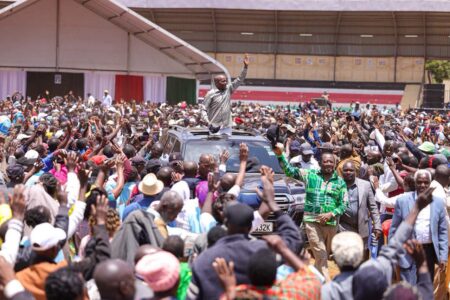






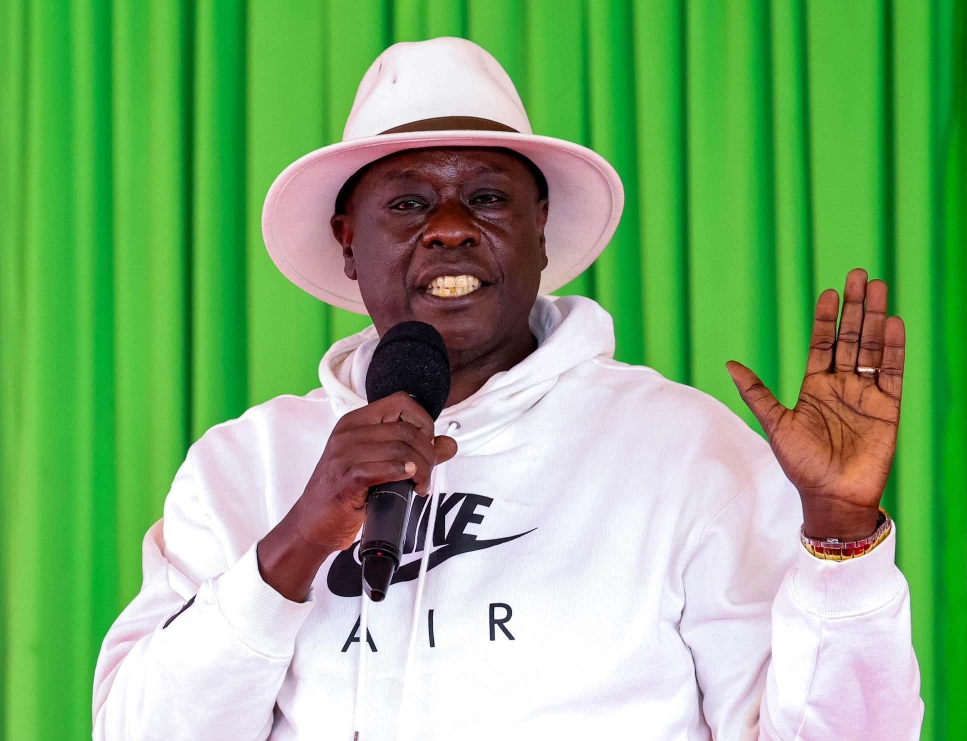
Democracy for Citizens Party (DCP) leader Rigathi Gachagua has escalated his criticism of the Kenya Kwanza administration, accusing the government of targeting small-scale liquefied petroleum gas (LPG) traders while raising fresh concerns over the integrity of preparations for the 2027 General Election.
Speaking before travelling to the United States, where he said he would spend several weeks engaging Kenyans working and living in the diaspora ahead of the August 10, 2027 polls, the former deputy president made a series of allegations against the government, the energy regulator and electoral officials.
Mr Gachagua accused the administration of using state agencies to frustrate small LPG dealers through what he described as arbitrary arrests, seizures of cylinders, intimidation and unlawful enforcement operations.
He also alleged that the electoral system being prepared for the 2027 elections had been designed to favour the Kenya Kwanza administration and claimed that South Korean technology firm Miru Systems had been earmarked to supply the Integrated Elections Management System.
The allegations come at a politically sensitive moment, with the electoral preparations for the 2027 polls gathering pace. The tender for the supply, installation, testing, commissioning, support and maintenance of the Integrated Elections Management System, under reference IEBC/OIT/01/2026-2027, was advertised in August and has a September 1, 2026 deadline.
Mr Gachagua, however, did not provide documentary evidence in his address to substantiate his claim that the procurement outcome had already been predetermined.
The DCP leader said the plight of small-scale LPG dealers was evidence of what he termed the abandonment of the administration’s Bottom-Up Economic Transformation Agenda.
He claimed millions of Kenyans depend on small retail businesses, including LPG outlets, and accused the government of imposing policies that were making it increasingly difficult for small traders to survive.
Mr Gachagua revisited President William Ruto’s 2023 pledge on affordable cooking gas, saying the promise had raised expectations among households and small businesses.
He alleged that LPG dealers had subsequently faced intensified enforcement operations and claimed that more than 200,000 cylinders had been seized in raids conducted in Nairobi, Kiambu, Kajiado, Machakos and other parts of the country.
He further alleged that some operations were carried out by a special police unit whose existence and mandate, he claimed, had not been properly gazetted.
Mr Gachagua named several senior officials and private individuals whom he accused of participating in the alleged crackdown and demanded investigations into their conduct.
The allegations could not be independently verified from the material accompanying his speech.
Government agencies, however, have previously defended enforcement operations in the LPG sector, saying they are aimed at combating illegal refilling, counterfeit cylinders and other practices that pose safety risks to consumers.
In November 2025, the Energy and Petroleum Regulatory Authority (EPRA) told a Senate committee that it was conducting a nationwide crackdown on illegal LPG refilling plants and counterfeit cylinders as part of efforts to improve consumer safety.
EPRA has also publicly said confiscated cylinders have been handed over to their legitimate brand owners after enforcement operations targeting illegal refilling and rebranding.
The Energy and Petroleum Tribunal has separately dealt with disputes surrounding LPG enforcement. In one 2025 case, the tribunal found that raids in question had been conducted by police and EPRA and noted that impounded items were listed in search certificates bearing the National Police Service emblem.
Mr Gachagua nevertheless insisted that the issue was not enforcement of regulations but what he described as abuse of the regulatory process to drive small traders out of the market.
He demanded the immediate return of cylinders he claimed had been seized unlawfully and compensation for affected traders.
He also called for investigations into officials involved in LPG enforcement and urged authorities to ensure that the legal framework governing the sector was applied uniformly.
The former deputy president went further to allege that powerful political and commercial interests were seeking to dominate the LPG market.
He linked the alleged crackdown to several companies and projects, including gas manufacturing and storage ventures, and claimed that government decisions were being used to give politically connected interests an advantage.
Those claims were not accompanied by documentary evidence in his address.
Mr Gachagua then turned his attention to the Independent Electoral and Boundaries Commission (IEBC), warning that public confidence in the electoral system must be protected ahead of the 2027 elections.
He accused IEBC chairman Erastus Ethekon and other officials of being too close to the administration and alleged that the commission was preparing to award the elections technology contract to Miru Systems of South Korea.
The IEBC tender is publicly listed as an invitation for bids for the Integrated Elections Management System, with a September 1 deadline. The available tender notice does not establish that Miru Systems has been selected as the successful bidder.
Mr Gachagua claimed the procurement process was merely being conducted to create an appearance of competition before the alleged selection of a preferred bidder.
He further alleged that changes had been made within the commission’s procurement structures to facilitate the process and accused some commissioners of working against the interests of their colleagues.
He called on the IEBC to open up the procurement process and reassure Kenyans that the election technology would be selected transparently and competitively.
Mr Gachagua also questioned the suitability of Miru Systems, citing controversies surrounding the company’s involvement in elections in other countries.
He referred to alleged problems associated with election technology supplied or deployed by the company in the Democratic Republic of Congo, the Philippines and Iraq’s Kurdistan region.
He argued that Kenya could not afford to experiment with technology that could undermine the credibility of the 2027 elections.
However, the claims made in the speech about Miru Systems’ international record require independent verification and should not be treated as established findings of electoral malpractice.
The DCP leader said the credibility of election technology would be particularly important given the country’s history of disputed elections and the violence that followed the 2007-08 presidential contest.
He urged the IEBC to place national confidence and electoral integrity above political interests.
Mr Gachagua called on Kenya’s development partners, foreign missions and international observers to closely monitor the country’s electoral preparations.
He argued that international scrutiny would help safeguard the credibility of the 2027 election and prevent disputes arising from questions over technology, voter registration and procurement.
He also challenged IEBC officials to demonstrate independence and warned that Kenyans would hold them accountable for the conduct of the electoral process.
The DCP leader’s remarks add to an increasingly combative political debate ahead of the 2027 elections, with opposition figures placing greater focus on the independence of electoral institutions, procurement of election technology and the government’s economic policies.
His intervention also brings the LPG sector into the political contest, linking the grievances of small traders with wider accusations of economic exclusion and alleged government favouritism.
For the IEBC, the controversy comes as preparations for the 2027 elections move into a critical phase. The commission’s advertised Integrated Elections Management System tender is therefore likely to attract heightened public and political scrutiny as the September 1 bidding deadline approaches.
For LPG traders, the dispute similarly highlights the delicate balance between enforcing safety and licensing regulations and protecting thousands of small businesses whose livelihoods depend on the retail energy market.
Mr Gachagua said he would continue raising the issues during his engagement with Kenyans in the United States, insisting that the interests of ordinary citizens must remain at the centre of the country’s political and economic debate.