






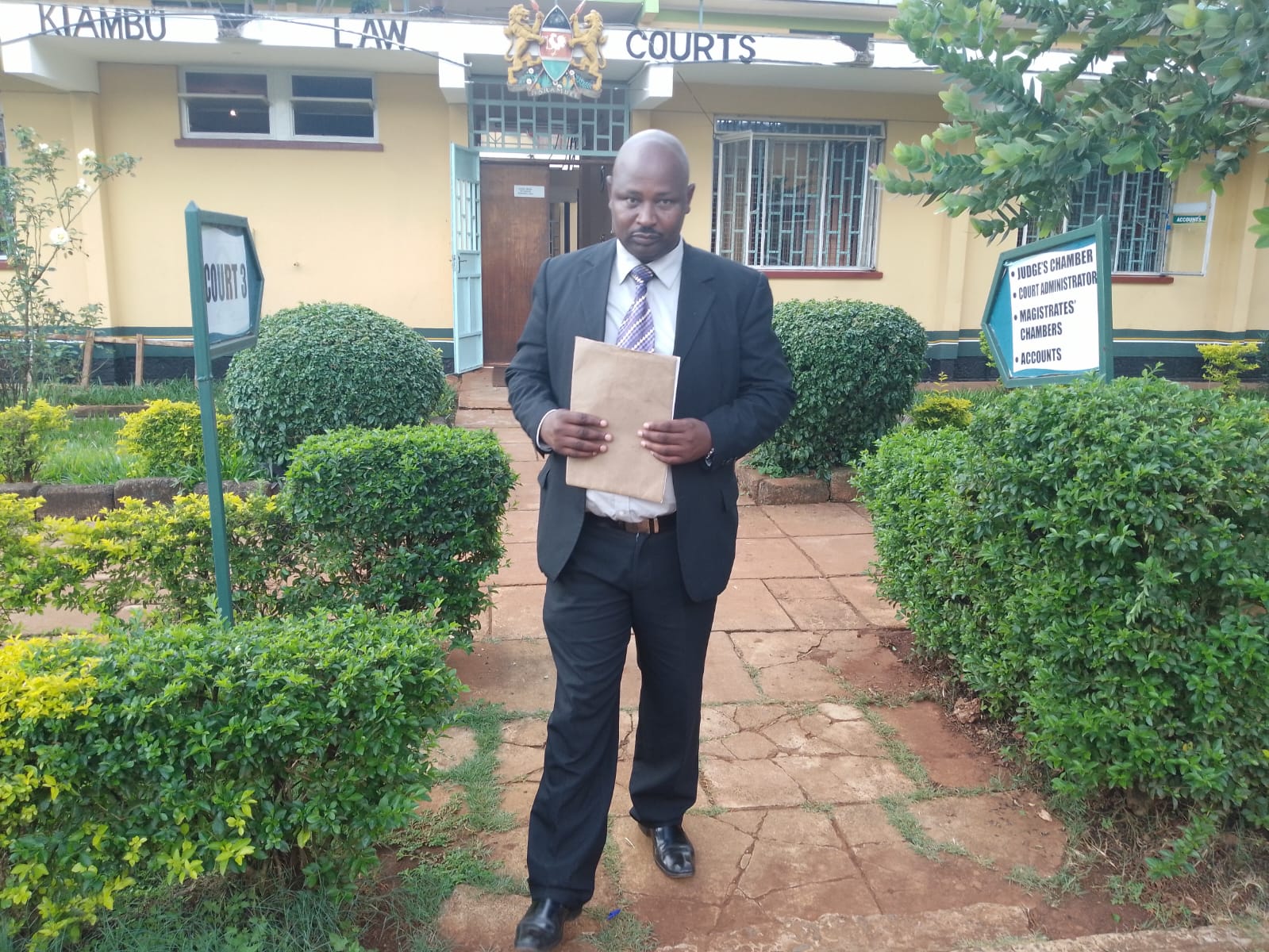
The Court of Appeal has granted a Limuru resident permission to pursue an appeal against a High Court decision that dismissed his constitutional petition seeking to shield Kiambu Governor Paul Kimani Wamatangi from investigations and possible prosecution by State agencies.
In a ruling delivered in Nairobi on November 6, 2026, Court of Appeal Judge Fatuma Sichale allowed an application by Stephen Mwangi Kimani to file and serve a notice of appeal outside the prescribed timelines, giving him 30 days to lodge the intended appeal.
The decision reopens a legal battle arising from a petition that was struck out by the High Court in Kiambu in July 2025 after Justice Dorah Chepkwony found that Kimani lacked the legal standing to institute proceedings challenging investigations involving the governor.
Kimani had approached the High Court seeking orders to restrain the Attorney General, the Director of Public Prosecutions (DPP), the Ethics and Anti Corruption Commission (EACC) and the National Police Service from arresting or prosecuting Wamatangi.
He had also sought orders barring the deputy governor from assuming office in the event that the county chief was arrested or otherwise prevented from discharging his duties.
However, Justice Chepkwony upheld a preliminary objection by the respondents, ruling that Kimani had not demonstrated how his constitutional rights had been violated by investigations directed at the governor.
The judge observed that the investigations concerned Wamatangi personally and that he was therefore the appropriate person to challenge any alleged violation of his rights.
The court consequently struck out the petition with costs, prompting Kimani to seek appellate intervention.
In his application dated March 3, 2026, Kimani told the Court of Appeal that he had been unable to file his appeal within the statutory period because of delays by the High Court registry in preparing and certifying the proceedings and ruling.
He maintained that he had requested the documents on August 4, 2025, but they were not ready for collection until February 4, 2026, as confirmed by a certificate of delay issued by the registry.
He argued that the delay was beyond his control and that the intended appeal raised substantial constitutional and public interest questions that deserved judicial consideration.
The EACC, the third respondent, opposed the application, arguing that the explanation was incomplete because Kimani had waited until March 3, 2026, to file his application despite the proceedings having been ready a month earlier.
The anti graft agency also contended that the application amounted to an abuse of court process, maintaining that the original petition had sought to interfere with investigations and prosecution involving a third party over whom the applicant had not demonstrated legal standing.
But Justice Sichale found that the delay in obtaining certified court documents was sufficiently established and could not be attributed to the applicant.
In considering whether to extend time, the judge relied on established principles governing applications under Rule 4 of the Court of Appeal Rules, which require courts to consider the length of delay, reasons for the delay, prospects of the intended appeal and potential prejudice to the parties.
Although the application was filed about eight months after the High Court ruling, the judge found the delay was not inordinate in the circumstances.
“I consider the reasons given for the delay to be plausible/reasonable and ultimately therefore, I am of the considered opinion that the delay herein has sufficiently been explained to the satisfaction of this Court,” Justice Sichale ruled.
She further observed that refusing the application would effectively deny Kimani an opportunity to pursue his case through the appellate process.
On whether the intended appeal had reasonable prospects of success, the judge declined to make a determination, noting that the question was not for a single judge sitting on an application for extension of time.
The court consequently allowed the application as prayed, directing Kimani to file the intended appeal within 30 days from November 6, 2026.
The judge warned that failure to comply with the deadline would automatically result in the orders granting additional time being vacated.
Costs of the application were ordered to abide by the outcome of the intended appeal.
The respondents named in the proceedings are the Attorney General, DPP, EACC, National Police Service and the Chief Magistrate at Milimani Law Courts.
The latest ruling does not determine the legality of the investigations involving Wamatangi, nor does it overturn the High Court’s decision on locus standi.
Rather, it gives Kimani an opportunity to place his challenge before the appellate court, where the substantive legal questions surrounding his petition and the High Court’s decision may be considered.
The outcome of the intended appeal could provide further judicial guidance on the limits of public interest litigation, particularly the circumstances under which a citizen can institute proceedings concerning investigations and possible prosecution involving another individual.