




Mount Kenya University (MKU) has successfully held two international conferences in Mombasa mainly sponsored by the German government.
Hosted by MKU’s Mombasa Campus, the events brought together international partners to exchange ideas, foster innovation, strengthen collaboration, and build sustainable ecosystems through education and partnerships. The official forum was held at Mombasa Continental Resort.
The November 5 to 13th Access 2.0 Summer School ran alongside the International IN4IN Conference 2026 held on November 12–13, 2026, at the MKU Mombasa Campus under the theme “The Triple Synergy: Building Sustainable Innovative Ecosystems.
The Access 2.0 project is part of the Africa Centre for Career Enhancement and Skill Support (ACCESS) project, which is backed by a €4.5 million (Sh656 million) from Germany’s DAAD grant. The German Academic Exchange Service (DAAD) is the world’s largest funding organisation for the international exchange of students and researchers.
The initiative is supported by the German Academic Exchange Service and Federal Ministry for Economic Cooperation and Development (BMZ). Delegates from access Ghana, Germany, Benin, Nigeria, The African Centre for Career Enhancement and skills support, Rwanda and Ethiopia and Kenya joined the forum from Day One.
The program equips African university students with practical skills, innovation training, entrepreneurship, and stronger links between higher education and industry to tackle graduate unemployment. The theme of the conference was “Co-Creating Sustainable Solutions: Scaling MSMEs through SDG 9” (also framed as “Innovate for Impact: Scaling Kenyan MSMEs through SDG 9”).
During the Mombasa 2026 Summer School, the 9-day intensive summer program brought together students and partner institutions from across Africa and beyond at the coastal campus. The event featured chief guest Prof. Dr. Utz Dornberger, Director of the SEPT Competence Center and ACCESS Project Director at Leipzig University, Germany, alongside Guest Speaker Dr. Vincent Gaitho, Pro Chancellor of MKU.
Re-imagining the university of the future
Officially opening the two-day 2026 Annual University Conference and Intelligence for Innovation (iN4iN) Conference, Dr Gaitho challenged universities to move beyond traditional roles as institutions of teaching and knowledge dissemination to become centres of knowledge creation, innovation, entrepreneurship and practical solutions to societal challenges.
He said that the rapidly changing world, driven by artificial intelligence, digitalisation, and climate change and emerging technologies, requires universities to rethink their approaches to education, research and innovation.
“Education must equip graduates with both qualifications and critical thinking, creativity, digital competencies, problem-solving abilities and an entrepreneurial mindset. Our graduates should be prepared not merely to seek employment but to undertake research of the hiring company and propose practical innovative solutions that address challenges unique to the company,” he noted.
He highlighted MKU’s investment in emerging technologies, including the acquisition of a humanoid robot that provides students with hands-on opportunities to explore robotics, artificial intelligence and programming.
Through developing code that enables the robot to interpret commands and execute instructions, students gain practical exposure to intelligent systems and experiential learning.
He further appreciated the support by Germany’s DAAD and BMZ as well as Leipzig University in strengthening African universities through mentorship, institutional collaboration and capacity building.
“Partnerships must move beyond signing memoranda of understanding to delivering tangible outcomes through joint research, technology transfer, industrial attachment, entrepreneurship and commercialisation of innovative ideas,” he noted.
Dr Gaitho reaffirmed MKU’s commitment to its strategic leadership role as the United Nations Academic Impact (UNAI) SDG 9 Hub Chair for Industry, Innovation and Infrastructure for 2025–2027.
In his keynote presentation titled “Unlocking Business Potential Through University Living Labs,” Prof. Dr. Utz Dornberger, Director of the SEPT Competence Center at Leipzig University, Germany, and Project Director of ACCESS, introduced University Living Labs as an innovative approach to connecting academic knowledge with real-world business and community challenges.
Prof. Dornberger explained that universities are evolving through different generations, from traditional teaching and research institutions to entrepreneurial universities, ecosystem universities and digital universities. He highlighted the growing importance of universities generating industry partnerships, creating opportunities for startups and promoting AI-driven open innovation.
He described Living Labs as user-centred, open innovation ecosystems built on systematic user co-creation, embedding research and innovation activities directly within real-life communities and settings. The approach brings together universities, businesses, government and civil society to identify challenges, develop solutions and test innovations in authentic environments.
Prof. Dornberger outlined seven key dimensions for establishing successful university-operated Business Living Labs: a clear value proposition, academic coaching, viable institutional and business models, strategic industry and ecosystem partnerships, real-life experimentation, curriculum and research integration, and responsible co-creation.
Drawing from Leipzig University’s experience, he showcased different Living Lab models focusing on artificial intelligence, smart farming, business process optimisation, logistics, international business development and digital education.
Of particular relevance to African universities was the presentation of Process Living Lab Africa, a proposed programme for process optimisation among African startups. The initiative outlines a structured approach to helping early-stage enterprises assess their operations, simulate production processes and improve decision-making as they prepare to scale.
Prof. Dornberger further highlighted opportunities for international Living Lab collaboration between Leipzig University and African universities, particularly in supporting startup development and international business development.
The model presents an opportunity for African universities to strengthen their innovation infrastructure while creating practical environments where students can develop solutions alongside businesses and communities.
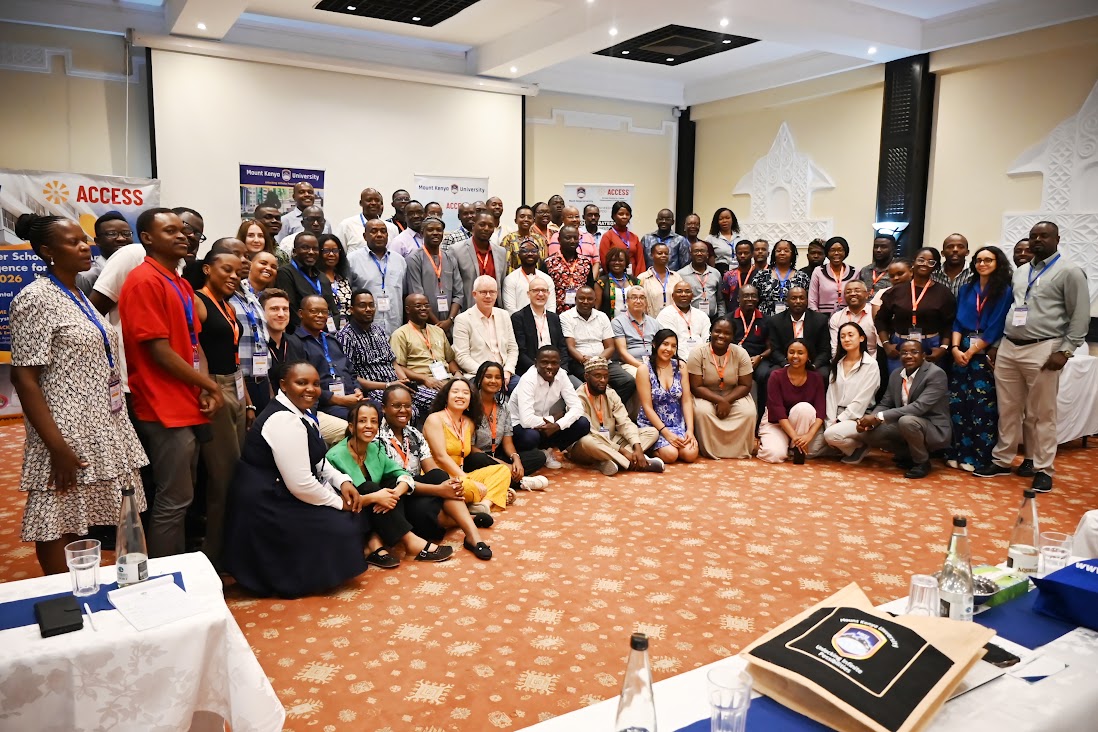
The INNIS conference marked the culmination of the ACCESS IDEAS International Summer School 2026, which brought together students, academics, industry experts and ACCESS partners from eight universities between 5th and 11th November 2026 in Mombasa.
In remarks delivered on his behalf by Prof. Peter G. Kirira, Deputy Vice-Chancellor, Academic and Student Affairs, Prof Deogratius Jaganyi, MKU Vice-Chancellor challenged universities to move beyond counting conferences, boot camps and participants to demonstrating the tangible impact of their innovation and entrepreneurship programmes.
“The real measure of our success is not the number of conferences we hold, the number of boot camps we organise or the number of participants who attend our programmes. The real measure of success is the difference we make in people’s lives,” he observed.
He challenged universities and implementing partners to assess the impact of their initiatives by examining the businesses established, jobs created, young people empowered to become entrepreneurs and communities benefiting from university-led innovations.
He further emphasised the importance of documenting success stories, conducting impact studies and following up with programme beneficiaries to establish what has changed, what has worked and what needs improvement.
The Vice-Chancellor reaffirmed MKU’s commitment to entrepreneurial education and highlighted the University’s Graduate Enterprise Academy, established in 2013 to identify, nurture and grow young entrepreneurs across East Africa.
Through mentorship, business development support and access to networks, the Academy provides an incubation environment for alumni-led startups to transform business ideas into viable enterprises.
He noted that MKU’s entrepreneurial journey is deeply rooted in its institutional history, inspired by the vision of its founder, Prof. Simon Gicharu, and reinforced through international conferences, entrepreneurship boot camps, summer schools and strategic industry partnerships.
He also underscored the importance of institutional collaboration, noting that no single university, regardless of its resources, can independently address the complex challenges facing society.
Through ACCESS and similar networks, universities have an opportunity to build bridges across institutions, countries, disciplines and industries to advance innovation, entrepreneurship and sustainable development.
Prof. Peter G. Kirira, MKU Deputy Vice-Chancellor, Academic and Student Affairs, and hosting ACCESS Board Member, observed that the engagements were designed to help students appreciate the practical dimensions of innovation.
“Through these engagements, we wanted students to appreciate that innovation is not simply about having a brilliant idea or developing technology; it is about understanding problems, working collaboratively and creating solutions that can be sustained and scaled. We look forward to seeing how these projects evolve beyond the Summer School. Equally important, the students had an opportunity to engage culturally, appreciate their diverse backgrounds and learn from one another.”
Innovative projects
Through mentorship by ACCESS Coordinators and invited experts, industry-led sessions, group projects and pitching exercises, participants gained practical insights into transforming ideas into viable solutions.
Reflecting on the outcomes, Bismark Yeboah, ACCESS Coordinator at Leipzig University, expressed excitement about the innovative projects developed by the international student teams. He outlined the partnership’s path to its 2027–2029 targets.
“We are excited by the innovative ideas and projects emerging from the cross-country student teams following their intensive collaboration. It has been encouraging to see students from different universities and cultural backgrounds come together, exchange perspectives and develop solutions to real-world challenges facing businesses and communities. Beyond the project development sessions, the students had an invaluable opportunity to learn from experienced industry practitioners and entrepreneurs.
And speaking behalf of the National Commission for Science and Technology (NACOSTI) CEO, Dr. Charity Musembi said that 87 percent of licensed research is postgraduate work that is rarely commercialised, while nearly six million of Kenya’s 7.4 million MSMEs operate informally. “Research must deliver usable tools and process innovation,” she noted.
Dr. Henry Yatich of MKU presented the Problem-Based Service Learning (PBSL) model at the 2026 ACCESS Ideas Summer School in Mombasa. The initiative connects university education directly with industry needs by pairing students with local businesses.
“In this model, student teams solve real business challenges, MSMEs get free advisory support, and students gain market skills. Twenty four students have consulted so far, and KEPSA has committed to onboarding 102 MSMEs,” Dr Yatich, the Principal, College of Graduate Studies and Research at MKU, said.
ACCESS 2.0 initiative is coordinated by Dr. Henry Yatich, who serves as Co-Principal Investigator alongside Lead Principal Investigator Prof. Dr. Utz Dornberger.
An MKU student Rose Brenda Gathoni pitched Tengabiz, an app tackling cash co-mingling, a leading cause of small business failure. It automatically splits revenue (40 per cent operations, 30 per cent savings, and 30 percent profit) and scores loan readiness.
Eng. Mike Mutungi (CEO, I Choose Life – Africa) contrasted Kenya’s median age of 19 with Germany’s 55, urging universities to measure impact by startups launched and venture capital attracted, not just graduates.
Breakout sessions across our four pillars (university-business linkages, capacity building, employability research, and entrepreneurship) shaped joint work plans. “When academia, industry and government work together, sustainable innovation follows,” Mutungi said.