





Kenya has stepped up efforts to integrate artificial intelligence into government operations and public service delivery, signing a new cooperation agreement with South Korea while pursuing partnerships to expand digital infrastructure, strengthen data governance and equip young people with AI skills.
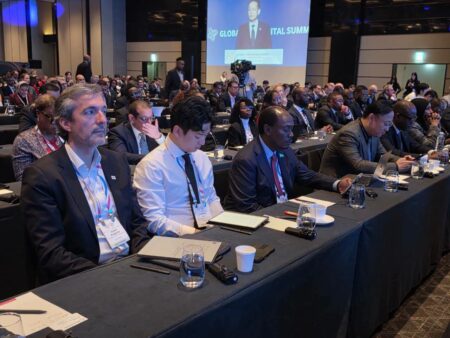
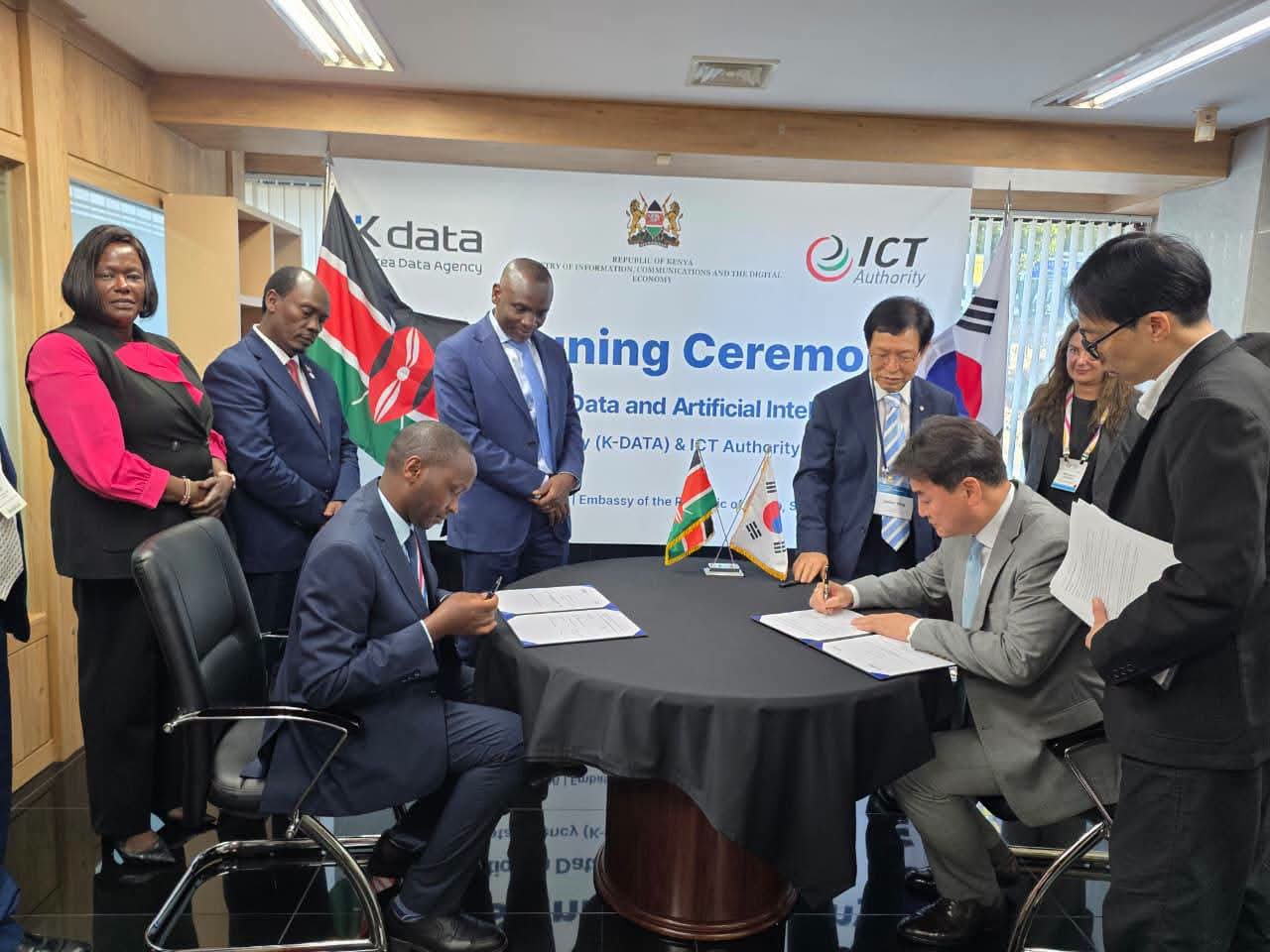
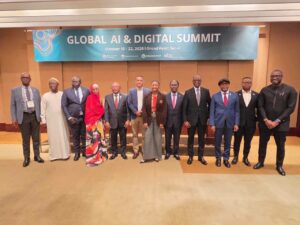
The agreement between Kenya’s ICT Authority and the Korea Data Agency (K-DATA) was signed at the Embassy of Kenya in Seoul, witnessed by Information, Communications and the Digital Economy Cabinet Secretary William Kabogo on the sidelines of the Global AI and Digital Summit.
The partnership will focus on preparing government datasets for artificial intelligence applications, piloting AI solutions in public service delivery and establishing systems for secure data exchange across government institutions.
The two agencies will also cooperate on data governance, interoperability, data quality certification and training professionals to manage and utilise data effectively.

The initiative is expected to support the implementation of Kenya’s National Artificial Intelligence Strategy 2025–2030 and the Digital Master Plan, with its activities governed by the Data Protection Act, 2019.
The agreement signals Kenya’s growing focus on moving beyond the adoption of digital technologies towards using data and AI to improve government efficiency, public service delivery and economic productivity.
Kabogo thanked the leadership of K-DATA and the Kenyan Embassy in Seoul for facilitating the engagement, describing international cooperation as important to advancing the country’s digital transformation agenda.
During his visit to Seoul, Kabogo also held discussions with Kenya’s Ambassador to South Korea, Prof Emmy Kipsoi, and embassy officials on strengthening bilateral cooperation in information and communications technology and the digital economy.
The discussions covered digital infrastructure, skills development, e-government services and ongoing initiatives at Konza Technopolis, Kenya’s flagship technology and innovation hub.
The two sides also explored ways to attract more South Korean investment into Kenya’s technology sector and ensure that engagements arising from the summit translate into practical partnerships.
South Korea’s experience in digital government, data management and technology driven public services presents opportunities for Kenya as it seeks to expand its digital economy and improve access to government services.
The embassy is expected to play a role in facilitating engagements between Kenyan institutions and South Korean technology companies, investors and government agencies.
Kabogo commended Prof Kipsoi and the embassy team for their work in representing Kenya and supporting Kenyans living in South Korea.
Beyond government data and infrastructure, Kenya is seeking to harness artificial intelligence to improve healthcare delivery while ensuring that technology complements, rather than replaces, medical professionals.
Speaking during a panel discussion titled Benefiting Billions: Scaling AI for Healthier Lives in Seoul, Kabogo said the successful adoption of AI in healthcare requires more than promising pilot projects.
He identified sustained government commitment, adequate investment, public confidence in the handling of health information and clear accountability when AI systems inform clinical decisions as essential conditions for scaling up the technology.
Kenya’s Digital Health Act, 2023, and the Data Protection Act provide a legal framework for managing health information and guiding the responsible use of digital health technologies.
Kabogo maintained that healthcare workers must remain central to patient care and retain responsibility for clinical decisions, even as AI tools become more widely available.
For the technology to deliver meaningful results, he said, AI applications must be integrated into the national health system, while healthcare workers receive the training and support required to use them effectively.
He also highlighted the need to develop solutions that accommodate local languages and the devices available to frontline health workers, particularly those operating in communities with limited access to advanced technology.
Reliable internet connectivity at health facilities and community-level service points was identified as another critical requirement.
Kabogo said Kenya’s national fibre network had expanded from approximately 8,000 kilometres in 2022 to 30,000 kilometres, providing a foundation for extending digital services to more parts of the country.
The government intends to continue expanding affordable connectivity to health facilities and community health promoters to support the adoption of digital health solutions.
The challenge, however, will be ensuring that improved connectivity is matched by adequate equipment, trained personnel, reliable systems and safeguards against the misuse of sensitive health information.
Kenya also used the Seoul summit to strengthen its engagement with the World Bank on the implementation of the National Artificial Intelligence Strategy 2025–2030.
Kabogo held a meeting with Sangbu Kim, the World Bank Group’s Vice President for Digital and AI, to review the institution’s support for Kenya’s digital transformation through the Kenya Digital Economy Acceleration Project.
The project supports the expansion of the Digital Superhighway, connectivity for learning institutions and government offices, digital government services and the development of digital skills.
With the national AI strategy already launched, the government’s priority is now to translate its ambitions into practical applications that benefit citizens and strengthen the economy.
Kabogo and Kim discussed potential support for AI training among young people through the Ajira and Jitume programmes, as well as capacity building for public servants through the Kenya School of Government.
They also explored the next phase of the digital economy project, with emphasis on applying AI in agriculture, healthcare, education and public administration.
Other priorities included developing AI solutions in local languages, expanding public Wi-Fi and equipping digital hubs across the country.
The discussions reflect Kenya’s ambition to make AI adoption part of a broader economic and public service transformation programme, rather than confining it to specialised technology institutions.

Agriculture, education and healthcare are among the sectors where AI applications could support service delivery, information access and decision making, provided the solutions are affordable, reliable and suited to local conditions.
The two sides agreed to continue discussions through their respective teams in Nairobi.
Kenya, Benin explore cooperation on African language AI
Kenya is also seeking closer cooperation with other African countries as governments across the continent develop national AI strategies and work to reduce dependence on technologies designed primarily for other markets.
At a bilateral meeting in Seoul, Kabogo held talks with Benin’s Minister of Digital Transformation and Innovation, Dr Mahuna Akplogan, whose portfolio includes responsibility for the country’s national AI strategy.
The two ministers discussed cooperation in implementing their respective national strategies, developing AI applications for African languages and strengthening digital public infrastructure.
Both countries are government partners in the ATLAS Umoja initiative, which is intended to advance cooperation around language technologies.
The development of AI systems capable of understanding and processing African languages is considered important to widening access to digital services, particularly for people who may not be comfortable using platforms designed primarily for English or other widely supported international languages.
The ministers also discussed establishing a framework for cooperation between their ministries and Kenya’s bid for re election to the International Telecommunication Union (ITU) Council at the organisation’s Plenipotentiary Conference in Doha next month.
Kabogo congratulated Akplogan on his appointment and, through him, extended his congratulations to Benin’s President Romuald Wadagni on his election.
He expressed optimism that cooperation between the two countries would contribute to advancing digital transformation across Africa.
Regional connectivity and digital integration also featured in Kabogo’s bilateral meeting with Uganda’s Minister of ICT and National Guidance, Justine Kasule Lumumba.
The two countries are linked by the Northern Corridor, along which fibre optic infrastructure provides an important foundation for cross border communications and digital services.
Their discussions covered the commercial operation of the government fibre link at Busia, cooperation on a proposed regional communications satellite and joint efforts to strengthen AI policy, legislation and digital skills.
Kenya, Uganda, Rwanda and South Sudan have been involved in discussions around a feasibility study for a regional communications satellite, an initiative intended to support regional connectivity.
The ministers also considered a framework for cooperation between their respective ministries, digital integration within the East African Community and coordination ahead of the ITU Plenipotentiary Conference in Doha.
Kabogo congratulated Lumumba on her appointment and acknowledged the contribution of her predecessor, Chris Baryomunsi, to regional ICT cooperation, including engagements at the Connected Africa Summit held in Nairobi in April.
The talks come as East African countries seek to improve the movement of digital services across borders, strengthen shared infrastructure and harmonise approaches to emerging technologies.
Closer coordination could help reduce fragmentation in regional digital systems, improve cross border communications and create opportunities for businesses operating across East Africa.
Kabogo also joined fellow African ministers responsible for ICT and the digital economy in a meeting on the sidelines of the Seoul summit, where they agreed to strengthen coordination on issues affecting the continent’s digital future.
The ministers committed to advancing a common African position in international forums to ensure that the continent’s priorities are reflected in global decisions on digital technology and artificial intelligence.
They also identified online child protection as a shared responsibility, with governments expected to work together to make digital platforms safer for children and young people.
As more young Africans use digital platforms for education, employment, communication and business, the ministers recognised the need to balance expanding digital access with measures that protect users from online risks.
Kenya said it would continue working with other African states through regional and continental platforms, including the Connected Africa initiative hosted in Nairobi, to advance the commitments.
The meeting highlighted the importance of African governments speaking collectively on issues such as AI governance, digital infrastructure, skills development and online safety, particularly as international rules and standards continue to evolve.
The engagements in Seoul underscore Kenya’s efforts to position itself as a regional player in artificial intelligence, digital public services and data driven development.
The cooperation with South Korea is expected to support the preparation of government data for AI use, while discussions with the World Bank and other African governments could help mobilise technical expertise, investment and skills needed to implement the national strategy.
However, the success of these initiatives will depend on how effectively agreements are translated into funded programmes, operational systems and measurable improvements in public services.
For Kenya, key priorities include ensuring the quality and security of government data, protecting personal information, expanding reliable internet connectivity and training public servants and young people to use AI responsibly.
The country must also ensure that emerging technologies do not deepen inequalities between urban and rural communities or exclude citizens who lack access to suitable devices, affordable internet or digital skills.
As the government pursues its Digital Superhighway agenda, the focus will increasingly shift from announcing partnerships to demonstrating how the investments improve access to healthcare, education, government services and economic opportunities.
The Seoul engagements provide Kenya with additional avenues for international cooperation. Their long term value will ultimately be measured by whether the partnerships deliver practical solutions that improve the lives of citizens and strengthen the country’s digital economy.