






For decades, Kenya’s cotton industry has carried the promise of transforming rural agriculture into a powerful engine of industrialisation, employment creation and wealth generation.
Yet that promise remained largely unfulfilled as farmers abandoned the crop due to expensive inputs, unreliable markets and inadequate processing infrastructure.
Today, a renewed partnership between the government, through the Agriculture and Food Authority (AFA), and Thika Cloth Mills is beginning to change that narrative.
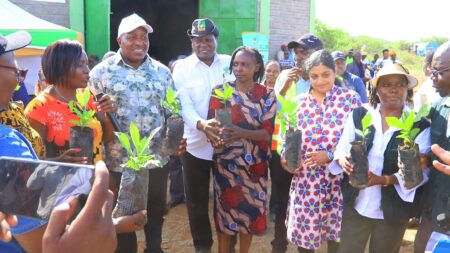
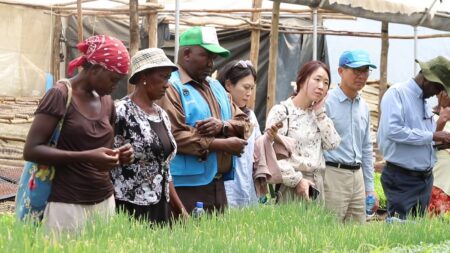
The distribution of Bt cotton seeds cuts across the cotton growing regions and marks another significant step in rebuilding the industry, with the exercise entering its second day at Kathwana in Tharaka Nithi County after its launch in Mutuobare, Kiambere Ward, Mbeere North, Embu County.

The programme also targets farmers in Meru, Kirinyaga, Machakos, Makueni and Kitui among other cotton growing regions offering renewed hope to thousands of growers ahead of the anticipated El Niño rains.
In Mutuobare farmers Francis Runje and Joseph Nyagah welcomed the government’s intervention, describing the free Bt seeds as a major relief to small scale growers who previously struggled to afford quality planting materials.
They said a kilogramme of Bt cotton seed had been selling at approximately KSh4,000, putting it beyond the reach of many farmers.
The two explained that the improved variety takes approximately three months to mature, compared to six months for ordinary varieties, produces more cotton bolls and offers resistance to destructive insect pests.
They expressed optimism that access to the seeds, coupled with favourable weather and proper farming practices, would help them increase their yields.
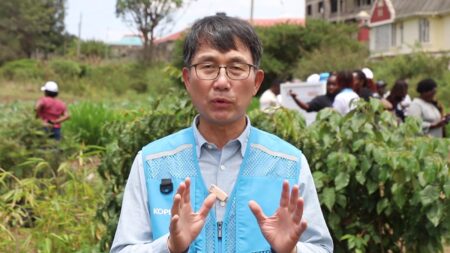
An AFA director said the government was committed to ensuring adequate seed availability as part of a broader strategy to restore cotton production and strengthen the country’s textile industry.
At the centre of this transformation is Thika Cloth Mills Chief Executive Officer Tejal Dhodhia, whose involvement in the cotton value chain goes beyond manufacturing.
For years, her company had to source cotton from neighbouring Uganda and Tanzania to sustain its textile operations because local production could not meet industrial demand.
However, since 2016, intensified campaigns around the Buy Kenya, Build Kenya initiative, alongside improved incentives and the increase in the cotton purchase price from KSh52 to KSh72 per kilogramme, have encouraged farmers who had abandoned the crop to return to their fields.
Dhodhia says the growing production is changing the country’s cotton outlook, with stakeholders now exploring opportunities to export surplus cotton rather than relying heavily on imports to meet domestic industrial requirements.
Dhodhia says her company and other industry players are ready to purchase farmers’ cotton at KSh72 per kilogramme, providing an important market incentive for growers to expand production.
She has personally supported farmers across the country through the provision of cotton seeds and pesticides, making the government’s latest intervention particularly significant in easing the burden on private investors.
She has urged farmers to prepare their land early, plant in good time and take advantage of the anticipated rains.
Embu Governor Cecily Mbarire echoed the call, pledging that her administration would work with the national government and private investors to empower farmers, support agricultural production and strengthen market access.
She described the partnership as an opportunity for farmers to rebuild their livelihoods through a crop with a ready industrial market.
While the seed distribution in Eastern Kenya is opening new opportunities for farmers, another important development is taking shape in Lamu County, where Thika Cloth Mills has invested in modern cotton ginning infrastructure at Mpeketoni.
For decades, the distance between cotton growing areas and processing facilities discouraged production, with farmers facing high transport costs and logistical challenges.
The new ginnery is intended to bring processing closer to farmers, creating a more organised supply chain through which cotton can be aggregated, processed and supplied to textile manufacturers.
Reports on the Lamu project have highlighted its potential to create employment, reduce post harvest costs and provide a more dependable market for coastal cotton growers.
The facility is also part of a wider effort to position Lamu as an important centre for cotton production and processing in Kenya.
The significance of the Lamu investment lies in its ability to reconnect the farmer directly to industry.
Through cooperatives and organised farmer groups, growers can aggregate their produce and access a structured market, while the ginnery separates cotton lint from seed before the lint proceeds to textile manufacturing.
This is the foundation of a cotton to fabric economy in which value is created at every stage, from seed production and farming to ginning, spinning, weaving, garment manufacturing and retail.
According to industry reporting, Lamu’s cotton production has been growing, with Thika Cloth Mills working with farmer cooperatives to strengthen supply and processing.
The company’s integrated manufacturing operations in Thika provide an important industrial destination for locally produced cotton, helping retain more economic value within the country.
The economic benefits of a revived cotton industry could extend far beyond the farms and factories.
Increased production means more opportunities for agricultural workers, transporters, input suppliers, cooperative societies, ginnery operators, technicians and garment manufacturers.
Women and young people stand to benefit from employment and enterprise opportunities across the value chain.
Dhodhia has also pointed to government procurement of locally manufactured uniforms for the Kenya Defence Forces, National Youth Service and National Police Service as an example of how public procurement can sustain domestic manufacturing.
She is urging Kenyans to embrace Buy Kenya, Build Kenya, arguing that supporting local industries is essential for employment creation, industrial sustainability and economic growth.
The partnership between farmers, government and manufacturers therefore represents an opportunity to turn cotton into a broader rural and industrial development programme.
Kenya’s cotton revival, however, will depend on maintaining the momentum beyond seed distribution.
Farmers need timely access to quality inputs, extension services, reliable rainfall information, competitive prices and consistent markets, while manufacturers require sufficient quantities of locally produced cotton to operate efficiently. AFA’s industry data has previously shown that local production has remained below the raw material requirements of textile manufacturers, underlining the scale of the recovery still needed.
With the seed programme, the expansion of processing infrastructure in Lamu and Thika Cloth Mills’ commitment to buying local cotton, the building blocks of a stronger value chain are taking shape.
The ultimate ambition is clear that to move Kenya from importing cotton to producing enough for its industries, creating jobs, improving farmers’ incomes and eventually becoming a regional supplier of cotton and textile products.