










Agriculture Cabinet Secretary Sen. Mutahi Kagwe has assured Kenyans that the country will not slide into a food crisis despite a drought expected to hit maize production and further expose the vulnerability of the country’s food system to increasingly erratic weather.
Mr Kagwe said the Government was already putting in place measures to bridge the anticipated production deficit, including importing maize from the Common Market for Eastern and Southern Africa (Comesa) region to supplement local supplies.
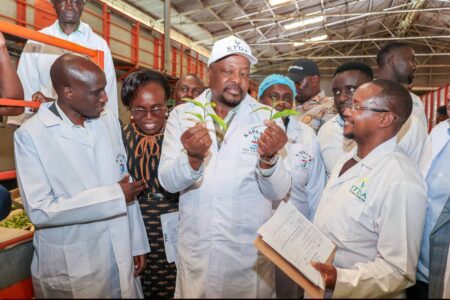
The CS spoke during a tour of Trans Nzoia County, where he assessed the impact of the prevailing dry conditions on maize production and seed multiplication, underscoring the growing pressure on the Government to safeguard food supplies ahead of the next planting season.
He was accompanied by Trans Nzoia Senator Allan Chesang, Kenya Seed Company managing director Sammy Kiplagat Chepsiror and other national and county government officials.
Mr Kagwe acknowledged that the prolonged dry spell would take a toll on maize yields, with production expected to decline.
However, he said the Government had anticipated the shortfall and would move to secure additional supplies rather than allow declining domestic output to translate into shortages and soaring food prices.
“Kenya will import maize to supplement what will be produced locally,” Mr Kagwe said, adding that the Government was looking to neighbouring Comesa countries for supplies.
The assurance comes as farmers grapple with unpredictable rainfall patterns that have complicated planting decisions and threatened crop yields in some of the country’s major agricultural zones.
The CS also sought to reassure farmers that the drought would not compromise the availability of certified maize seed for the next planting season.
He said the Government was satisfied with the country’s seed stocks despite the adverse weather, although between 25 and 30 per cent of the seed crop could be lost because of the dry conditions.
Despite the anticipated losses, Mr Kagwe said there would be sufficient seed to support farmers when the rains return.
The assessment of maize seed production is particularly significant for Trans Nzoia, one of Kenya’s leading grain-producing regions and a major centre for seed multiplication.
Mr Kagwe said the Government was increasingly being forced to rethink traditional approaches to agriculture and livestock production as climate change alters rainfall patterns and increases the frequency of droughts and other extreme weather events.
He said weather forecasting and early-warning information from the Kenya Meteorological Department would remain central to Government planning.
“Climate change is already a reality,” Mr Kagwe said, noting that agricultural planning could no longer rely on predictable weather patterns.
He said the Government was developing contingency measures for both crop and livestock production to enable farmers to respond more quickly to drought, El Niño and other extreme weather conditions.
Mr Kagwe said Kenya would continue relying on imports for commodities whose domestic production falls short of demand, citing wheat and rice among the key products.
Kenya produces only a fraction of its wheat requirements and has historically depended on imports to meet the deficit.
Demand for rice has also continued to rise, driven by population growth, rapid urbanisation and changing eating habits, particularly among the country’s youthful population.
The CS said the Government would therefore have to balance efforts to boost local production with strategic imports to keep the market supplied.
On sugar, however, he struck a more optimistic note, saying production had increased significantly and had doubled for the first time.
The rise in domestic sugar production, he said, could help Kenya substantially reduce its dependence on imports and potentially eliminate the need for external supplies if the gains are sustained.
The latest Government intervention highlights the difficult choices facing Kenya as climate variability increasingly disrupts agricultural production.
For farmers, changing rainfall patterns have made it harder to determine when to plant, while prolonged dry spells threaten both food crops and livestock.
Mr Kagwe said the Government would therefore maintain a flexible response, continuously reviewing weather forecasts and adjusting agricultural interventions according to emerging conditions.
He said contingency planning would cover both immediate food-supply needs and longer-term measures aimed at protecting farmers from the effects of climate change.
The Government’s strategy, he added, would be to ensure that a fall in domestic production does not automatically become a national food emergency.
While maize output is expected to fall during the current difficult season, the CS maintained that imports, adequate seed stocks and closer monitoring of weather conditions would help cushion consumers and farmers.
Mr Kagwe said the Government would continue tracking production, weather patterns and market requirements and take corrective measures whenever necessary.
The message from Trans Nzoia was therefore one of caution rather than alarm: Kenya faces a difficult agricultural season, but the Government says it has sufficient measures to prevent the drought from turning into a full-blown food crisis.