









Agriculture Cabinet Secretary Mutahi Kagwe has ordered tea factories to strictly enforce the recommended “two leaves and a bud” plucking standard, warning that poor-quality green leaf is undermining the value of Kenya’s tea and denying farmers better returns.
Dr Kagwe said the Government’s Sh7.1 billion tea factory modernisation programme must be accompanied by a corresponding improvement in the quality of green leaf delivered by farmers.
Speaking during a visit to Kapsara Tea Factory in Trans Nzoia County, where he handed over Sh44.6 million for the installation of a new withering plant, the CS said investing in modern machinery would have limited impact if factories continued receiving and processing inferior leaf.
He said Kenya’s tea industry must move away from a volume-driven approach and focus on producing high-quality teas capable of commanding better prices in international markets.
“If we have agreed that quality tea is two leaves and a bud, then that is what must come to the factory. We cannot have farmers who are doing the right thing being punished because a few others bring poor-quality leaf which is then processed together with theirs,” said Dr Kagwe.
The CS said the strict enforcement of quality standards should not be interpreted as a punishment of farmers but as part of a wider effort to establish a quality culture across the tea value chain.
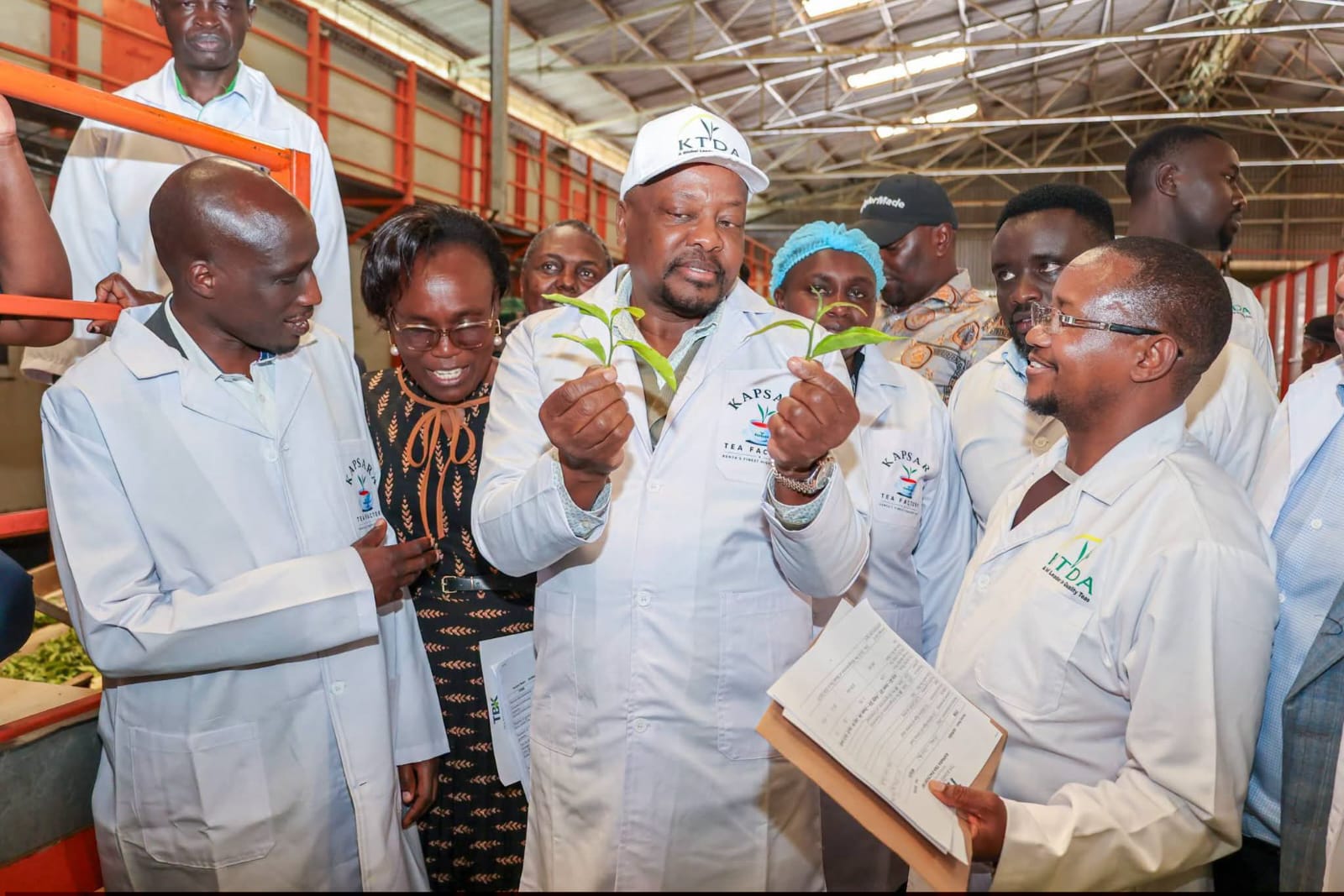
At Kapsara, he displayed samples of tea plucked from farms to demonstrate the difference between desirable green leaf and material that should not be accepted for processing.
He warned that mixing inferior leaf with quality plucks compromises the quality of the final product, lowers the price secured by factories at auction and ultimately affects the income earned by farmers.
Dr Kagwe said the debate on green-leaf quality should be anchored on its direct impact on farmers’ earnings rather than merely on production standards.
He cited Momul Tea Factory as an example of how improved leaf quality can translate into higher returns, saying the factory had raised the value of its tea from about US$2 to more than US$3 per kilogram after improving the quality of green leaf supplied for processing.
“This is not simply about saying two leaves and a bud. It is about how much money eventually gets into the pockets of farmers,” the CS said.
He said higher-quality green leaf would enable Kenyan factories to produce teas capable of attracting premium prices while expanding opportunities in orthodox, specialty and other value-added tea segments.
Kenya, he said, must reclaim its position as a producer of premium tea by improving quality from the farm level through processing, marketing and export.
The Sh7.1 billion factory modernisation programme, Dr Kagwe said, is intended to replace ageing machinery, improve energy efficiency, reduce processing costs and create capacity for factories to produce higher-value tea products.
At Kapsara, the Sh44.6 million allocation will finance the installation of a new withering plant to replace ageing equipment that has been consuming excessive amounts of electricity.
The CS directed the factory management to ensure the funds are used strictly for the intended purpose and that the investment delivers tangible benefits to farmers.
He said modernisation should be accompanied by stronger extension services and farmer education to ensure growers understand the economic value of harvesting only the recommended plucks.
“The machinery can be modern, but if the raw material going into it is poor, we will not get the quality and prices that Kenyan tea deserves,” he said.
Dr Kagwe said the Government’s broader strategy was to create a new cycle of growth in the tea industry based on quality green leaf, modern processing facilities, value addition, product diversification and access to new international markets.
The CS also called for an aggressive diversification of Kenya’s tea export markets to reduce overreliance on traditional buyers.
He said factories should increasingly explore the production of orthodox, specialty and value-added teas capable of entering premium markets and generating greater returns than conventional bulk tea.
Kenya, he said, must strengthen its existing markets while deliberately pursuing new destinations where consumers are willing to pay a premium for quality and differentiated tea products.
The push for higher-value products is expected to complement the factory modernisation programme by allowing farmers and factories to benefit from a wider range of products rather than depending heavily on bulk tea sold through conventional channels.
Dr Kagwe also challenged politicians opposed to the tea levy to stop politicising the initiative, insisting that the levy is paid by tea buyers and not by farmers or factories.
He said revenue generated through the levy would support key interventions in the sector, including price stabilisation, tea research, infrastructure development, marketing, quality improvement, value addition and opening up new markets.
The CS said the levy would also contribute to strengthening the global identity and competitiveness of Kenyan tea.
Senator Allan Chesang praised Dr Kagwe’s efforts to reform the agricultural sector and improve farmer incomes.
He said better road infrastructure in tea-growing areas would complement interventions in the tea industry by improving the movement of green leaf from farms to factories and reducing delays that can affect the quality of harvested tea.
Dr Kagwe said the Government would continue supporting farmer training and extension services as part of the campaign to improve green-leaf quality.
He said the success of the tea modernisation programme would ultimately be measured not only by new machinery installed in factories but by the quality of tea produced, the prices secured in international markets and the income returned to farmers.