





Deputy President Kithure Kindiki has reaffirmed the government’s commitment to strengthening Kenya’s cooperative movement, describing it as one of the country’s most powerful engines for wealth creation and economic transformation.
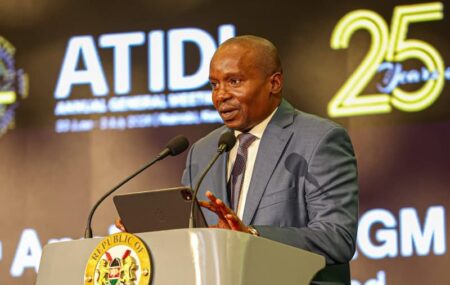
Speaking during the 104th National Ushirika Day celebrations marking the World Day of Cooperatives at Uhuru Park in Nairobi, the Deputy President said Kenya’s cooperative sector remains among the most successful globally, bringing together millions of citizens through savings, investment and shared enterprise.

Kindiki said Kenya has about 14 million cooperative members, including eight million SACCO members who collectively hold more than Sh1 trillion in savings, demonstrating the immense contribution of the cooperative movement to the country’s financial stability and economic growth.
He noted that cooperatives have empowered millions of Kenyans by enabling them to pool resources, share risks, establish businesses and generate wealth, making them an indispensable pillar of the national economy.
“The Government is implementing reforms to create more transparent, better governed, professionally managed, financially resilient and technology-driven cooperative institutions,” Kindiki said.
He added that the government’s long-term vision is to position cooperatives as stronger drivers of Kenya’s economic transformation by improving governance, embracing digital technologies and enhancing financial sustainability across the sector.
Beyond the cooperative agenda, the Deputy President outlined progress in the establishment of the National Infrastructure Fund (NIF), saying the country is at the final stages of operationalising the fund, which he described as a game changer in financing critical development projects.
Kindiki disclosed that the legal framework establishing the fund is already in place and that the government has secured substantial seed capital. According to him, more than Sh100 billion has been realised from the sale of part of the government’s stake in the Kenya Pipeline Company, while an additional Sh245 billion has been generated from the sale of part of the state’s stake in Safaricom.
He said the resources will significantly boost the country’s ability to finance major infrastructure projects without increasing the public debt burden or introducing new taxes.
“The National Infrastructure Fund gives us greater confidence in our ability to finance infrastructure, water and other strategic investments. Every shilling invested in the fund will leverage about ten shillings in additional financing,” he said.
The Deputy President said the innovative financing model would unlock private sector capital to support public development projects that have traditionally depended heavily on government borrowing.
On water development, Kindiki said Kenya has made encouraging progress, revealing that national water coverage has reached 76 per cent, with the government targeting universal access in the coming years.
He attributed the expected acceleration in water projects to the new legal and regulatory framework that clearly separates the responsibilities of the national government as the provider of bulk water services from county governments, which are responsible for last-mile distribution to households and communities.
He added that the National Infrastructure Fund will play a major role in financing irrigation schemes and industrial water projects that are essential for expanding agricultural production and supporting manufacturing.
“Water is at the centre of agricultural transformation and is equally critical for manufacturing because of industrial use. The future looks very promising,” he said.
Kindiki emphasized that the government’s new financing strategy would enable Kenya to mobilise domestic resources creatively by partnering with the private sector instead of relying excessively on loans or imposing additional taxes on citizens.
He said proceeds generated from selected state investments would be redirected towards addressing long-standing infrastructure challenges, including irrigation, roads and water supply, which have slowed the country’s economic progress.
According to the Deputy President, transforming agriculture and manufacturing remains fundamental if Kenya is to achieve higher levels of economic development.
He observed that while the country has registered notable progress in sectors such as tourism, information and communication technology and financial services, sustainable economic advancement will ultimately depend on modernising agriculture and expanding manufacturing capacity.
“Without transforming agriculture and manufacturing, no country can move to the next level of economic development,” Kindiki said.
The Deputy President reiterated that the government’s reforms in the cooperative sector, combined with innovative infrastructure financing and increased investment in water resources, are designed to stimulate enterprise, create jobs, enhance food security and position Kenya for inclusive and sustainable economic growth.