








The government is preparing a tougher legal and enforcement regime against illicit alcohol and drug trafficking, including heavier financial penalties, confiscation of offenders’ assets and the channelling of recovered proceeds towards rehabilitation of addicts.
Deputy President Kithure Kindiki said the proposed measures would target manufacturers, distributors and retailers involved in the illegal trade, as the government moves to strengthen its nationwide campaign against substance abuse.
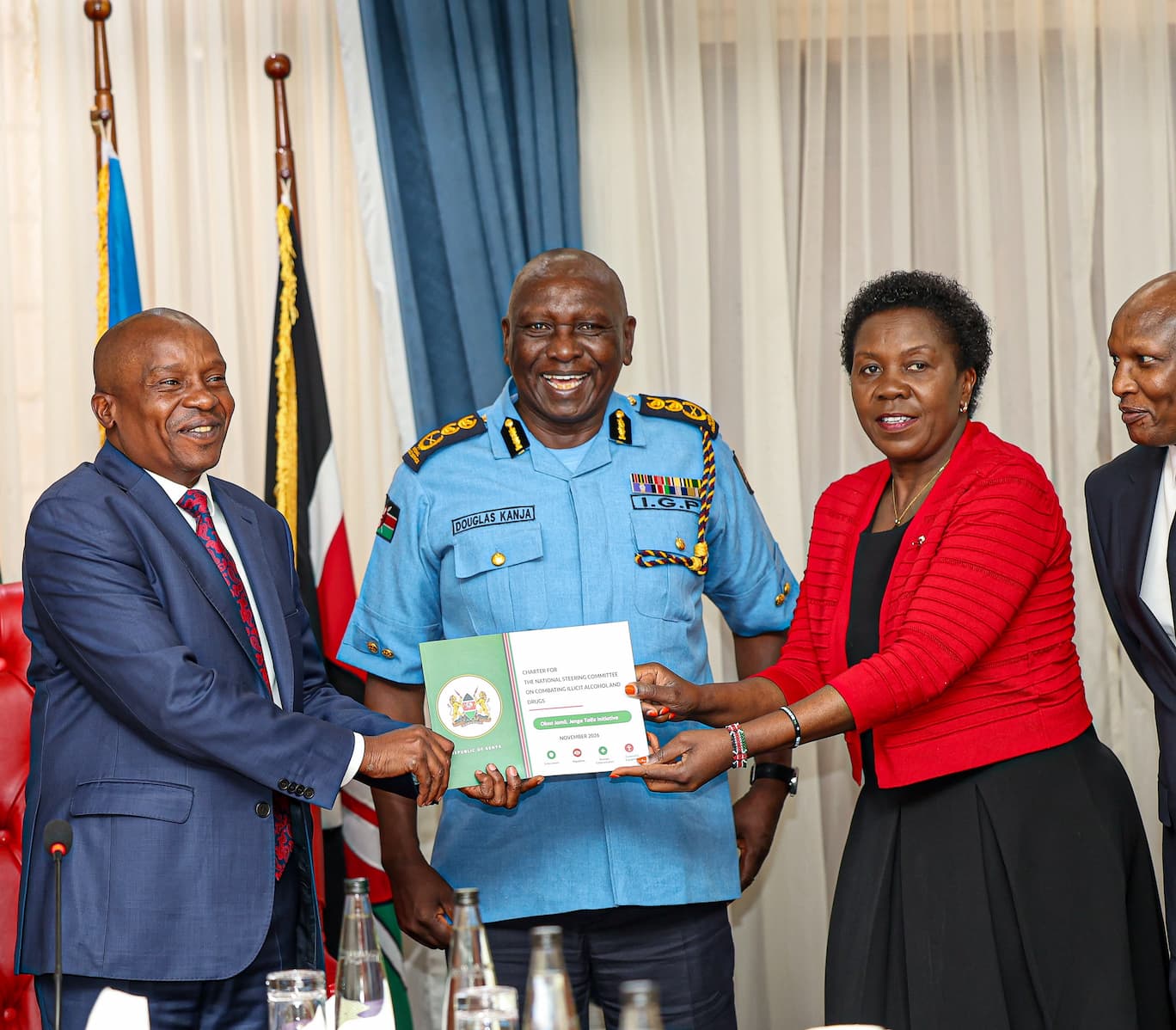
Speaking at his official residence in Karen, Nairobi, on Wednesday, November 18, 2026, Prof Kindiki received the National Charter for the Steering Committee on Combating Illicit Alcohol and Drugs, a policy framework intended to coordinate enforcement agencies, government institutions, county administrations and community based organisations.
The charter is expected to provide a coordinated approach to the fight against illicit alcohol and narcotics while addressing the social and economic consequences of addiction through expanded rehabilitation programmes.
The Deputy President said the document outlines the responsibilities of different government agencies and other stakeholders, providing a common framework for intelligence gathering, enforcement operations, public awareness and accountability.
He said the campaign, whose theme is ‘Okoa Jamii, Jenga Taifa’, would combine security operations with legislative, administrative and social interventions to address both the supply of illegal substances and the growing challenge of addiction.
“The Charter provides the framework for coordinating this exercise, the role of different organs of State, including the national government, county governments, private sector actors, civil society and members of the community,” he said.
Prof Kindiki said the government was also pursuing comprehensive amendments to the Alcoholic Drinks Control Act of 2010 to close loopholes that have enabled criminal networks to manufacture, distribute and sell illicit products.
Under the proposed changes, offenders could face substantially higher fines, with penalties linked to multiples of the market value of ethanol diverted for illegal production and distribution.
The government also intends to strengthen provisions on asset forfeiture, targeting individuals and businesses whose wealth is linked to the illicit alcohol and narcotics trade.
Kindiki said proceeds recovered from confiscated assets should directly support rehabilitation facilities and programmes for people affected by substance abuse.
“We are reviewing comprehensively the Alcoholic Drinks Control Act of 2010 to make it extremely punitive for people who are perpetuating this criminal activity, to ensure forfeiture of their assets, and to ensure that proceeds of such forfeiture are used for rehabilitation of the victims of their crime directly,” he said.
The proposed reforms signal a shift towards targeting not only the physical supply of illicit substances but also the financial networks sustaining the illegal industry.
The Deputy President further disclosed that the government had identified widespread tax non compliance within the alcohol industry, warning that the taxation framework would be tightened to ensure all operators meet their statutory obligations.
He said preliminary findings had revealed that only a small number of licensed manufacturers were complying with their tax responsibilities, raising concerns about revenue losses and unfair competition within the sector.
“We are going to strengthen taxation in this industry to ensure that all people in this sector adhere to their tax obligations because we have discovered only a few licensed manufacturers are honouring their tax obligations,” he said.
The new charter comes amid intensified intelligence led operations targeting illegal alcohol manufacturing plants, distribution networks and drug trafficking activities across the country.
Kindiki said the ongoing crackdown had recorded arrests and seizures, crediting law enforcement agencies for supporting the National Authority for the Campaign Against Alcohol and Drug Abuse (NACADA) and other institutions involved in the campaign.
However, he cautioned that enforcement agencies must maintain professionalism and ensure that the gains made so far were not undermined by complacency, corruption or a lack of coordination.
He called on the multi agency teams to sustain the operations and consolidate the achievements into a long term national strategy.
The Deputy President also directed the steering committee to commence nationwide community led initiatives, signalling an expanded role for residents, local leaders and civil society organisations in identifying and addressing the spread of illicit substances.
The approach is expected to complement police operations by strengthening public awareness, community surveillance, prevention programmes and access to treatment for people struggling with addiction.
The government is seeking to balance punitive enforcement against those profiting from the illegal trade with interventions aimed at helping victims recover and reintegrate into society.
The charter also provides for a public communications strategy intended to mobilise communities, communicate the dangers of substance abuse and encourage public participation in the campaign.
Kindiki approved the campaign theme and the proposed programme of activities, directing the committee to begin implementing the community engagement component across the country.
The meeting brought together Attorney General Dorcas Oduor, Inspector General of Police Douglas Kanja, Director of Public Prosecutions Renson Igonga, Principal Secretaries and heads of government agencies.
The effectiveness of the new framework will depend on how quickly the proposed legal amendments are translated into law, the consistency of enforcement and the availability of resources for prevention and rehabilitation.
With the government now placing asset recovery, tax compliance and community participation at the centre of its strategy, the campaign is expected to test the ability of multiple institutions to work together against an illegal trade that continues to threaten public health, family welfare and national security.