









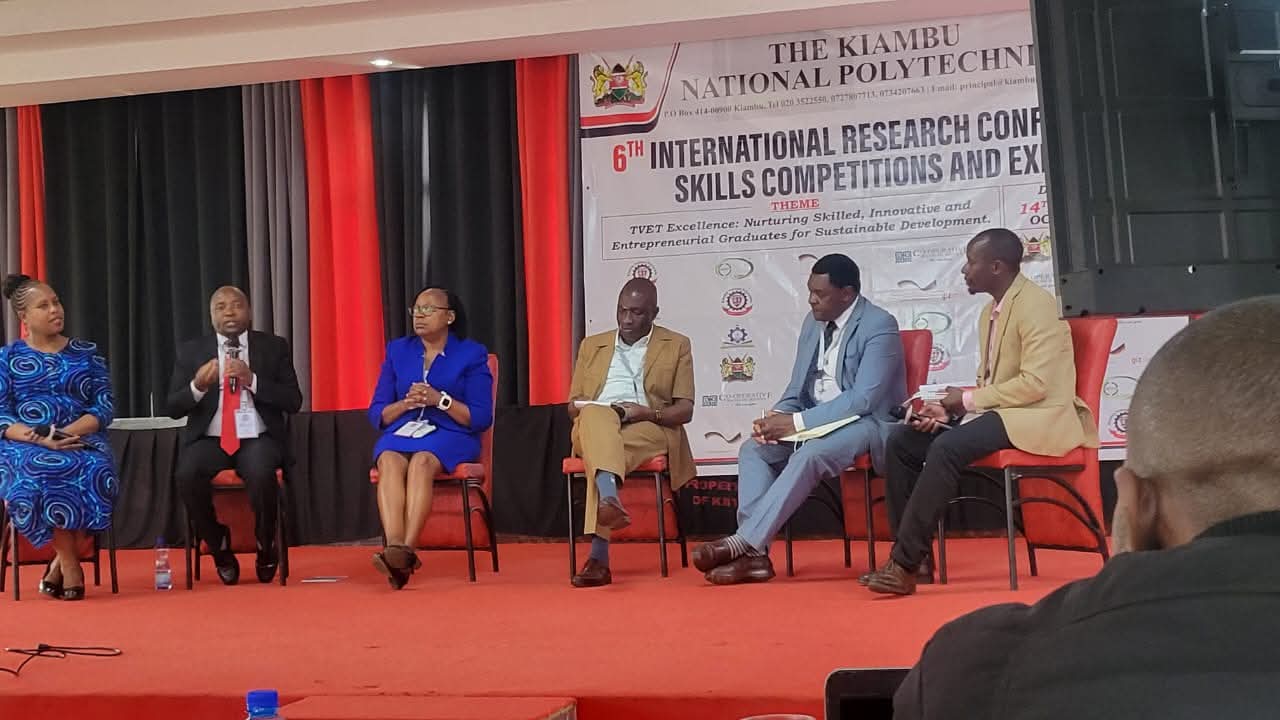
Kiambu National Polytechnic has challenged educators, researchers and policymakers to shift the focus of education from academic qualifications to practical skills, innovation and the ability to solve real world problems as Kenya grapples with unemployment among graduates.
The call was made during the closing ceremony of the institution’s sixth International Research Conference, where educationist and curriculum specialist Professor Julius Otundo urged learning institutions to strengthen competence based education and training (CBET), recognise skills acquired outside formal classrooms and promote innovation capable of creating jobs.

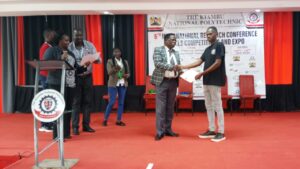
Professor Otundo, who was the chief guest at the three day conference, said Kenya needed to reconsider an education system that often measures success through academic grades and certificates without adequately assessing what graduates can do with the knowledge they acquire.
He argued that technical and vocational education and training (TVET) institutions had a central role to play in preparing young people for employment, entrepreneurship and the changing demands of the economy.
“ The question is what can you do, not what grade you have,” was the central message of his address, in which he challenged educators to connect classroom learning with practical solutions to society’s problems.
His remarks came as researchers, academics, industry representatives and students presented ideas and innovations during the conference, which brought together participants to examine challenges affecting society and explore possible solutions through research.
Professor Otundo said Kenya needed to move beyond an education culture that has historically portrayed technical training as an alternative for students who fail to secure places in universities.
He said the perception had undermined the value of practical skills despite their importance in manufacturing, construction, agriculture, technology and other sectors that support economic growth.
Under the traditional approach, he noted, students who failed to attain particular grades or secure admission to prestigious secondary schools and universities were often regarded as academic failures, with TVET institutions unfairly associated with poor performance.
He challenged parents, teachers and education policymakers to abandon such attitudes and recognise that different learners possess different talents and abilities that can be developed into productive careers.
According to the professor, a skilled artisan capable of designing furniture, repairing machinery or preparing quality food can make a significant contribution to society even without holding a university degree.
He cited everyday products, including chairs, mobile phones and microphones, as examples of how practical ideas and human ingenuity translate into innovations that improve lives.
The challenge, he said, was to create an education system that recognises both academic knowledge and the practical ability to apply it.
Professor Otundo also called for stronger recognition of prior learning (RPL), a framework that enables people to have skills and competencies acquired through work experience, informal training and other non formal routes assessed and formally recognised.
He said many Kenyans possessed valuable abilities despite having limited access to formal education, leaving them disadvantaged when seeking employment, professional recognition or opportunities to advance their careers.
To illustrate his argument, he recounted how people without formal culinary training could prepare excellent meals, while experienced mechanics could repair vehicles despite lacking the academic qualifications associated with engineering professions.
He said such individuals should be given opportunities to have their competencies assessed, certified where appropriate and improved through further training.
RPL, he argued, would help bridge the gap between informal skills and formal employment while enabling experienced workers to improve their productivity and competitiveness.
Professor Otundo said the approach should not be interpreted as a rejection of university education but as a call for a more inclusive system in which practical experience, academic knowledge and professional competencies complement one another.
He also recalled his involvement in efforts to advance competence based education in Kenya, saying discussions on the model began years before its eventual implementation gained momentum.
He challenged institutions to ensure that competence based education and training went beyond policy documents and translated into demonstrable skills among learners.
In a prediction that challenged conventional thinking about higher education, Professor Otundo said the distinction between universities and technical training institutions could become less pronounced as the demand for practical competencies grows.
He suggested that university graduates, including those pursuing master’s and doctoral degrees, could increasingly enrol in TVET programmes to acquire hands on skills relevant to their professions and businesses.
He said such a shift would reflect the growing recognition that academic qualifications alone may not meet the requirements of employers or adequately prepare graduates to establish their own enterprises.
The professor pointed to a mismatch between the skills employers seek and the qualifications held by many jobseekers, saying the disconnect has made it difficult for businesses to find workers with the competencies they require even as graduates struggle to secure employment.
He urged training institutions to strengthen collaboration with industry so that their programmes respond to actual labour market needs.
For Kiambu National Polytechnic and other TVET institutions, he said, the priority should be to produce graduates who can demonstrate their abilities, create products, provide services and respond to emerging economic opportunities.
He challenged educators to measure success not only by the number of students who graduate but also by the impact they make in workplaces, businesses and their communities.
The professor also called on researchers and innovators to ensure that ideas presented at academic conferences are translated into practical applications.
He said research should help identify problems, develop solutions and generate knowledge that can be applied to improve livelihoods.
His remarks reinforced the purpose of the conference, which brought together keynote speakers, panelists, researchers and presenters to discuss different themes and share knowledge over three days.
Kiambu National Polytechnic Deputy Principal for Academics Phena Owiye thanked the participants for attending the event and acknowledged the contributions of keynote speakers, distinguished panelists, researchers and presenters.
Owiye said the conference had provided an important platform for exchanging ideas, examining challenges facing society and proposing solutions through research and innovation.
She emphasised that the value of the discussions would ultimately depend on how effectively participants translated the knowledge gained into practical initiatives.
“We want to encourage our trainees to come up with different innovations,” she said, highlighting the institution’s commitment to nurturing creativity among students.
She noted that the polytechnic had been encouraging learners to develop innovations and had showcased student projects at the Nairobi International Trade Fair.
The institution also organises an annual open day during which students can demonstrate their work and engage with members of the public.
Owiye said innovation was a continuous process that required learners to keep exploring new ideas rather than treating research and project development as activities limited to conferences or exhibitions.
She urged participants to apply the lessons learnt during the conference to develop practical solutions to existing challenges.
The deputy principal said the institution appreciated the time and effort researchers had invested in preparing and presenting their work, adding that the conference had helped expand knowledge and stimulate fresh thinking.
She also welcomed Professor Otundo to deliver his closing remarks, describing research and innovation as essential pillars of academic excellence and responses to societal challenges.
Professor Otundo further urged innovators to think beyond producing goods for immediate sale and consider how their ideas could generate sustained economic value.
Using examples from technology and entrepreneurship, he argued that innovators should develop products and business models capable of growing, reaching wider markets and generating continuing returns.
He cited the importance of processing agricultural produce, saying value addition could help farmers and entrepreneurs earn more from their products instead of relying solely on selling raw commodities.
He also used examples from digital technology to illustrate how ideas, when developed into scalable products and services, could benefit large numbers of people.
His argument was that research should not end with the publication of a paper or the presentation of a project. Instead, it should open pathways to commercialisation, enterprise development and employment creation.
He challenged students to identify problems in their communities and view them as opportunities for innovation rather than obstacles to progress.
Kenya, he said, should be viewed as a country whose challenges can inspire solutions, with innovators and entrepreneurs playing a central role in addressing them.
He encouraged learners to embrace project based learning, creativity and experimentation, saying these approaches could help them develop the confidence and practical abilities needed to compete in a changing economy.
The professor also questioned the assumption that better opportunities could only be found abroad, recounting a story of educated Kenyans who were reluctant to return home because they believed the country had little to offer them.
He used the example to argue that the ability to create opportunities locally was just as important as acquiring qualifications or seeking employment overseas.
He said the country needed graduates who could identify gaps in the economy, establish enterprises and employ others rather than depend entirely on formal jobs.
The message was particularly relevant to young people who spend long periods searching for employment after graduation, sometimes relying on their families to meet transport and other expenses associated with job hunting.
Professor Otundo urged them to consider entrepreneurship and practical skills development as additional pathways to economic independence.
The conference also highlighted the importance of nurturing creativity among students and challenging stereotypes about careers and professional success.
Professor Otundo recalled how some career choices, including creative professions, were once discouraged by parents and teachers who considered them less prestigious than conventional occupations.
He said such attitudes could prevent young people from pursuing talents that might eventually become viable businesses or sources of employment.
He encouraged institutions to create environments in which students can experiment, develop ideas and discover how their abilities can be applied to real world challenges.
For Kiambu National Polytechnic, the discussions underscored the need to continue investing in research, innovation and practical training as part of its effort to prepare learners for an increasingly competitive employment market.
As the conference concluded, participants were challenged to ensure that the knowledge shared during the three day event did not remain confined to lecture halls and research papers.
Instead, the institution called for stronger links between research, teaching, industry and community needs, with innovation serving as a bridge between education and economic development.
The broader message from the conference was that Kenya’s education system must equip learners not only to pass examinations but also to create, produce, innovate and solve problems.
For TVET institutions, the challenge is to ensure that every qualification is backed by practical competence and that the skills acquired by learners can translate into employment, enterprise and measurable benefits to society.