







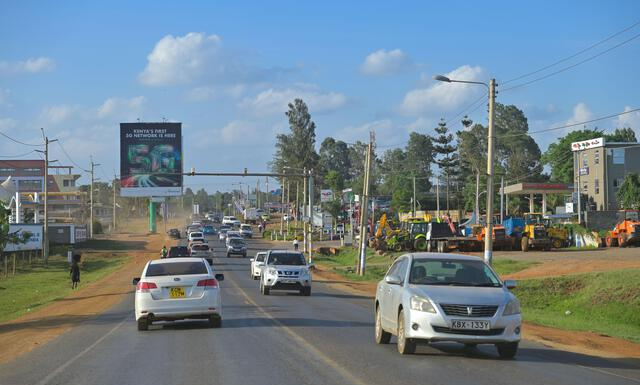
The Kenya National Highways Authority (KeNHA) has confirmed plans to introduce speed-calming and other road-safety measures along the accident-prone Kirigiti–Riabai–Lioki Road in Kiambu following concerns raised by residents over speeding, poor visibility and frequent crashes.
The development follows a formal intervention by Kiambu MP Machua Waithaka, who petitioned KeNHA in April to address what residents had identified as a dangerous section of the road.
KeNHA subsequently conducted a site inspection on July 21, 2026, and confirmed that the affected stretch requires improved road-safety measures.
In a letter dated August 24, KeNHA Director-General Eng. Luka Kimeli informed the MP that the authority had assessed the concerns and recommended several interventions, including speed-calming measures, warning signs, road markings and improvements to the carriageway and shoulders.
The authority, however, said the measures could not be implemented immediately under the existing maintenance contract because its instructed works component had already been fully utilised.
The current performance-based maintenance contract, awarded to Yatico Supplies & Construction Ltd at a cost of Sh92.38 million, commenced in September 2024 and is scheduled to expire on September 19, 2026.
KeNHA said a new maintenance contract for the road is already under procurement and that the recommended safety interventions will be undertaken under the new contract, subject to its provisions.
The authority’s inspection report paints a worrying picture of the road section, particularly the approximately one-kilometre stretch between Riabai Cemetery at Km 3+200 and Riabai Dispensary at Km 4+200.
According to the report, the section has a steep and winding profile, with sharp curves and significant changes in elevation that reduce the distance at which motorists can see approaching hazards.
The inspection team also found no speed-calming measures, including warning signs and speed humps, along the affected section.
Residents told the team that the road had been the scene of numerous crashes, some of them fatal, which they attributed largely to speeding and poor sight distance.
The community also raised concerns over pedestrians and domestic animals being exposed to speeding traffic, with residents reporting cases of dogs being knocked down while crossing the road.
At Riabai Trading Centre, the inspection found heavy roadside activity, worn shoulders and pedestrians operating close to the carriageway without adequate separation or traffic-calming measures.
The road also has sections with worn-out shoulders and inadequate markings. A number of curves were found without the road markings and warning signs normally required to alert motorists to the hazards ahead.
At a road junction near Riabai Dispensary, inspectors observed pedestrians crossing directly on the carriageway in an area without clear markings, signage or a designated crossing point.
Following the assessment, KeNHA recommended the installation of road humps and rumble strips at the identified black spot, particularly along the steep descent, to force motorists to reduce speed.
The authority also recommended speed-limit and warning signs ahead of the sharp curves and steep gradients, as well as road markings and additional rumble strips on approaches to the curves.
Pedestrian crossings have also been proposed at locations where residents frequently cross the road, while shoulder and carriageway improvements have been identified as necessary to improve overall safety.
The inspection involved a walk-through survey, measurements, observation of traffic conditions, consultations with residents, community leaders and clergy, a desktop assessment and photographic documentation of the road conditions.
The findings provide official backing to concerns that had been raised by residents and subsequently taken up by the Kiambu MP.
In his April 29 letter to KeNHA, Mr Waithaka described the stretch as a black spot and said residents had reported a distressing number of accidents, including deaths and serious injuries.
He said school-going children were among those affected and urged the authority to urgently install speed bumps and rumble strips to reduce vehicle speeds and protect motorists and pedestrians.
The MP also submitted a list of people reportedly killed or injured in crashes along the road between October 2025 and March 2026, underscoring the urgency of the intervention.
With the existing contract nearing its September 19 expiry date, attention now turns to the new maintenance contract and whether the recommended safety measures will be incorporated and implemented without further delay.
Mr Waithaka said he would continue engaging KeNHA and other relevant agencies to ensure the concerns raised by residents are addressed.
The case highlights a wider challenge facing Kenya’s road network, where communities frequently identify dangerous stretches long before formal engineering interventions are undertaken. In such areas, measures such as speed humps, rumble strips, warning signs, road markings, pedestrian crossings and improved shoulders can be critical in reducing the risk of crashes, particularly where roads pass through busy trading centres and settlements.
For residents of Riabai, the immediate concern is whether the recommendations contained in KeNHA’s inspection report will translate into visible safety improvements on the ground.
The authority’s assessment has now established the need for intervention. The next test will be implementation.