









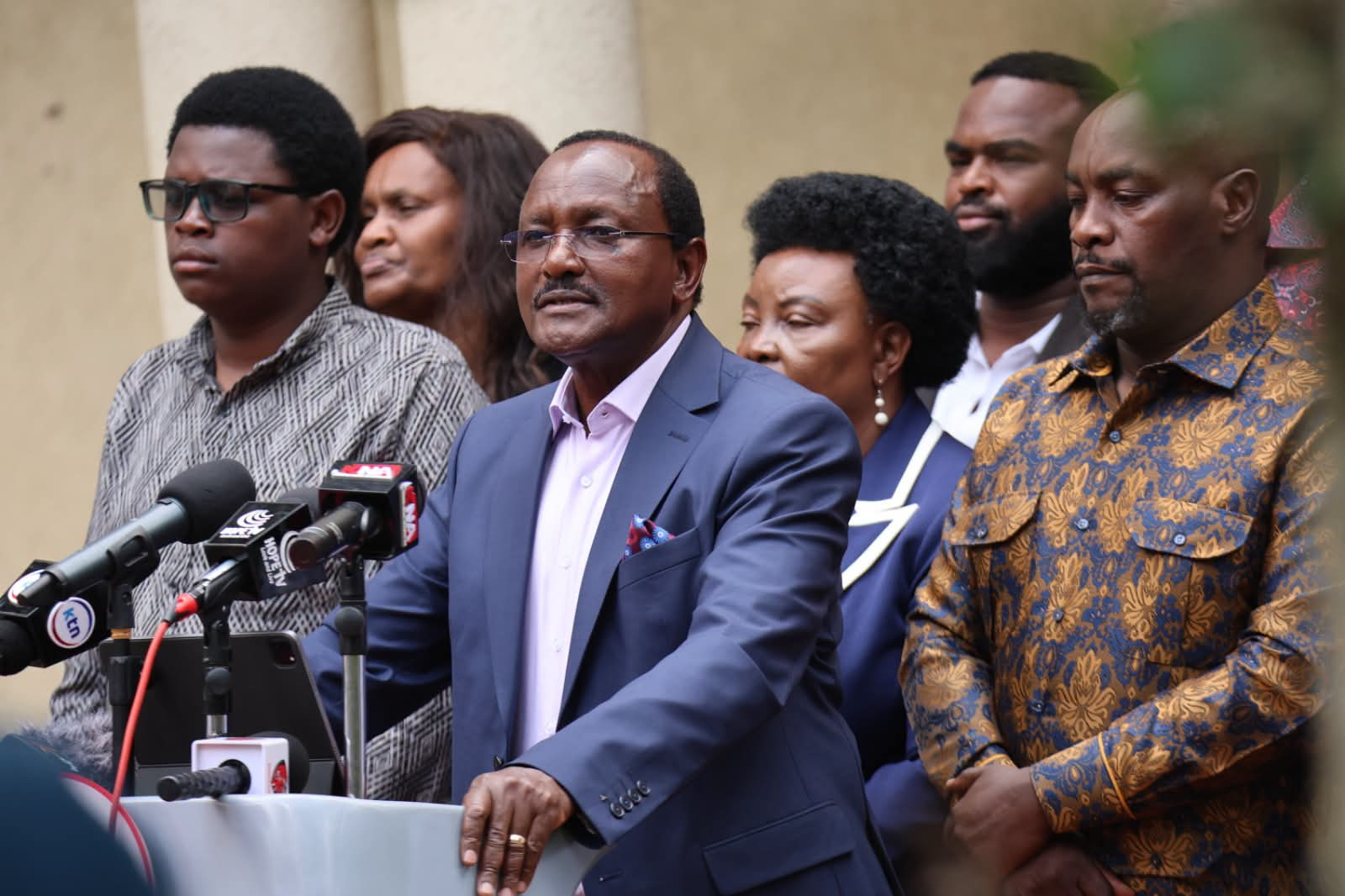
Wiper Party leader Kalonzo Musyoka has renewed his opposition to President William Ruto’s administration, pledging to pursue what he termed the “Ukombozi” movement and accusing the government of presiding over political intolerance, intimidation and threats to democratic freedoms.
In a wide ranging State of the Nation address ahead of Mashujaa Day, Mr Musyoka linked the opposition’s political campaign to the legacy of former Prime Minister Raila Odinga, saying the struggle for a democratic Kenya, accountable leadership and protection of citizens’ rights must continue following the veteran opposition leader’s death.


He also demanded investigations into violence witnessed during the first anniversary commemoration of Mr Odinga in Bondo, Siaya County, called for accountability over alleged intimidation of opposition leaders and condemned continued logging in the Aberdare Forest, warning that destruction of the country’s water towers threatened future generations.
The Wiper leader further urged young people to reject political violence and instead exercise their constitutional rights through peaceful demonstrations, voter registration and participation in democratic processes.
Mr Musyoka’s remarks came as the opposition intensified its criticism of the administration, with the 2027 General Election increasingly featuring in political mobilisation and debate over the country’s leadership.
He invoked the biblical journey to Canaan to describe the opposition’s political mission, insisting that the struggle would continue despite the challenges facing those seeking political change.
“The journey to Canaan is still on,” he said, dismissing suggestions that the opposition’s ambitions had been diverted from their original course.
He described the envisioned Canaan as a democratic Kenya where citizens from all parts of the country would enjoy equal rights, opportunities and protection under the law.
Mr Musyoka said Mr Odinga had fought for ordinary Kenyans to have a voice and insisted that his political legacy should not be rewritten to suit competing interests.
He also recalled the cooperation between opposition leaders during previous electoral contests, saying their commitment to political reforms had survived difficult moments.
The Wiper leader used the biblical figures of Moses, Joshua and Caleb to illustrate what he described as the continuing struggle for democratic change, saying those who shared Mr Odinga’s vision had a responsibility to carry it forward.
He warned against the use of violence and intimidation to influence political outcomes, predicting that the electorate would have an opportunity to hold leaders accountable at the next General Election.
Mr Musyoka condemned the violence reported during Mr Odinga’s first death anniversary commemoration at Migwena in Bondo, where stones were allegedly thrown towards a VIP tent as opposition leaders and mourners gathered to honour the former Prime Minister.
He thanked Mr Odinga’s widow, Ida, and members of the family, including their children, for welcoming opposition leaders despite the grief surrounding the anniversary.
The Wiper leader said the family had demonstrated generosity by hosting political leaders who had worked closely with Mr Odinga, even as they continued to mourn their husband, father and brother.
He also wished Siaya Senator Oburu Oginga a speedy recovery, recalling that he had attended the senator’s 80th birthday celebration as chief guest.
Mr Musyoka said the violence at the anniversary event was particularly disturbing because the gathering was intended to honour Mr Odinga’s life and political contribution.
He claimed that the incident had raised questions about the security arrangements and the presence of individuals allegedly armed with machetes and other weapons.
According to Mr Musyoka, he witnessed people being ushered into school buses as some individuals carried machetes. He alleged that the violence was organised but did not present evidence in his address to substantiate claims linking it to the government.
He said police had arrested five suspects following the incident but challenged the Inspector General of Police and the Directorate of Criminal Investigations to pursue those who may have financed or organised the violence.
“The investigation should not stop with those who were arrested. Follow the money and the vehicles,” he said, urging investigators to establish whether the suspects had acted independently or on behalf of other individuals.
Mr Musyoka argued that young people recruited into political violence often bear the consequences alone, while those who may have hired them remain beyond the reach of the law.
He appealed to young Kenyans not to allow themselves to be used as instruments of political intimidation, warning that they could face prosecution, injury or death while their alleged sponsors escape responsibility.
The opposition leader also called for political tolerance, saying no Kenyan should be attacked or threatened because of supporting a particular candidate or party.
He cited reports of violence in Homa Bay and appealed to residents to reject ethnic hostility and political divisions.
Mr Musyoka said the freedom to support one political formation must be respected in the same way that citizens should be allowed to support competing political interests.
The Wiper leader urged young people to channel their frustrations through lawful political participation rather than violence.
He cited Articles 33 and 37 of the Constitution, which protect freedom of expression and the right to assemble, demonstrate, picket and present petitions peacefully and unarmed.
However, he cautioned that constitutional freedoms did not permit incitement to violence, hate speech or the violation of other citizens’ rights.
He also referred to Article 28, which protects human dignity, arguing that political disagreements should never become a justification for humiliation, harassment or physical attacks.
Mr Musyoka encouraged young people to use social media platforms, including X, Facebook, Instagram and TikTok, to express their views and demand accountability.
He said the country’s youth had a legitimate stake in decisions affecting taxation, employment, public spending and governance.
According to him, young people should focus on registering as voters, organising politically and participating in elections rather than accepting money to take part in violent confrontations.
He linked their aspirations to the constitutional reforms championed by Mr Odinga, arguing that the 2010 Constitution had created opportunities for greater public participation and the distribution of resources through devolution.
The Wiper leader called on young Kenyans to join what he described as the Ukombozi movement, saying the campaign should be driven by democratic participation rather than intimidation.
His remarks also came against the backdrop of youth led demonstrations in 2024, when protesters demanded accountability over government spending, taxation and governance.
Mr Musyoka signalled his readiness to take a leading role in the opposition’s campaign against President Ruto in the next General Election.
He said he was confident of securing support in the Nyanza region should he be entrusted with the opposition’s presidential ticket.
The Wiper leader announced plans to return to Homa Bay and Migori counties for further political engagements, although he said the proposed visit had been postponed following consultations.
He maintained that voters in the region were politically conscious and capable of making independent decisions.
His remarks underscored the continuing political contest over the support base previously associated with Mr Odinga, whose death has reshaped opposition politics and triggered renewed discussions over leadership and alliances ahead of 2027.
Mr Musyoka also criticised the reported deployment of security personnel during recent political activities in Kitale, Trans Nzoia County, where Governor George Natembeya and leaders associated with the Linda Mwananchi campaign were reportedly caught up in confrontations.
He described the treatment of the governor and other opposition figures as a national political concern rather than an isolated county dispute.
The Wiper leader questioned reports of heavy security deployment, alleged tear gassing and the withdrawal of security personnel attached to the governor, calling for respect for elected leaders and political pluralism.
The claims require clarification from the relevant security agencies, which were not quoted responding to his allegations in the address.
Mr Musyoka also criticised what he described as interference with private property rights, citing reports concerning a residential property associated with the family of former President Daniel arap Moi in Eldoret.
He argued that public office should not be used to intimidate citizens or interfere with their lawful enjoyment of property.
Beyond politics, Mr Musyoka turned his attention to environmental conservation, warning that continued destruction of the Aberdare Forest threatened the country’s water security and undermined its climate commitments.
He said the country’s major water towers including the Mau Forest Complex, the Aberdares, Mount Kenya, Mount Elgon and the Nyambene Hills were vital to the survival of communities, agriculture and urban centres.
The former Vice President said he had joined efforts to challenge activities threatening the Aberdares, including proceedings in which the Court of Appeal was expected to take a closer look at alleged forest destruction.
He recalled receiving a request from Kipipiri MP Wanjiku Muya to assist with the matter while he was in London, after which he instructed lawyer Dego Njiru to represent him in court.
Mr Musyoka said the court had made a decision to inspect the affected forest area on October 23, describing the planned visit as an important step towards establishing the extent of the alleged destruction.
He nevertheless expressed concern that logging was reportedly continuing despite court proceedings and called on authorities to enforce any applicable court orders.
The Wiper leader warned that those responsible for illegal logging, as well as anyone facilitating or protecting the activities, should be held accountable.
He questioned the government’s environmental record, arguing that tree planting campaigns would have limited value if existing forests continued to be destroyed.
“Accountability is necessary. You cannot claim to be planting trees while allowing an entire forest to be destroyed,” he said.
Mr Musyoka linked the conservation of the Aberdares to the protection of water resources serving Nairobi and other communities, noting that the region’s forests were important to river systems and downstream livelihoods.
He also recalled his time as Environment Minister and his association with Nobel Peace Prize laureate Wangari Maathai, whose campaign for forest conservation remains influential in Kenya’s environmental movement.
He said her legacy should inspire renewed action to protect forests and resist activities that compromise the interests of future generations.
Mr Musyoka warned that forest destruction could undermine efforts to address climate change and expose communities to long-term environmental and economic consequences.
He pledged to pursue the matter through the courts and other lawful channels, saying accountability should extend to every section of forest lost through illegal activities.
As he concluded his address, Mr Musyoka turned to Mashujaa Day, saying the national holiday should be an occasion to reflect on the sacrifices made by Kenyans who fought for freedom, justice and constitutional reforms.
He recalled that the 2010 Constitution replaced Kenyatta Day with Mashujaa Day to recognise the contribution of heroes and heroines across the country.
He urged Kenyans to use the occasion to reflect on the responsibilities that accompany the freedoms secured through the country’s struggles for independence and democratic reform.
For Mr Musyoka, the legacy of Mr Odinga formed part of that continuing national story.
He argued that the former Prime Minister’s contribution should be remembered through a renewed commitment to democratic institutions, accountable leadership, protection of civil liberties and equitable development.
The Wiper leader’s address combined tributes to a departed political ally with a sharp attack on the government and an appeal for political mobilisation ahead of the next election.
His challenge to the authorities over the Bondo violence and alleged forest destruction places renewed emphasis on the need for transparent investigations, respect for court processes and the protection of citizens’ constitutional rights.
As the country marks Mashujaa Day, Mr Musyoka said the struggle for a more democratic and accountable Kenya remained unfinished, urging citizens to pursue political change through peaceful and constitutional means.