










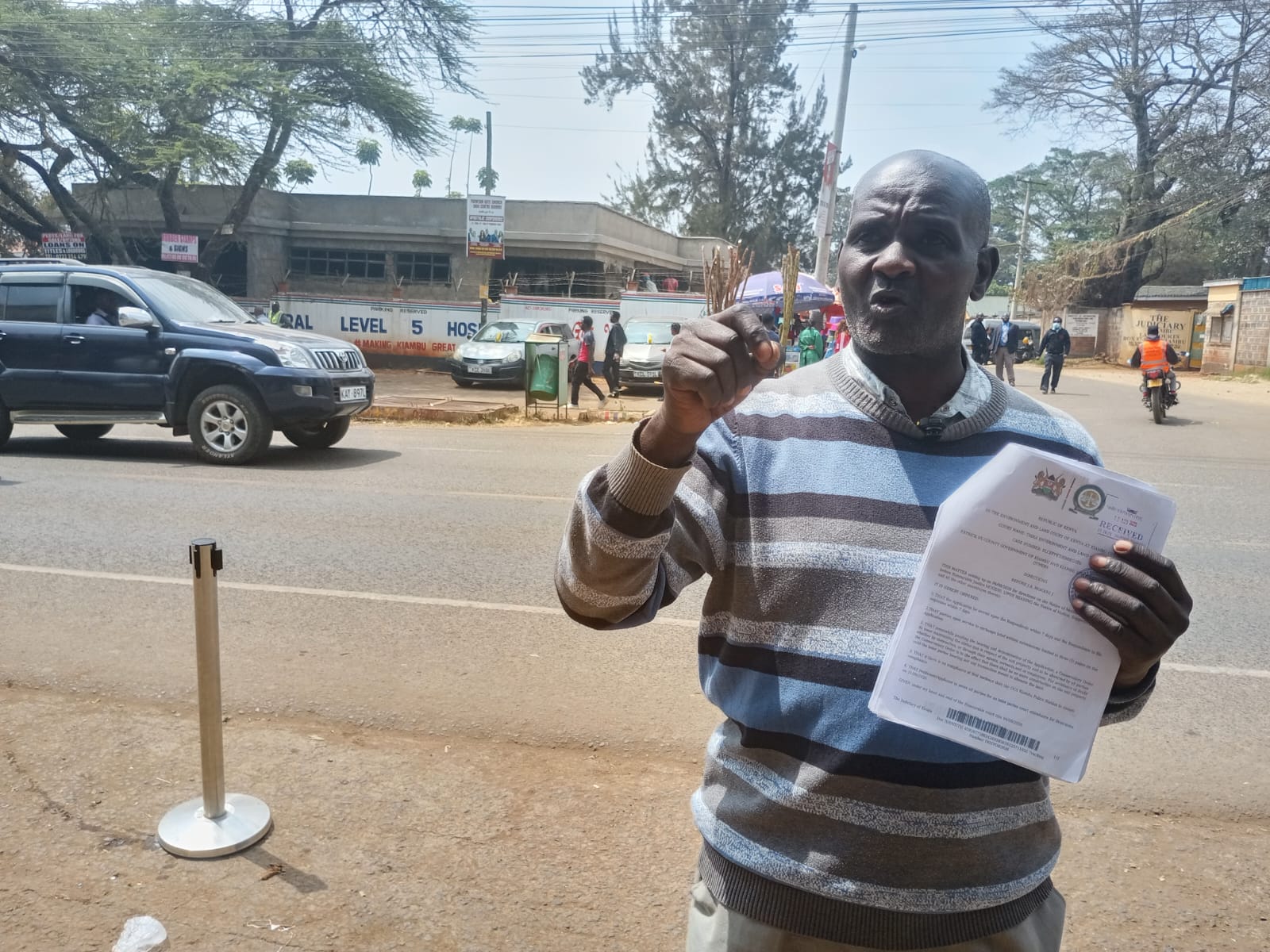
The Environment and Land Court in Thika has temporarily halted construction works at Kiambu Level 5 Hospital after issuing conservatory orders in a constitutional petition challenging the development of commercial facilities within the hospital compound.
Justice J.A. Mogeni directed that the status quo be maintained pending the hearing of the application, effectively stopping any further construction or transactions involving the disputed land.
The court ordered the petitioner to serve all respondents within seven days, after which they will have seven days to file their responses. The parties have also been directed to exchange written submissions, limited to three pages each, before the matter returns to court for directions on September 21, 2026.
In addition, the court directed that the Officer Commanding Station (OCS) at Kiambu Police Station enforce compliance should any party fail to obey the conservatory orders.
The petition was filed by Kiambu resident Patrick Mwangi Muiruri, who says he moved to court both in his personal capacity and in the public interest under Articles 22 and 258 of the Constitution.
The respondents are the County Government of Kiambu, the Board of Management of Kiambu Level 5 Hospital, an unnamed contractor or developer, and the National Environment Management Authority (NEMA).
In the petition before the Environment and Land Court, Muiruri alleges that the respondents have commenced or allowed the construction of commercial stalls, a hotel and public toilets within land reserved for the hospital.
He argues that the developments threaten the hospital’s core mandate of providing healthcare services and violate constitutional guarantees on the right to a clean and healthy environment and the right to the highest attainable standard of health.
According to court documents, the petitioner contends that the commercial developments would reduce space meant for health services, create congestion, generate noise and waste, compromise ambulance access and pose security risks to patients, staff and visitors.
He further claims that the construction is taking place on public land designated for healthcare services and that no public participation was conducted before the project commenced.
The petitioner also alleges that the project proceeded without an Environmental Impact Assessment (EIA) licence from NEMA as required under the Environmental Management and Coordination Act (EMCA).
He argues that unless the court intervenes, the construction would be completed, resulting in irreversible damage to public health infrastructure and public land.
In his supporting affidavit, Muiruri says he personally visited the site and photographed the ongoing works, which he attached as evidence before the court.
He further states that the construction began in April 2026 and remains active, threatening future expansion of the county referral hospital that serves thousands of residents.
Through the constitutional petition, Muiruri is seeking several orders from the court, including:
A declaration that the construction of commercial stalls, a hotel and public toilets within Kiambu Level 5 Hospital is unconstitutional and violates the Environmental Management and Coordination Act.
A permanent injunction stopping any further construction on the site.
An order directing the demolition or removal of any structures found to have been erected unlawfully.
Costs of the petition and any other relief the court may deem appropriate.
Pending the hearing of the application, Justice Mogeni ordered that no additional construction should take place and that no transactions intended to alienate the disputed land should be undertaken.
The conservatory orders will remain in force until the application is heard inter partes.
The respondents are expected to file their responses after being served, paving the way for the court to determine whether the temporary orders should remain in force as the constitutional petition proceeds.
The case is likely to draw significant public interest because it raises broader questions over the use of public hospital land, environmental compliance, public participation in development projects, and the constitutional protection of public healthcare facilities.