









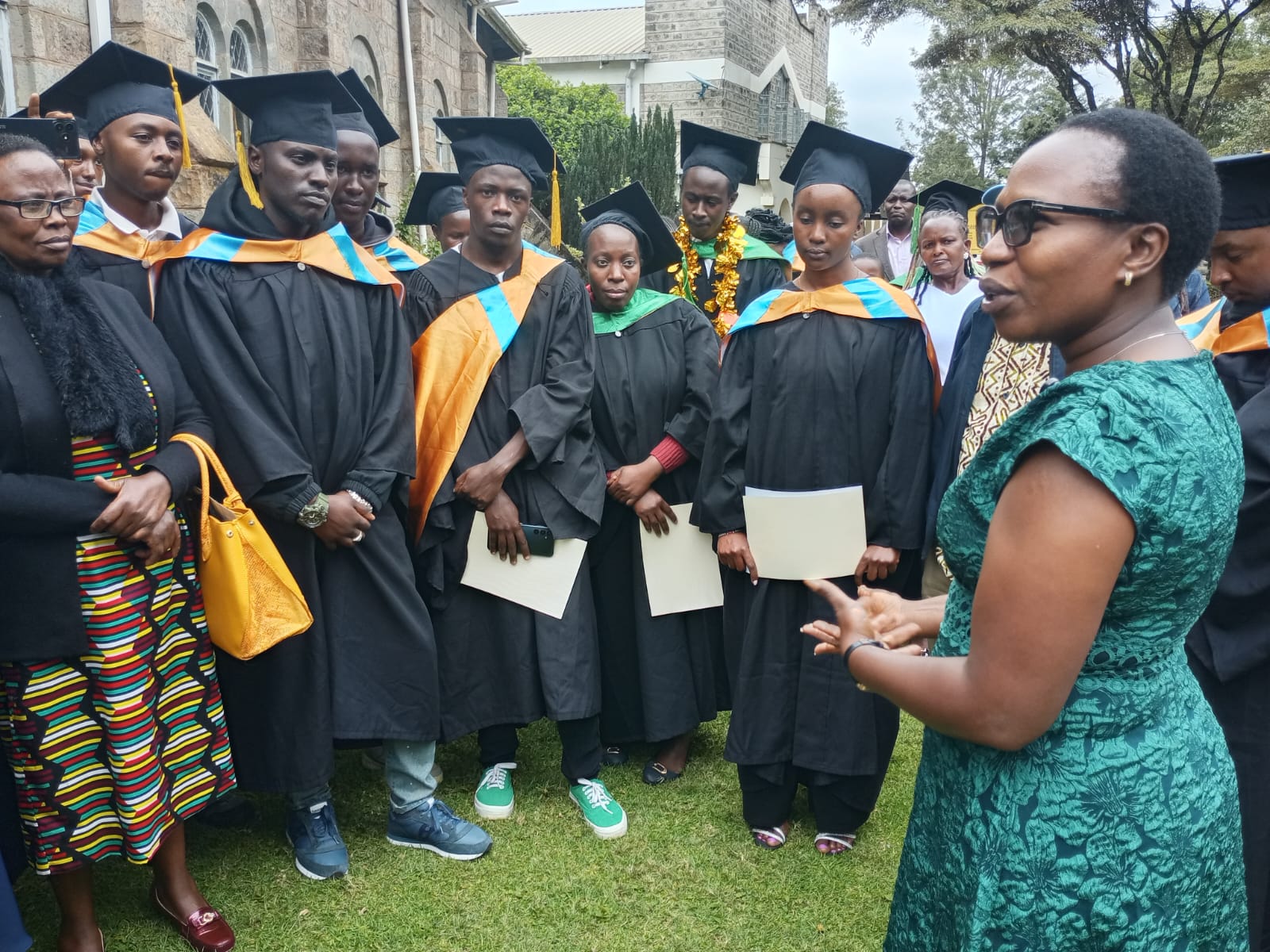
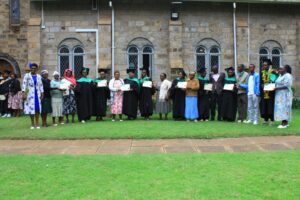
The need to equip young people and adults with practical skills took centre stage as Brighter Minds Technical and Vocational Education and Training (TVET) College held its graduation ceremony at ACK All Saints Church, Kamonde, Tigoni, Limuru.
The ceremony brought together graduates, parents, trainers, church leaders and community stakeholders, with speakers emphasising the importance of technical and vocational training in preparing learners for employment and self-employment.


Brighter Minds director Ruth Wahu said the institution, which she described as accredited under the TVET system, has been expanding opportunities for learners to acquire hands-on skills in areas including hospitality, cooking, coffee and barista training, hairdressing, beauty and other vocational disciplines.
She said skills training was particularly important at a time when many young people complete formal education but struggle to secure employment.
Wahu urged parents and young people to consider acquiring multiple skills to increase their chances of earning a living.
“Hands on skills are helping our youths to employ themselves, get jobs and also work in groups,” she said.
She said the college has established partnerships with institutions, including hotels, to create opportunities for industrial attachments, job placements and networking.

According to Wahu, some graduates can proceed to employment after attachments while others can use their skills to start small enterprises.
She cited hairdressing, cosmetology, catering and hospitality as areas where graduates can begin earning with relatively modest capital by serving clients within their communities.
Wahu also appealed to employers, hotel owners, institutions and other businesses to partner with training institutions and provide opportunities for graduates to gain experience.
She said such partnerships could help bridge the gap between training and employment by exposing graduates to workplaces while giving employers access to trained personnel.
The graduation also highlighted the value of flexible and affordable training for people who may not have had an opportunity to pursue formal education earlier in life.
One of the graduates, Panis Maria Wako, said she undertook a three month hospitality course after discovering an opportunity to pursue her long-standing interest in cooking.
Wako, a mother, said balancing education with family responsibilities had previously made it difficult for her to return to school.

She said the discounted cost of the programme encouraged her to enrol and acquire skills that she hopes to turn into a small business.
“I have always had a love for cooking but I did not have the opportunity to go to school at that time,” she said.
With her new qualification, Wako said she hopes to start a small enterprise producing cakes, cookies and other food products, and appealed for support to help her acquire the initial capital.
Another parent, Hannah Waceke from Karanjee in Limuru, said she was encouraged to enrol her child after noticing that he had remained idle at home despite having completed some level of education.
Waceke said the training had given the young person a renewed sense of purpose and encouraged him to continue with education.
She urged parents not to dismiss vocational training, saying certificates alone do not necessarily guarantee employment.
“Even if you have studied and reached university, you can still go back and study because it will help you in one or two ways,” she said.
The parent also encouraged young people to pursue practical skills that can open opportunities locally and beyond the country.
The ceremony also triggered a wider discussion on unemployment and the economic environment facing young people.
Rosemary Muthoni Kinuthia, a kiambu county women representative seat aspirant who attended the graduation, said Kenya continues to produce large numbers of graduates while employment opportunities remain a major concern.
She called for greater focus on investment, infrastructure and economic growth as part of efforts to create jobs.
Kinuthia argued that employment opportunities depend heavily on a thriving economy and called for policies that encourage investors to establish and expand businesses capable of absorbing young workers.
She said attention should not only focus on taxation but also on creating an environment in which businesses can grow and employ more people.
“What is it that we need to do to enable more people to invest in our county and accommodate young people to get employment?” she posed.
Dr Wakili Mburu Machua, an advocate of the High Court of Kenya and community stakeholder, said the graduation demonstrated the importance of providing young people with alternatives to conventional university education.
He said not every young person could afford university or college education and that vocational institutions had an important role in making education and skills accessible.
“We recognise that not every youth can go to universities and colleges. Some cannot even afford the fare to travel from where they live,” he said.
Machua called for what he described as holistic education, saying young people should be exposed to different skills and opportunities capable of helping them earn a living.
He also urged stakeholders to intensify efforts against alcohol and substance abuse, which he said was affecting young people and families.
Machua said programmes addressing mental health, sexuality, substance abuse and other social challenges should form part of youth empowerment initiatives.
He further called for greater investment in sports as a way of identifying and developing talent while creating opportunities for young people.
He cited athletics disciplines such as javelin, shot put, discus, high jump, long jump and triple jump, as well as martial arts and boxing, as activities that can open pathways for talented youth.
Machua also urged young people to become more informed about civic affairs and public leadership so that they can participate meaningfully in decisions affecting their communities.
He said stakeholders, including national and county governments, churches, the media, businesses and civil society organisations, should work together to address youth unemployment and idleness.
The graduation thus offered more than a celebration of academic achievement, highlighting a broader debate over how Kenya can convert its youthful population into an economic asset.
For the graduates, however, the immediate task is to turn their newly acquired skills into livelihoods.
Brighter Minds officials said the institution would continue strengthening links with employers and other partners to help graduates move from classrooms and training workshops into workplaces and businesses.
The message from the ceremony was clear that vocational education is not merely an alternative to academic education, but a pathway through which learners can acquire practical skills, pursue self employment and compete for opportunities in an increasingly skills driven economy.