





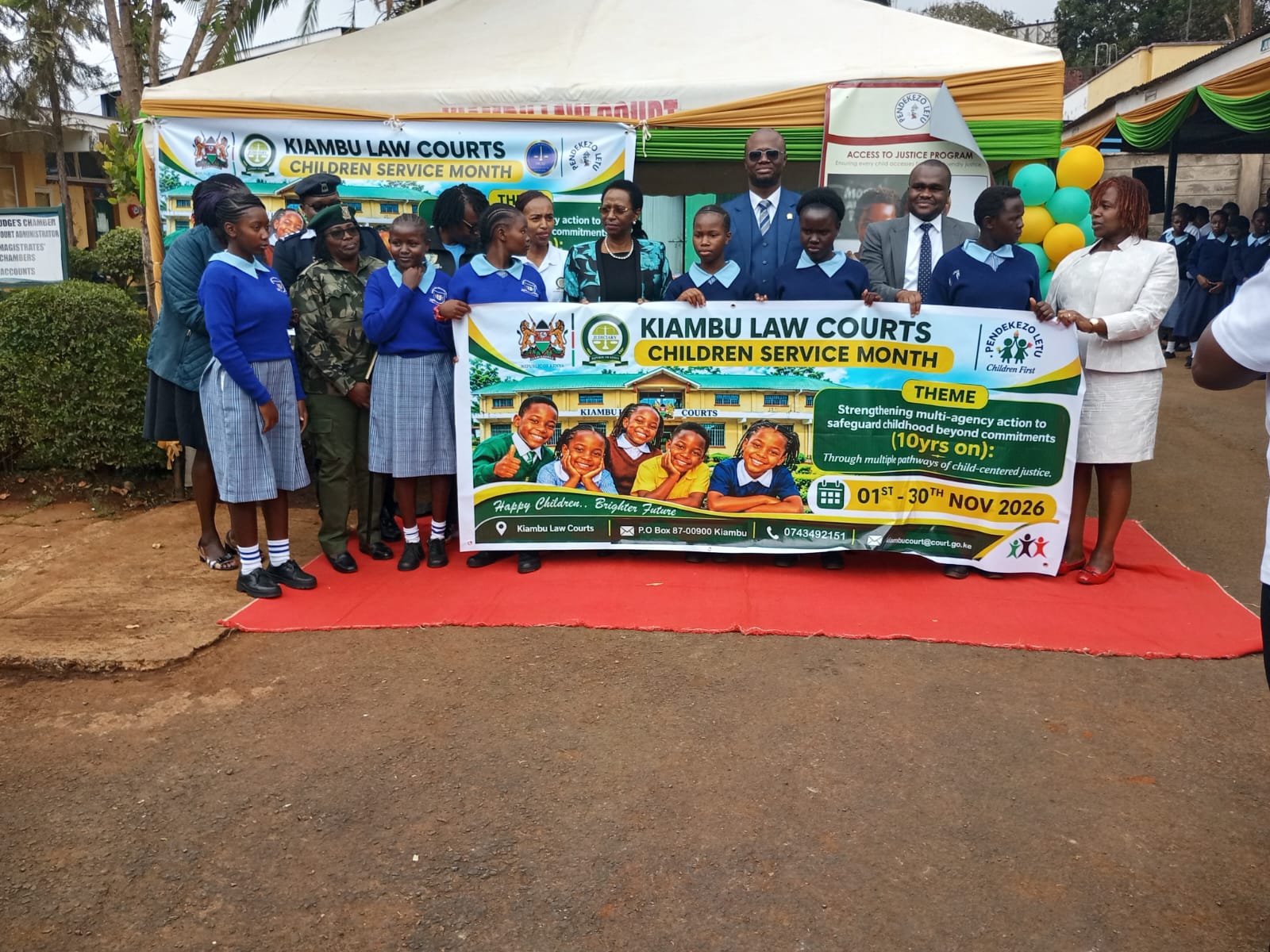
Kiambu Law Courts have reported significant progress in the determination of cases involving children, with hundreds of matters concluded as the Judiciary intensifies efforts to improve access to justice and strengthen child protection services.
Presiding Judge Lady Justice Margaret Njoki said the courts had made considerable progress in handling children’s cases through improved coordination among judicial officers, police, children’s officers, probation services, lawyers and other child protection agencies.
The achievements were highlighted during the launch of the 2026 Children’s Service Month at Kiambu Law Courts, where stakeholders called for stronger community involvement, improved parental responsibility and faster intervention in cases involving abuse, neglect and exploitation of minors.
The court’s performance figures indicate that more than 300 of the 502 children’s matters filed before the magistrates’ courts have been concluded, demonstrating progress in addressing cases that affect the welfare and rights of minors.
In matters relating to custody and maintenance, 112 cases were filed in 2026, with 21 already concluded. The courts also reported that, out of 333 cases involving children in need of care and protection, 208 had been determined.
The Judiciary expressed optimism that the recruitment and deployment of additional magistrates would improve the rate of case determination and reduce the backlog.
Lady Justice Njoki said the progress reflected sustained collaboration among institutions working towards a coordinated, child centred justice system in which the best interests of minors remain paramount.
She noted that child friendly procedures had been institutionalised within the courts, including the use of age appropriate language, psychological support and legal representation for children who require assistance.
The courts are also working with police stations that have dedicated children’s welfare desks, as well as officers from the Department of Children Services who investigate cases and provide reports to guide judicial decisions.
The judge commended the Law Society of Kenya’s Kiambu Chapter for providing pro bono legal services to children, particularly minors in conflict with the law, and acknowledged the contribution of professionals offering psychological and other specialised support.
She urged stakeholders to build on the achievements by strengthening prevention, early intervention, family based care, referral systems and information sharing.
However, she emphasised that protecting children should not be left to courts and government institutions alone, arguing that the responsibility begins within families and communities.
With schools closed for the long holiday, she warned parents and guardians against leaving children unattended or allowing them to roam freely without supervision, exposing them to kidnapping, abduction, defilement and physical abuse.
She said parents must remain vigilant about changes in their children’s behaviour and emotional well being, adding that signs of distress should prompt immediate attention rather than being dismissed.
The judge challenged families to take a more active role in parenting, noting that the manner in which children are raised at home has a lasting impact on their development and conduct.

She said the success of the child protection system should not be measured merely by the number of policies adopted or institutions established, but by whether vulnerable children receive protection, justice and humane treatment.
Nellie Ann Ng’ang’a, the Kiambu children’s magistrate, said Children’s Service Month provides an opportunity to assess progress in safeguarding children’s rights, identify gaps and mobilise institutions and communities to address emerging challenges.
She explained that children appearing before the courts are entitled to legal representation, with pro bono advocates helping them understand court proceedings and ensuring their interests are protected.
The courts also conduct in camera proceedings in children’s cases to safeguard the privacy and dignity of minors and prevent unnecessary exposure during hearings.
Children’s officers prepare social inquiry reports to help magistrates understand the circumstances surrounding individual cases and determine appropriate interventions.
Ng’ang’a said police, prosecutors, probation officers, lawyers and children’s institutions must work together to ensure investigations are completed, witnesses are facilitated to attend court and perpetrators are brought to justice.
She urged parents not to abandon children who get into trouble with the law, saying parental rejection and the tendency to describe children as troublesome could undermine rehabilitation.
She added that the Judiciary and other agencies were increasingly embracing diversion, an approach that allows appropriate cases involving children to be handled outside formal court proceedings.
Parents experiencing difficulties with children were encouraged to seek assistance from the relevant children’s offices and other agencies instead of resorting to punitive measures that could worsen the situation.
Representing the Kiambu County Commissioner, Grace Wairimu called for stronger community based reporting of child abuse, saying the protection of minors required collective responsibility.
She warned that the festive season and school holidays presented additional risks, particularly where children were exposed to alcohol, cigarettes and other substances during social gatherings.
Wairimu challenged parents to consider the long term consequences of exposing children to substance abuse and harmful practices, including during traditional initiation ceremonies.
She also raised concern about the welfare of boys, urging families and community leaders to pay greater attention to their emotional and psychological well being.
The county representative encouraged residents to report suspected abuse and neglect rather than assuming that child protection was solely the responsibility of government officers.
County Coordinator for Children Services Rose Mbarine said the November campaign was an important opportunity to strengthen access to justice and promote the rights and welfare of children.
She cited Article 53 of the Constitution, which guarantees every child the right to protection from abuse, neglect, harmful cultural practices, violence and exploitation, while making the best interests of the child paramount in all matters concerning them.
She also cited the Children Act, 2022, and the National Care Reform Strategy for Children in Kenya 2022–2032, which seeks to shift the country’s child care system from institutionalisation towards family and community based care.
Rose Mbarine said a situational analysis conducted in Kiambu County in 2026, in collaboration with development partners, had highlighted the need for greater attention to children living in charitable institutions and government facilities, including Kirigiti and Kiambu Children Remand and Rescue Centre.
She identified child neglect, physical and sexual abuse, online exploitation, child labour, school dropout, street connected children and the separation of minors from their families as some of the persistent challenges facing the county.
She called for stronger collaboration between the Judiciary, National Police Service, health professionals, schools, probation officers, community leaders and civil society organisations to ensure children receive timely and appropriate assistance.
The coordinator also urged residents to use Child Helpline 116, a free service through which cases of abuse and other child protection concerns can be reported for intervention.
She announced that this year’s World Children’s Day celebrations would be held at Ndumberi Stadium in Kiambu County, bringing together stakeholders to promote children’s rights and welfare.
Rosemarine further highlighted the department’s Positive Parenting Manual, which is being disseminated to stakeholders to equip parents and caregivers with practical guidance on raising children in safe and supportive environments.
Representatives of the probation service said their responsibilities included preparing social inquiry reports, conducting community assessments and compiling victim impact statements to assist courts in determining appropriate interventions, particularly in cases involving sexual offences.
The Law Society of Kenya’s Kiambu Chapter also reaffirmed its commitment to providing free legal assistance to children, while encouraging families to consider alternative dispute resolution mechanisms in appropriate cases.
The lawyers cautioned against involving children in parental disputes or coaching them to give misleading accounts in court, warning that such practices could expose minors to emotional harm and undermine the administration of justice.
They said children have a right to protection and representation, but adults must also ensure that their interests are not manipulated to settle personal disagreements.
As the Children’s Service Month campaign gathers momentum, stakeholders called for stronger accountability, coordinated case management and sustained support for children beyond the conclusion of court proceedings.
They said every child protection case represents a life and a future that must be safeguarded, urging parents, institutions and communities to translate the country’s child rights laws into practical action.
The overarching message was that protecting children cannot be treated as the responsibility of one institution. It requires a united commitment from families, schools, communities and public agencies to ensure every child grows up safe, respected and protected.