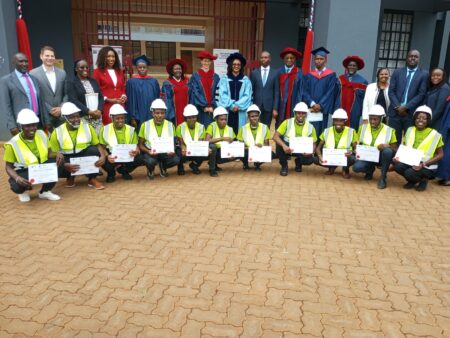







For hundreds of young people graduating from Petanns Technical College, the next challenge is no longer passing examinations but converting their newly acquired skills into sustainable livelihoods.
That transition received a boost when Kiambu County Woman Representative Anne Wamuratha used the institution’s fifth graduation ceremony to equip selected graduates with tools intended to help them start small businesses and enter the job market.
The graduation ceremony, held at Ndumberi Stadium Grounds in Kiambu County, brought together young people trained in a range of technical and professional disciplines, including cosmetology, hairdressing and beauty, hospitality, journalism and mass communication, fashion and design, tourism, engineering, ICT and health sciences.

Wamuratha said the intervention was designed to bridge the gap between completing training and securing the equipment necessary to put those skills into practice.
Through the National Government Affirmative Action Fund (NGAAF), her office awarded selected graduates hair dryers, blow dryers and UV machines to enable them to begin offering beauty services and generate income.
The initiative reflects a growing emphasis on linking technical and vocational education with practical economic opportunities, particularly for young people who may lack the capital required to establish their first businesses.
“Education gives us knowledge. Skills give us the power to create opportunities,” Wamuratha said, urging the graduates not to wait indefinitely for formal employment before putting their training to use.
She encouraged the beneficiaries to start small, arguing that a modest beginning could provide the foundation for a sustainable enterprise.
“Start with the very first step. Your tomorrow must be better than today,” she told the graduates.
One of the beneficiaries was Jacinta Wambui Wathika, who graduated with distinction and received a blow dryer and hair dryer.
Other graduates in the beauty field were presented with equipment, including UV machines used in nail and beauty services.
Wamuratha said such support was meant to give graduates a practical starting point after completing their studies.
She urged the beneficiaries to consider mobile and home-based services as an entry point, allowing them to begin earning even before securing premises for a fully established business.
“You can start doing people’s nails at their homes. You only need the gel and you can start,” she said.
The message was clear: vocational education should not end with a certificate hanging on a wall. It should translate into an income-generating skill.
For young people facing a difficult employment market, access to even basic equipment can determine whether a newly acquired skill remains dormant or becomes a source of income.
Wamuratha also pointed out that support under her office was not restricted to one trade.
She said graduates in other technical areas, including plumbing, could also benefit from similar empowerment initiatives when equipment-support programmes were available.
The approach positions NGAAF not merely as a source of educational assistance but also as a potential bridge between training and economic independence.
For graduates in trades such as beauty, plumbing, fashion, ICT and hospitality, the greatest barrier after training can often be access to tools, working capital and opportunities to gain experience.
Providing equipment addresses one part of that challenge by enabling beneficiaries to begin working immediately and gradually build their customer base.
The intervention also fits into the broader national conversation on youth unemployment, skills development and the need to expand opportunities for self-employment.
Kenya’s labour market continues to place a premium on practical skills, entrepreneurship and adaptability, with technical and vocational education increasingly viewed as an important pathway for young people seeking employment or wishing to establish enterprises.
The Petanns graduation demonstrated the diversity of skills now being pursued by young Kenyans.
Graduates emerged from courses spanning beauty and personal care to engineering, ICT, media, hospitality and health sciences—fields with potential for both formal employment and entrepreneurship.
The challenge, however, remains ensuring that training is followed by opportunities to practise and earn from those skills.
It is in this space that empowerment programmes such as the NGAAF-backed equipment support can make a difference.
Wamuratha told the graduates that success would not necessarily come from waiting for a major opportunity.
Instead, she urged them to begin with whatever resources were available and build progressively.
Her message resonated throughout the ceremony as graduates were encouraged to see their certificates not as the end of their education journey but as a launchpad for economic independence.
Wamuratha repeatedly returned to the theme of personal initiative, asking the graduates to embrace a mindset of progress despite the challenges ahead.
She led them in repeating the declaration: “My tomorrow must be better than today.”
The statement captured the central message of the ceremony—skills acquisition must be accompanied by determination, enterprise and access to opportunities.
She also emphasised that the equipment support was being channelled through the office of the Woman Representative under NGAAF, describing it as a government empowerment programme.
“This is Mama County’s office. It is a government programme under the National Government Affirmative Action Fund,” she said.
She added that the objective was to assist needy graduates who had completed their training but lacked the basic equipment required to begin earning a living.
The intervention, she said, was intended to lift beneficiaries from the point where they were struggling to get started and place them on a path towards self-reliance.
For the graduates, the ceremony therefore marked more than the culmination of their studies.
It was also a reminder that the value of vocational training is ultimately measured by what happens after graduation—whether a trained beautician can open a salon or offer mobile services, whether a plumber can establish a business, whether an ICT graduate can secure clients, or whether a hospitality graduate can find a place in the expanding service economy.
The responsibility now shifts to the graduates to turn their certificates and equipment into productive ventures.
Wamuratha congratulated the class and challenged them to embrace innovation, hard work and self-reliance as they begin the next phase of their lives.
The ceremony ended on an optimistic note, with the graduates being reminded that their circumstances on graduation day need not define their future.
With the right skills, tools and determination, the message from Ndumberi was that a certificate can become more than proof of training—it can become the foundation of a business, a job and, ultimately, a more secure livelihood.