










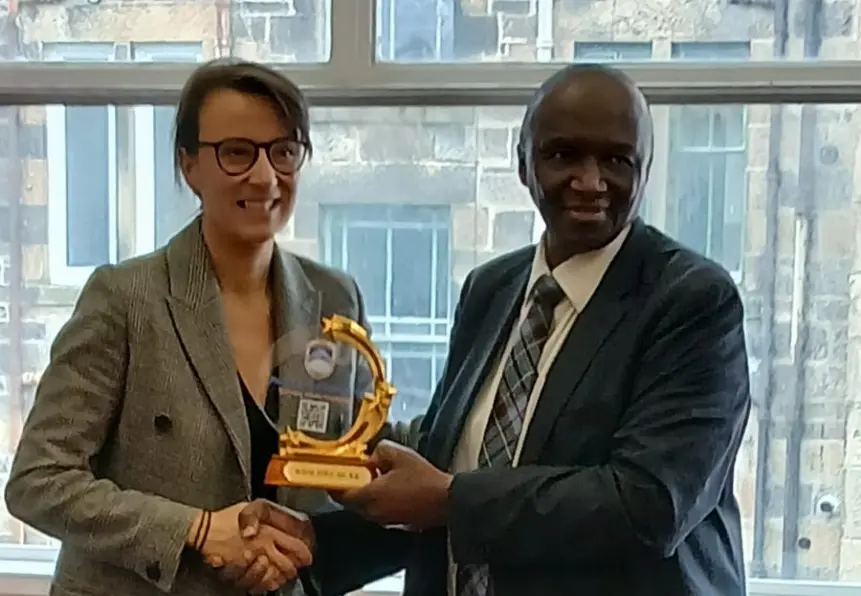
A strong call for transformative, forward-looking governance in African universities dominated high-level discussions this week as global higher education leaders convened in Lancaster, United Kingdom, for a landmark forum on institutional leadership and performance.
The conference, held under the theme “Governing Councils as Strategic Stewards and Custodians of Institutional Performance,”brought together policymakers, university executives, and governance experts to examine how institutions can remain competitive in an increasingly complex global academic landscape.
Delivering a keynote address, Dr. Vincent Gaitho, Chairman ,University Council and Pro-Chancellor of Mount Kenya University (MKU), emphasized that the future of African universities will be shaped not by infrastructure alone, but by the quality of leadership and governance structures guiding them.
“Institutional success is no longer determined solely by academic excellence,” Dr. Gaitho noted. “It is increasingly determined by the quality of governance and leadership.”
Shift Toward Strategic Governance
Participants highlighted that universities across Africa are navigating mounting pressures, including rapid technological disruption, reduced traditional funding sources, intensified competition for students and talent, and growing expectations for accountability and societal impact.
Experts at the forum urged governing councils to move beyond routine oversight and embrace a strategic role that shapes institutional direction, resilience, and long-term sustainability.
Central to discussions was the concept of **strategic stewardship**—the responsibility of councils to safeguard institutional values and resources while proactively positioning universities to seize emerging opportunities and address potential risks.
Defining High-Performing Governing Councils
The forum outlined key attributes of effective governing councils, including:
-Strategic Focus: Prioritizing long-term sustainability over day-to-day operational concerns
– Collective Competence: Integrating diverse expertise across finance, policy, innovation, and technology
– Independence: Providing objective, constructive oversight
– Data-Driven Decision-Making: Utilizing analytics and measurable performance indicators
– Continuous Improvement: Regularly evaluating governance effectiveness
Speakers emphasized that governance strength lies not only in who sits on boards, but in the collective capabilities and competencies they bring.
Beyond governance structures, the forum underscored the growing importance of cohesive leadership teams. High-performing institutions, participants noted, are guided by leadership that demonstrates:
– Shared vision and alignment
– Strong execution capabilities
– Accountability through measurable outcomes
– Innovation-driven thinking
– Cross-functional collaboration
“A brilliant strategy poorly implemented remains just a document,” Dr. Gaitho remarked, underscoring the need for disciplined execution.
A recurring theme was the importance of clearly defined roles and trust between governing councils and management teams. Governance failures, participants cautioned, often stem from blurred responsibilities, lack of transparency, and adversarial relationships.
“The Council governs, management manages—but both must lead,” one speaker observed.
The forum identified critical pillars for building resilient and high-performing universities:
1. Strategic planning with measurable outcomes
2. Enterprise risk management embedded in decision-making
3. Robust performance frameworks across academic and financial metrics
4. Digital governance, including AI and cybersecurity oversight
5. Leadership succession planning
Participants also called for universities to prepare for emerging challenges such as artificial intelligence governance, financial sustainability, global competition, and environmental and social responsibility.
Africa’s youthful population was highlighted as a key opportunity, with universities urged to equip graduates with skills for innovation, entrepreneurship, and the future workforce.
*Strengthening Global Partnerships**
On the sidelines of the conference, Mount Kenya University (MKU) reaffirmed its commitment to international collaboration through strengthened ties with the University of the West of Scotland (UWS) and its sister institution, Mount Kigali University (MKUR), Rwanda.
The trilateral engagement explored expanded cooperation in:
- -Joint academic programmes
- Faculty and student exchange initiatives
- Collaborative research and innovation
- Governance and leadership capacity building
MKU Vice-Chancellor Prof. Deogratius JAGANYI and Council Chairman Dr. Vincent Gaitho led the Kenyan delegation, while Dr. Martin Kimemia, Vice-Chancellor of Mount Kigali University, headed the Rwandan team.
“Our continued partnership reflects a shared vision to internationalise education, expand opportunities for students, and strengthen cross-border research,” Dr. Gaitho said.
The conference reinforced the importance of integrating African universities into the global knowledge economy while maintaining strong regional collaboration.
MKU’s partnership with Mount Kigali University—anchored in joint programmes and student exchanges—was highlighted as a model for cross-border education in East Africa, now strengthened through global linkages with institutions such as UWS.
In closing, participants issued a call for bold governance reforms across African universities, including:
- Transitioning from administrative oversight to strategic governance
- Shifting from compliance-focused models to value-driven leadership
- Embracing collective leadership approaches
- Prioritizing long-term sustainability over short-term gains
“Good governance creates confidence. Good leadership creates results. Together, they create enduring institutions,” Dr. Gaitho concluded.
As African universities seek to enhance their global competitiveness and relevance, the message from Lancaster was clear: governance and leadership are no longer optional—they are the defining pillars of institutional success.