







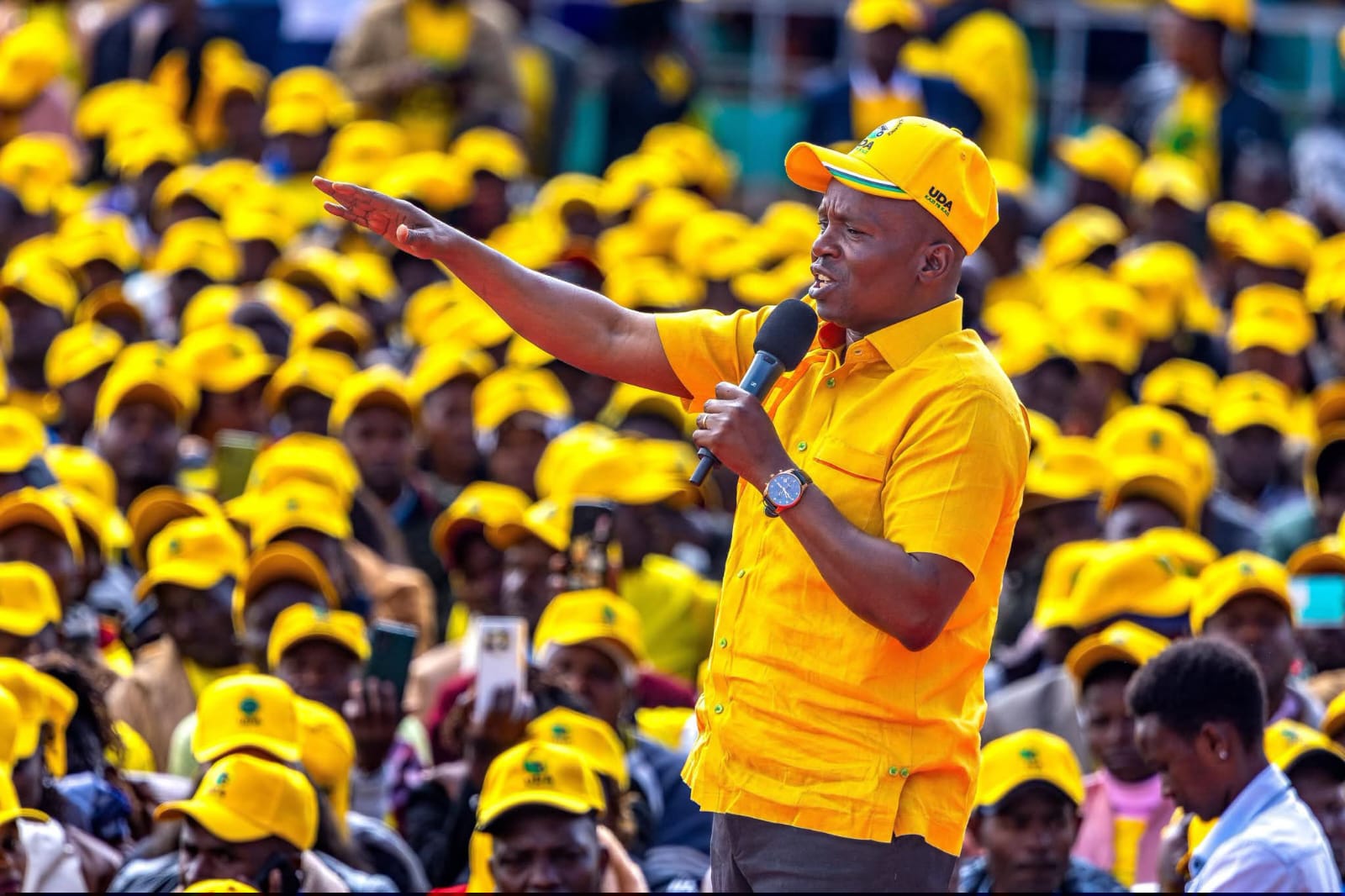
A powerful show of political unity around President William Ruto and Deputy President Kithure Kindiki unfolded in Meru on Friday as leaders from Mount Kenya rallied their supporters to defend the Kenya Kwanza administration and prepare for the 2027 General Election.
Speaking at Kinoru Stadium during a UDA polling-centre officials’ mobilisation event, the leaders presented the region as a crucial political constituency for the re-election of President Ruto while openly positioning Prof Kindiki for a future presidential bid.
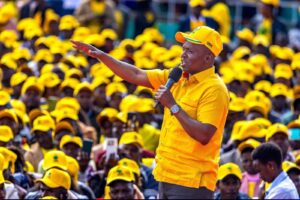
The gathering, attended by more than 20,000 UDA polling-centre officials from across Meru County, turned into a vigorous defence of the Government’s record and an appeal to voters to judge the administration by its development programmes rather than political slogans and personalities.
Prof Kindiki told the grassroots officials that they would be central to the Government’s campaign to explain its record to voters ahead of the 2027 elections.
He described the elected polling-centre officials as the “bosses” of UDA at the grassroots, saying they were responsible for promoting the party, communicating its agenda and defending the Government at the point where votes are cast.
“You are the party,” Prof Kindiki told the officials, emphasising that their role would extend beyond election-day mobilisation to explaining government policies and projects to citizens.
Meru has about 25,000 elected grassroots party officials, with 20 officials elected at each polling centre earlier this year. Nationally, UDA’s grassroots network is said to comprise more than two million officials.
Prof Kindiki praised the officials for investing their time and personal resources in building the party at the grassroots, arguing that their work would determine whether UDA retained its support in the region.
He also challenged rival political formations to demonstrate comparable structures, claiming UDA was the only party to have conducted democratic elections at polling-centre level.
The Deputy President said the grassroots officials would be expected to lead the campaign on issues affecting ordinary Kenyans, including roads, agriculture, education, healthcare, employment and the cost of living.
Prof Kindiki used the occasion to list what he described as some of the Government’s major achievements since taking office in 2022.
He said the administration had reduced the price of subsidised fertiliser from Sh7,500 in 2022 to Sh2,500, with a further Sh500 reduction announced this week.
He also cited reductions in the cost of certified maize seed and sexed semen, saying the measures were intended to increase agricultural productivity and improve farmers’ incomes.
According to Prof Kindiki, certified maize seed has fallen from Sh300 to Sh150 per kilogramme, while subsidised sexed semen has dropped from Sh8,000 to Sh1,400 per dose.
He said the Government was also pursuing further reductions in the price of maize flour, with a target of bringing a two-kilogramme packet to Sh100.
The Deputy President said the Government’s economic interventions had also strengthened the shilling, noting that the currency had moved from about Sh165 to the dollar to approximately Sh129.
He further claimed that Kenya had risen from Africa’s eighth-largest economy in 2022 to sixth position.
Prof Kindiki linked the Government’s economic performance to its political case for a second term, saying voters should assess the administration based on measurable results.
“President William Ruto and I are ready to face the people of Kenya eye to eye, face to face, and explain what this government has done in the last five years,” he said.
The Deputy President placed particular emphasis on projects in Meru, saying the county was benefiting from investments in healthcare, roads, agriculture, electricity and markets.
He disclosed that Sh1 billion had been allocated to upgrade Meru Level Five Hospital to Level Six status, comparable to Kenyatta National Hospital.
He said Phase One of the project was expected to be completed before December.
The Government, he added, had earmarked Sh44 billion for more than 500 kilometres of additional tarmac roads in Meru County.
He also announced a further Sh200 million allocation to Meru Dairy to expand milk production and processing.
Prof Kindiki said the Government had already supported improvements in milk prices, noting that farmers in the region were now receiving Sh52 per litre, up from Sh50.
He described Meru Dairy, which draws milk from Meru, Tharaka Nithi and Embu, as a major regional processor and said increased investment would strengthen the dairy value chain.
Other projects highlighted included the construction of modern markets, electricity connectivity and youth employment programmes.
Prof Kindiki said the Government was constructing 600 modern markets nationally, with more than 20 planned or under development in Meru.
He said an ongoing Sh2.3 billion electricity connectivity programme in Meru was expected to connect 27,000 households, as part of a national programme that had connected 1.4 million households.
On youth empowerment, he cited the NYOTA programme, which he said was supporting young people with financial assistance, alongside overseas employment opportunities and digital jobs.
He said 540,000 young Kenyans had secured employment opportunities abroad, while 3,000 young people had secured jobs through the Kazi Mtandaoni initiative.
The Affordable Housing Programme, he added, had created work for about one million young people.
Education featured prominently in Prof Kindiki’s defence of the Government.
He said the administration had constructed 23,000 classrooms and 1,600 laboratories and was on course to recruit 120,000 teachers.
Technical education, he said, had recorded a major increase in enrolment, from 297,000 students in 2022 to 718,000 currently.
He attributed the growth to reforms including modularised training, the Dual Training Policy and Recognition of Prior Learning, which allows people with practical skills but without formal certification to have their competencies assessed and recognised.
On healthcare, Prof Kindiki said 32.3 million Kenyans had registered under the Taifa Care health insurance programme, compared with eight million under the former NHIF system.
He also cited the deployment of 107,000 Community Health Promoters across the country as part of the Government’s strategy to strengthen primary healthcare.
Beyond the Government’s development record, the Meru meeting exposed growing political debate over the future of the presidency and the Deputy President’s position.
Igambang’ombe MP Patrick Ntwiga said Prof Kindiki had been closely involved in the formulation of the Kenya Kwanza manifesto and understood the projects the administration had promised to deliver.
He cited the Nithi Bridge, the proposed upgrading of Meru Level Five Hospital and the transformation of Meru Dairy as examples of projects he said were consistent with the Government’s manifesto.
Tigania West MP John Kanyuithia Mutunga called for Meru to deliver one million votes to the Ruto-Kindiki administration and urged supporters to remain loyal to the Government.
Buuri MP Mugambi Rindikiri similarly asked residents to act as ambassadors for the administration at the grassroots.
The strongest succession message came from leaders who openly presented Prof Kindiki as their preferred candidate for the presidency after the 2027 election.
Isiolo Governor Abdi Guyo said Mount Kenya should support Prof Kindiki, describing him as a leader with national reach.
Tharaka Nithi Governor Onesmus Muthomi Njuki invoked Kenya’s political history, noting that several former presidents had served as deputy presidents or held senior national leadership positions before ascending to State House.
He argued that Prof Kindiki’s elevation to the Deputy President’s office placed him in a strong position to seek the presidency in the future.
Meru Governor Isaac Mutuma said the region had supported leaders from other parts of the country for decades and now expected reciprocal political support for Prof Kindiki.
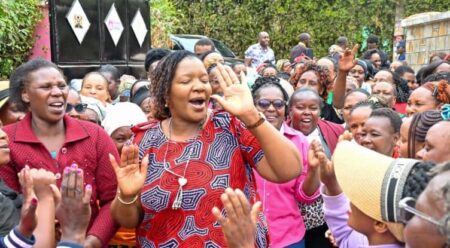
Governor Cicely Mbarire delivered one of the day’s most emotive interventions, appealing to political opponents to stop attacking Prof Kindiki personally.
She said the people of Meru, Tharaka Nithi and Embu had historically supported leaders from other regions and were now seeking an opportunity to rally behind one of their own.
“We are telling them that this time round, they should support our son, Professor Kithure Kindiki,” she said.
Ms Mbarire said political criticism was acceptable but personal insults directed at Prof Kindiki were offensive to the people of the region.
She described Prof Kindiki as a leader with the intellectual capacity and national networks required to seek the presidency.
Meru Senator and Deputy Speaker of the Senate Kathuri Murungi also dismissed rival political formations, urging residents to remain within UDA and support President Ruto’s re-election.
He said Meru had helped create the current Government through its votes and should therefore remain within the ruling party.
Governor Godana Doyo of Isiolo framed the emerging political alliance in broader regional terms, arguing that Mount Kenya East had an opportunity to produce a future president.
He urged Meru residents to remain united behind Prof Kindiki, saying neighbouring counties would also benefit from the region’s influence in national leadership.
The speeches demonstrated that the political contest in Mount Kenya is increasingly being framed not only around the 2027 presidential election but also around the question of who should succeed President Ruto.
For UDA, the Kinoru event provided an opportunity to strengthen its grassroots machinery ahead of a potentially competitive election.
For Prof Kindiki, it offered a platform to demonstrate his influence in his home region while defending the record of the administration he serves.
The Deputy President repeatedly urged the grassroots officials to take the Government’s achievements to voters and challenge opponents to present alternative policies rather than relying on political nicknames and slogans.
He said the coming campaign should focus on what candidates intended to do for Kenyans.
As the 2027 contest gathers momentum, the Meru meeting underscored the political calculation taking shape in Mount Kenya, defend the Ruto administration in the immediate contest while laying the groundwork for Prof Kindiki’s longer-term presidential ambitions.
The message from the leaders was unequivocal Meru intends to remain a key pillar of the UDA administration, while simultaneously seeking to turn the Deputy President’s national position into a springboard for the region’s own presidential ambitions.