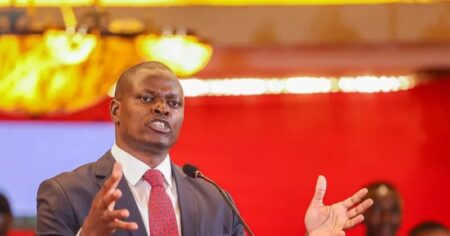









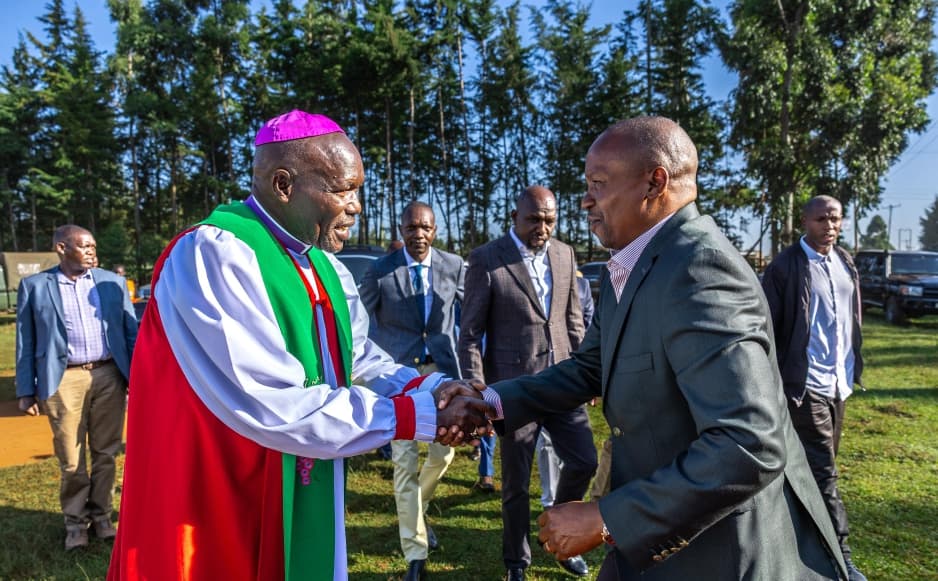
Deputy President Kithure Kindiki has warned opposition politicians against intimidating or blackmailing the Independent Electoral and Boundaries Commission (IEBC), saying the electoral agency must be allowed to discharge its constitutional mandate without fear, favour or political interference ahead of the 2027 General Election.
Prof Kindiki said the Kenya Kwanza administration does not want an IEBC that favours the Government, but one that is independent, impartial, transparent and fair to all political players.
Speaking on Sunday during an interdenominational church service and fundraiser for 22 churches at Kipsamoo School Grounds in Kapseret Constituency, Uasin Gishu County, the Deputy President challenged leaders seeking to unseat President William Ruto to abandon what he described as attacks on electoral institutions and instead convince voters through alternative policy proposals.
“IEBC does not vote. The citizens vote. Prepare your manifesto and sell it to Kenyans,” Prof Kindiki said.
He accused some opposition politicians of turning their attention to IEBC after allegedly sensing defeat in the 2027 elections.
The Deputy President said the Government had confidence in Kenya’s institutions and would not seek special treatment from the electoral agency.
“We don’t want IEBC to favour us. We don’t want it to favour the opposition. Let it do its work. Let it be fair, objective and impartial,” he said.
Prof Kindiki recalled the political tensions surrounding the 2022 election and argued that institutions must be protected from political pressure to prevent electoral disputes from degenerating into national instability.
He urged IEBC officials to remain firm, defend their constitutional mandate and resist intimidation, threats or attempts to influence their decisions.
The Deputy President’s intervention comes as political parties and potential presidential contenders begin positioning themselves for the 2027 contest, with electoral reforms, the credibility of institutions and preparations for the polls increasingly becoming central to political debate.
Prof Kindiki said those seeking the presidency should present Kenyans with clear programmes on health, education, agriculture, infrastructure, employment and the economy.
He challenged leaders who have previously served in senior Government positions to explain their own records before promising voters a different future.
“Those competing with President William Ruto should come with their agenda and vision for the Republic of Kenya and say how differently they will do what President William Ruto has done,” he said.
He cited President Ruto’s previous service as Deputy President and Cabinet Minister and challenged political competitors to demonstrate what they accomplished when they occupied influential Government positions.
The DP said the coming election should therefore be fought on competing development records rather than tribal mobilisation, slogans or political violence.
“Political competition is not war. Political competition is about agenda — who has a better agenda,” he said.
He said whoever presents the stronger programme should be given an opportunity to govern, while those who lose should accept the outcome and prepare for another political contest.
Prof Kindiki used the church gathering to mount a vigorous defence of the Ruto administration, listing agriculture, health, infrastructure, housing, sports and youth empowerment among areas where he said the Government had made significant progress since taking office in 2022.
He cited the reduction of the subsidised fertiliser price from Sh7,500 per 50kg bag to Sh2,500 and subsequently Sh2,000, saying the intervention was intended to lower production costs and improve food security.
The Government, he said, had also reduced the price of certified seed by half while implementing measures aimed at improving returns to farmers.
Coffee farmers, he said, were increasingly receiving between Sh120 and Sh150 per kilogramme as the Government sought to improve earnings from agricultural exports.
“We are reducing the price of fertiliser so that the Kenyan farmer can afford it, increase productivity and achieve food security,” he said.
He added that the Government was seeking to improve access to quality seed and farm inputs while increasing production of food crops and cash crops such as coffee and tea.
On healthcare, Prof Kindiki highlighted the recruitment and deployment of 107,000 Community Health Promoters across the country, saying the programme had strengthened healthcare delivery at the grassroots.
He said the Government was also providing equipment to the Community Health Promoters and had introduced emergency ambulance services as part of efforts to improve response to medical emergencies.
The DP defended the Social Health Authority, saying Kenyans can begin accessing services after registration rather than waiting for lengthy processing associated with the previous insurance system.
He also pointed to investment in hospital equipment through the National Equipment Support Programme, saying Level Three, Four and Five hospitals were being equipped to improve diagnosis and treatment.
He said the Government was also expanding support for cancer patients, citing a presidential directive to increase the package from Sh500,000 to Sh8 million per patient.
Prof Kindiki further cited the expansion of Taifa Care coverage, saying more than 32 million Kenyans had been enrolled.
The Deputy President linked the Government’s affordable housing, markets and student hostel programmes to employment creation, particularly among young people.
He said the projects had provided employment opportunities to hundreds of thousands of youths and challenged opponents of the housing levy and related programmes to explain what would happen to workers benefiting from the projects if the programmes were scrapped.
Prof Kindiki also defended the National Youth Opportunities Towards Advancement (NYOTA) programme, saying it was targeting young people without university qualifications but with business ideas and entrepreneurial potential.
He said the Government would implement a second round of support to reach more young entrepreneurs.
The DP argued that such interventions were necessary to reduce poverty and prevent unemployed youths from being exploited by politicians during political campaigns.
Prof Kindiki also placed sports infrastructure at the centre of the Government’s youth agenda.
He said the administration was constructing stadia across the country as part of a broader strategy to identify and nurture sporting talent.
He cited the Talanta Sports City project and other stadium developments, saying 33 sports stadia had been constructed or were under development in different parts of the country, alongside plans for additional 10,000-seater facilities.
The Government, he said, was seeking to create opportunities for young people whose talents may not necessarily lie in conventional academic fields.
On infrastructure, Prof Kindiki said more than 6,000 kilometres of roads had been returned to contractors and that every county had a road development programme.
He cited projects in northern Kenya, saying several sections of the long-promised road network linking parts of North Eastern and other regions were under construction.
He also listed expansion of the railway network, development of airports and other major infrastructure projects as evidence of the administration’s long-term development agenda.
The Deputy President further highlighted the proposed National Infrastructure Fund, saying the Government had accumulated Sh350 billion as seed capital and hoped to leverage public-private partnerships to attract additional investment.
He said the Government’s objective was to use the fund to unlock billions of shillings in infrastructure investment and transform the country’s economic landscape.
But the strongest warning from the Deputy President was reserved for politicians accused of using young people to fight their political battles.
Prof Kindiki said the Interior Ministry had been directed to deal firmly with individuals involved in political violence and warned leaders against mobilising youths to attack their opponents.
“We cannot sacrifice our country to criminals,” he said.
He called on Interior Cabinet Secretary Kipchumba Murkomen to maintain a tough security approach, citing the Government’s fight against banditry and terrorism.
“The way we have dealt with bandits and terrorism, we will deal with goons,” he said.
Prof Kindiki warned politicians who incite young people to violence that the Government would not allow Kenya to descend into political chaos.
He also urged leaders to maintain peace in Uasin Gishu and across the country, saying political competition should never become a reason for communities to turn against each other.
The Deputy President also appealed to political leaders and citizens to respect places of worship and avoid turning church services into platforms for political confrontation.
He said politicians had sufficient opportunities outside churches to debate policies, campaigns and political competition.
“When we are in church, we should respect the work of God and the work of the Church. We have a lot of time to discuss earthly things,” he said.
He praised leaders in Uasin Gishu for what he described as an example of peaceful political competition and urged them to explain Government achievements to residents without creating unnecessary divisions.
With the 2027 election approaching, Prof Kindiki framed the coming contest as a referendum on the Government’s development record.
He said President Ruto and his team were prepared to defend their record before voters and challenge their competitors to do the same.
“We are ready to face Kenyans eyeball to eyeball and explain to them what we have done in the last four years,” he said.
He argued that the ultimate decision belonged to voters, not politicians or electoral institutions.
“The citizens will decide,” he said.
Prof Kindiki maintained that the Government’s record on youth employment, agriculture, health, infrastructure, housing and sports would form the basis of its campaign for a second term.
He urged its opponents to come to the political arena with concrete alternatives rather than relying on tribal rhetoric, slogans or attempts to undermine institutions.
The Deputy President said Kenya needed political competition based on ideas and development rather than hostility.
“Bring your agenda. We are ready. President William Ruto is ready, the fireman is ready, and our entire team is ready to go to the field and face each other, face to face, everyone with their agenda,” he said.
The event was attended by Interior CS Kipchumba Murkomen, Principal Secretaries Belio Kipsang and Julius Bitok, Governors Jonathan Bii, Patrick Ole Ntutu and Stephen Sang, Senators Jackson Mandago and Kiprono Chemitei, MPs Oscar Sudi, William Kamket, Joseph Wainaina and Ruben Kiborek, COTU Secretary-General Francis Atwoli, MCAs and thousands of worshippers.