








Deputy President Kithure Kindiki has challenged opposition leaders to account for their record in government, saying Kenyans should scrutinise what political leaders delivered when they occupied public office instead of being swayed by campaign slogans.
Speaking in Embu County, Prof Kindiki mounted a spirited defence of the Kenya Kwanza administration’s development record, arguing that the Government had made measurable progress across the country since taking office in 2022.
He said the test for political leaders should be their contribution to improving household incomes, infrastructure, healthcare, agriculture and opportunities for ordinary citizens.
“The level of development we have reached is not where we found things in 2022, when we came into the office. There is work that has been done, and you can see it yourselves,” Prof Kindiki said.
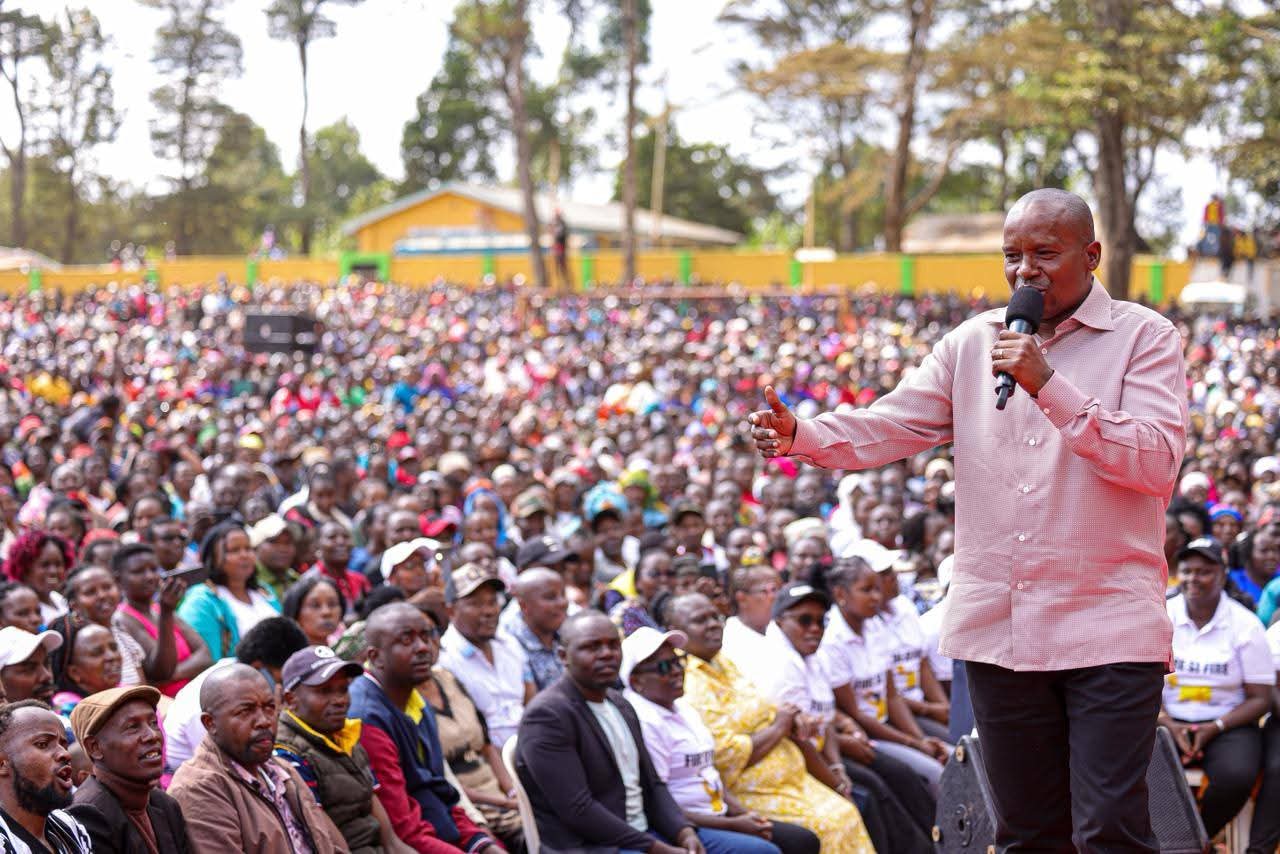
The Deputy President was addressing more than 30,000 grassroots leaders drawn from across Embu County in Manyatta Constituency during a stocktaking exercise on national Government programmes and projects.
The meeting brought together elected leaders and Government officials and provided an opportunity for the administration to outline its development agenda while receiving feedback from residents on the pace and impact of projects.
Prof Kindiki said he was ready to face Embu residents and Kenyans across the country to account for the Government’s record.
“I am willing to face the people of Embu County and all Kenyans countrywide face to face and explain to them what this Government has done to transform the country and empower all citizens economically,” he said.
He, in turn, challenged Government critics to produce their own scorecards.
“Let them tell us what they did when they held big positions in the past. I can tell you, they have nothing to show,” he said.
Agriculture emerged as a major plank of the Government’s case for Embu, a county whose economy is heavily dependent on farming.
Prof Kindiki said interventions targeting input costs, farm-gate prices and livestock production were intended to put more money in farmers’ pockets while raising productivity.
He cited the reduction in the price of fertiliser, which he said had fallen from as much as Sh7,000 a bag in 2022 to Sh2,000.
The Government, he said, had successively reduced the price from Sh7,000 to Sh3,500, then Sh2,500, before a further Sh500 reduction brought it to the current Sh2,000.
“We are reducing the price of fertilizer so that the Kenyan farmer can afford it, so that we can increase the productivity of our farms and achieve food security in our country,” he said.
Seed prices have also been reduced, with the cost cited as having fallen from Sh300 to Sh150.
The Government has additionally subsidised sexed semen, cutting the cost of artificial insemination from about Sh8,000 to Sh1,400 per dose over the past three years.
For Embu’s dairy farmers, the intervention is expected to improve the quality of herds and increase milk production.
Prof Kindiki said the gains were already being reflected in improved commodity prices.
Coffee farmers, he said, were receiving between Sh120 and Sh150 per kilogramme, while the price of milk had increased from Sh33 to Sh50 per litre.
“Today, farmers are getting between Sh120 and Sh150 per kilogramme of coffee as we move forward because we have improved the price of coffee. Milk was Sh33; now it is Sh50 for every litre. That is an increase in income and that is money in the pocket of the dairy farmer,” he said.
He said the Government would continue prioritising agriculture as a foundation for food security, rural incomes and economic transformation.
“Agriculture is not something to play with. To transform Kenya’s economy, we must improve agriculture so that we increase income in the pockets of farmers and the people of Kenya,” he said.
The Government is also betting heavily on infrastructure to unlock Embu’s agricultural and commercial potential.
Prof Kindiki said more than 6,000 kilometres of roads had been returned to contractors nationally, with Embu benefiting from a 415-kilometre road construction programme valued at about Sh20 billion.
The roads are expected to improve connectivity between farming areas, markets and urban centres while reducing the cost and time involved in transporting agricultural produce.
The county is also set to benefit from 12 modern fresh-produce markets.
Prof Kindiki said Embu was initially allocated seven markets but the number was increased after local leaders made a case for additional facilities.
“We had initially allocated seven markets to Embu County, but after leaders from Embu came to me and explained that the people of Embu are business people, I took them to the President. We were given more markets, and today we have 12 markets under development across Embu County,” he said.
Nationally, the Government is pursuing the construction of more than 600 modern markets, with the facilities intended to provide better trading spaces for small-scale traders and improve local commerce.
Prof Kindiki said the programme was also about restoring dignity to traders who operate in difficult conditions.
“I have the courage to say that this is the Government that has decided to restore dignity to the mama mboga, the small trader and the ordinary person who sells their goods in the sun and rain,” he said.
The Deputy President also highlighted investments in healthcare, pointing to the Social Health Authority and the National Equipment Support Programme as key pillars of the Government’s health agenda.
He said Level Three, Four and Five hospitals were being equipped with modern diagnostic and treatment equipment under the National Equipment Support Programme.
The Government is also re-kitting Community Health Promoters to strengthen preventive and primary healthcare at the grassroots.
In Embu, about 1,500 Community Health Promoters are expected to benefit from the re-kitting programme, giving them additional capacity to deliver essential services within communities.
“Disease does not discriminate. Anyone can become sick. A rich person can become sick, and so can a poor person. We want to ensure that no Kenyan is disadvantaged simply because they have become ill,” Prof Kindiki said.
The Government’s strategy, he said, was to shift greater emphasis towards prevention and early intervention while ensuring health facilities are equipped to handle patients requiring specialised care.
The administration is also seeking to push Embu beyond production of raw agricultural commodities towards value addition and manufacturing.
Coffee, milk and tea prices have improved compared with 2022, according to the Deputy President, while the near-completion of the County Aggregation and Industrial Park at Machanga is expected to provide a platform for processing and value addition.
The facility is expected to form part of the county’s industrialisation drive by creating opportunities for farmers and businesses to process agricultural products closer to their source.
For a county whose economy is anchored on farming, the industrial park could help tackle one of the sector’s persistent challenges—low returns from the sale of unprocessed produce.
The Government argues that value addition will create jobs, expand markets and allow farmers to capture a larger share of the value generated from their commodities.
Prof Kindiki’s visit to Embu comes as the administration increasingly takes its development message to the grassroots, seeking to demonstrate the impact of its programmes ahead of the 2027 General Election.
He urged residents to evaluate leaders based on tangible results, saying the Government was prepared to defend its record before voters.
For Embu, the immediate test will be whether lower farm-input costs, improved commodity prices, new roads, modern markets, better-equipped health facilities and industrial infrastructure translate into higher household incomes.
The Deputy President said the Government would continue implementing its programmes while listening to feedback from communities on the ground.
He maintained that the transformation agenda would only have meaning if it ultimately improved the economic fortunes and quality of life of ordinary Kenyans.