










Kenya has unveiled an ambitious national agricultural transformation agenda aimed at revolutionizing the sector through technology, private-sector investment, and climate-smart farming practices, in a move expected to significantly boost food security, create millions of jobs, and drive economic growth.
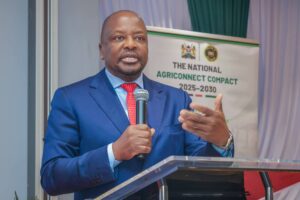
Speaking during the official launch of the Kenya AgriConnect Compact (2025–2030), Cabinet Secretary for Agriculture and Livestock Development, Mutahi Kagwe, described the initiative as a bold blueprint designed to reposition agriculture from traditional subsistence farming into a modern, technology-driven and commercially competitive industry.
“The AgriConnect Compact views agriculture not merely as a subsistence activity but as a technology-enabled, climate-resilient, investment-ready sector capable of driving inclusive economic transformation,” said Kagwe.
The five-year strategy seeks to accelerate agricultural productivity while strengthening value chains, increasing market access, and enhancing resilience against climate-related challenges.

A key pillar of the AgriConnect Compact is the integration of digital technologies across the agricultural value chain. The government plans to roll out digital extension services to farmers, establish agritech platforms that enhance product traceability, and deploy advanced processing technologies to reduce post-harvest losses, which continue to cost the country billions of shillings annually.
Officials believe the adoption of modern technologies will improve efficiency, increase productivity, and connect farmers directly to markets, thereby improving incomes and competitiveness.
To support implementation of the compact, the government has committed approximately USD 3.8 billion (about KSh 490 billion) in catalytic public financing. The funding is intended to attract an additional USD 7.6 billion (about KSh 980 billion) in private-sector investment, creating a combined investment portfolio of nearly USD 11.4 billion (about KSh 1.47 trillion) over the next five years.
According to Kagwe, the financing model has been carefully structured to lower investment risks and create an enabling environment for private capital participation.
“The AgriConnect Compact is a deliberate, strategic and urgent framework that aligns public investment with private-sector ambition. Public financing will support foundational systems and public goods, reducing risk and attracting large-scale private investment,” he explained.
The framework incorporates public-private partnerships, blended financing mechanisms, and credit guarantees aimed at making agricultural lending more attractive to investors. Priority value chains include dairy production, edible oils, horticulture, and other high-growth agricultural enterprises.
Beyond increasing production, the initiative seeks to transform agricultural markets through infrastructure development, digital trading platforms, and structured marketing systems that will improve price transparency and reduce exploitation of farmers by middlemen.
The reforms are expected to cut Kenya’s reliance on imported food staples such as maize and rice by 50 percent while increasing exports of high-value agricultural products by 60 percent.
Government officials noted that strengthening local production and improving market efficiency will contribute significantly to national food security while enhancing Kenya’s competitiveness in international markets.
One of the most significant objectives of the compact is employment generation. The strategy aims to create and upgrade approximately 2.482 million jobs by 2030, particularly targeting young people entering the labour market.
The new opportunities are expected to emerge across agro-processing industries, logistics, digital agricultural supply chains, agribusiness management, and other agriculture-related enterprises.
Kagwe emphasized that the initiative is designed to create meaningful employment opportunities while improving livelihoods across the country.
“The jobs that will be created are real jobs with dignity. The food security we achieve will ensure that no Kenyan goes to bed hungry,” he said.
The launch attracted high-level representation from both national and county governments, underscoring the broad political backing behind the initiative.
Among those present were Mutahi Kahiga, Governor of Nyeri County; Nathif Jama Adam, Governor of Garissa County; Joseph Ole Lenku, Governor of Kajiado County; and Deputy Governor Mathew Ochieng, alongside representatives from development agencies, financial institutions, and private-sector organizations.
Key partners supporting the initiative include the World Bank Group, International Fund for Agricultural Development, African Development Bank, Gates Foundation, Alliance for a Green Revolution in Africa, the U.S. Embassy Nairobi, Embassy of the Netherlands in Kenya, German Embassy Nairobi, GIZ, U.S. Chamber of Commerce, British Chamber of Commerce Kenya, Kenya Private Sector Alliance, the Kenya Association of Manufacturers, and the Agriculture Sector Network.
With the technical framework completed and political support secured, the government is now calling on investors and businesses to seize emerging opportunities within the agricultural sector.
Kagwe expressed confidence that the country possesses the necessary strategy, financing framework, and leadership commitment required to transform agriculture into a key pillar of economic growth.
“We have the strategy. We have the investment framework. We have the political will. What we need now is private-sector action,” he said.
The AgriConnect Compact marks one of Kenya’s most comprehensive agricultural reform programmes in recent years and signals a renewed national push towards achieving food self-sufficiency, job creation, and sustainable economic prosperity through a modernized agricultural sector.