










Technical and vocational education and training (TVET) institutions in the Nairobi and Kajiado region have turned to sport to nurture talent, strengthen interaction among trainees and reinforce the link between education, skills and employability.
The Kenya Association of Technical Training Institutions (KATTI) Nairobi Region Season Three ball games opened at Kiambu National Polytechnic (KINAP), bringing together students from 23 public and private technical training institutions for several days of competition.


The games, which run until Saturday, will feature football, volleyball and basketball for both men and women, with participating institutions using the regional competition to prepare their teams for the national KATTI ball games scheduled for November.
KINAP, formerly known as Kiambu Institute of Science and Technology (KIST), is hosting the competition, which has attracted trainees keen to demonstrate their sporting abilities while interacting with their counterparts from other institutions.
Nairobi and Kajiado region sports and recreation chairman Simon Nyaga said the competition was more than a contest for trophies, describing it as an important platform for trainees to network, exchange experiences and develop their talents.
“We are holding these regional ball games in preparation for the national ball games which will be held in November,” Mr Nyaga said.
He said the 23 institutions represented at the games include both public and private TVET institutions, creating an opportunity for trainees from different backgrounds to meet and share experiences.
According to Mr Nyaga, sport has become an important component of the TVET experience because it allows students to discover and sharpen talents that may otherwise remain hidden.
The games also provide a platform through which sports bodies and talent scouts can identify promising players for opportunities beyond the institutions.
“Some of these events are also where trainees are identified by other bodies,” he said, noting that sports organisations often attend competitions in search of talented players.
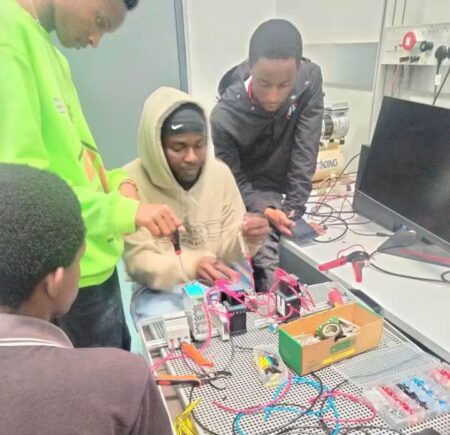
The KATTI games come at a time when TVET institutions are increasingly being positioned as key institutions for equipping young people with practical skills needed in a changing labour market.
Mr Nyaga said the sector was working closely with industry to ensure that training programmes respond to the needs of employers and emerging economic opportunities.
“We are training with the industry for the industry,” he said.

He said closer collaboration between training institutions and industry was helping to reduce the gap between skills taught in colleges and those demanded in the workplace.
The approach, he added, was expected to improve the employability of graduates and contribute to efforts to address youth unemployment.
“We have aligned ourselves to what we have in the market, both locally and globally,” he said.
The emphasis on practical skills was also evident among the students participating in the games, many of whom see sport as an important complement to their technical training.
For Lang’ata Technical and Vocational College student Victor Ouma, the KATTI games have provided an opportunity to learn beyond the classroom while developing his sporting talent.
Mr Ouma, who is pursuing Level Six automotive engineering, said this was his second year participating in the competition since joining Lang’ata TVC in September 2024.
He said the games enabled students from different institutions to socialise, compare experiences and understand how their counterparts were approaching both training and extracurricular activities.
“It gives us the experience about, apart from pursuing the course, we get the experience outside the institution,” he said.
Mr Ouma was taking part in volleyball while his institution also fielded a football team.

He said the competition had helped him appreciate the importance of balancing technical education with other talents, including sport.
Beyond employment, the students said their TVET training was giving them the confidence to consider entrepreneurship and job creation.
Mr Ouma said his automotive training had exposed him to emerging technologies, including electric vehicles, and could eventually enable him to establish his own workshop.
He said his ambition was not merely to seek employment after graduation but to use his skills to create employment for other young people.
“I can start my own workshop and employ others,” he said.
His experience reflects the growing emphasis on TVET as a pathway not only to formal employment but also to self employment and enterprise development.
Mr Ouma encouraged young people who have not enrolled in training programmes to consider TVET institutions as accessible avenues for acquiring practical skills.
He said the competency based education and training approach was creating opportunities for people with different educational backgrounds to acquire and demonstrate skills.
The student said people could pursue training, acquire practical competencies and have their skills assessed and certified, giving them an opportunity to advance in their chosen occupations.
For the students, however, the immediate priority remained competition.
At KINAP, teams arrived with determination to win while maintaining the spirit of friendship and sportsmanship that has become central to the annual games.
Jacinta Kiptoo of Maasai National Polytechnic in Kajiado said her team was determined to emerge victorious.
“I play netball and our expectation is to win and become the best,” she said.
At Kabete National Polytechnic, basketball captain Mark Oluoch was equally confident ahead of his team’s matches.
Kabete was placed in Pool B alongside Nairobi National and Nairobi Technical, with the teams battling for progression in the competition.
Mr Oluoch, who is also pursuing Level Six automotive engineering, said the tournament would be competitive because many of the players already had considerable experience from other leagues and competitions.
“We expect a win. The game won’t be easy, but we have to win,” he said.
He said the competition also offered an opportunity for players to build relationships, noting that many participants already knew one another from competitions outside TVET institutions, including Nairobi based leagues.
For Mr Oluoch, success in the modern labour market requires more than obtaining academic papers.
He urged students to combine qualifications with practical experience and initiative.
“You have to push yourself because nothing comes on a silver platter,” he said.
He encouraged trainees to apply the skills they acquire in college outside the classroom rather than relying solely on certificates.
“Papers plus skills, obviously, that will get you a job,” he said.
Mr Nyaga said the changing face of TVET meant that technical institutions should no longer be viewed simply as alternatives for students who fail to secure places in universities or other institutions of higher learning.
Instead, he described TVET as an avenue for anyone seeking practical and life skills.
“What we are now having in technical institutions are skills for living,” he said.
He encouraged young people to consider technical training regardless of their academic or career background, arguing that practical skills could complement other areas of specialisation.
The KATTI games therefore offer a picture of TVET beyond workshops and classrooms bringing together technical education, sporting talent, teamwork, networking, discipline and entrepreneurship.
As the regional competition progresses towards Saturday’s finale and the teams prepare for the national games in November, institutions are hoping that the platform will produce not only winners on the field but also trainees equipped with the confidence, skills and networks needed to succeed beyond college.
For the participants, the message is clear that winning a game matters, but developing a skill, discovering a talent and learning how to turn that ability into an opportunity may matter even more.