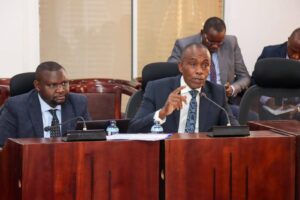




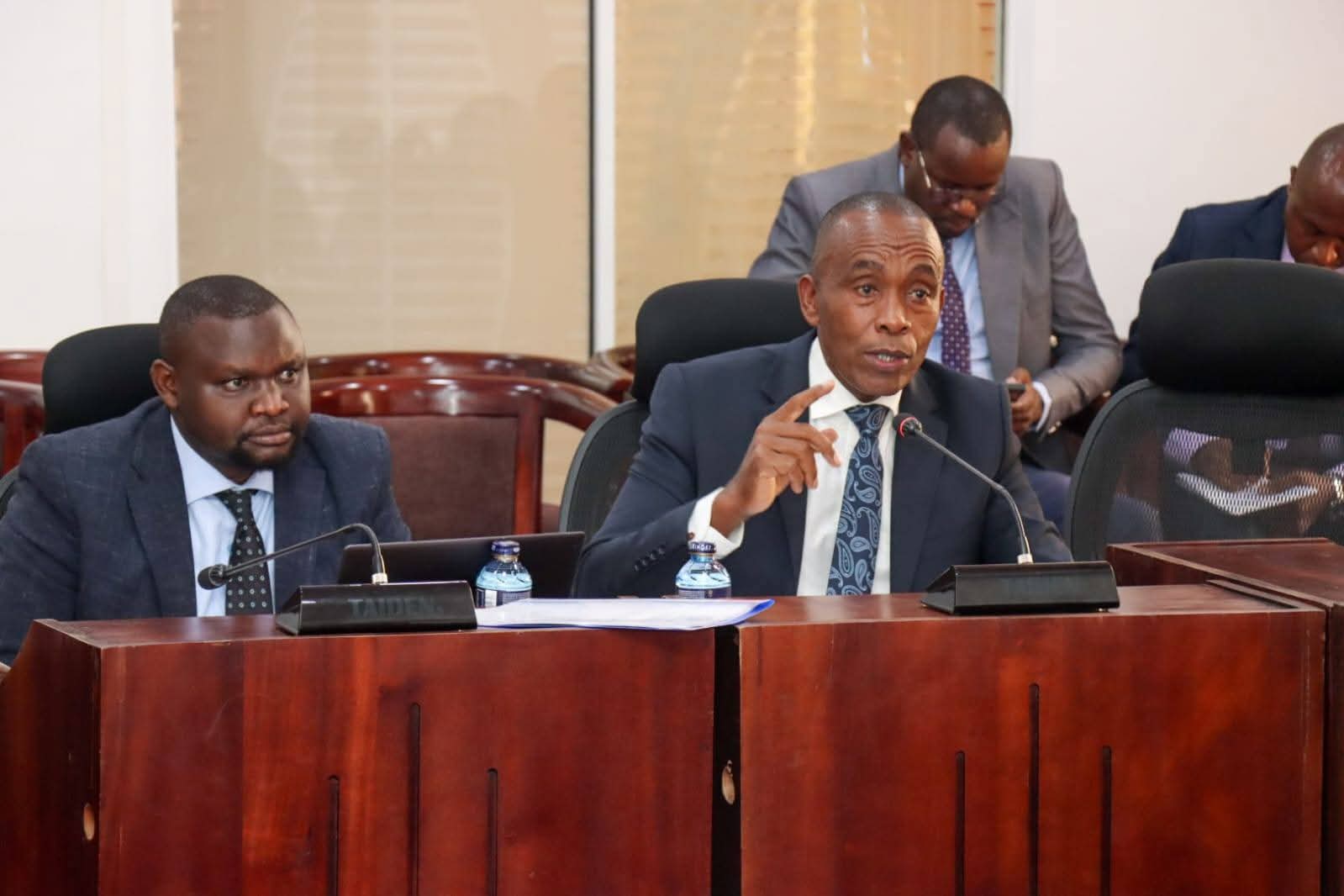
The Chairperson of the Council of Governors (CoG) Committee on Transport, Infrastructure and Energy, and the Kiambu county Governor Dr. Kimani Wamatangi, on Tuesday appeared before the Senate Committee on Roads and Transportation to present oral submissions on the proposed Kenya Roads (Amendment) (No. 3) Bill, 2025.
During the session, the Council made a strong case for increased allocation of the Roads Maintenance Levy Fund (RMLF) to County Governments, arguing that the proposed distribution under the Bill does not reflect the realities of road management at the devolved level.
In its submissions, the Council emphasized that the original intent of the Roads Maintenance Levy Fund was to allocate more than 50 percent of the Fund to the then Local Authorities — a mandate that now rests with County Governments following devolution.
Dr. Wamatangi told the Committee that counties currently manage approximately 182,092 kilometres of roads, representing 76 percent of Kenya’s national road network.
“County Governments are responsible for the largest share of the road network in this country. It is therefore only fair and constitutionally sound that the allocation of the Roads Maintenance Levy Fund reflects this reality,” Dr. Wamatangi said.
He argued that the proposal in the Bill to allocate counties five percent of the non-securitized portion of the Fund — translating to an effective 2.5 percent — was “impractical and inconsistent with the principles of equitable resource sharing.”
“This proposal does not align with the spirit of devolution or the constitutional requirement for equity. Counties cannot effectively maintain 76 percent of the road network with a mere 2.5 percent allocation,” he added.
The Council urged the Senate to amend the Bill to provide for a minimum allocation of not less than 42 percent of the Fund to County Governments, saying this would be commensurate with the road network under their management.
“We are not asking for privilege; we are asking for fairness. A minimum of 42 percent would be a reasonable and justifiable allocation based on the functions and infrastructure under county jurisdiction,” Dr. Wamatangi stated.
He noted that inadequate funding at the county level continues to hamper road maintenance, affecting connectivity, trade, and access to essential services, particularly in rural and peri-urban areas.
The Council also called for policy coherence, referencing the recommendations of the Presidential Taskforce on Parastatal Reforms chaired by Mohamed Abdikadir.
The Taskforce had proposed the dissolution of the Kenya Rural Roads Authority (KeRRA) and the Kenya Urban Roads Authority (KURA), on the basis that rural and urban roads are devolved functions under the Fourth Schedule of the Constitution.
“These recommendations were aimed at eliminating duplication of roles and enhancing efficiency in road management. The continued central control of resources for functions that are constitutionally devolved undermines that objective,” Dr. Wamatangi told the Committee.
The Council further noted that the proposed reforms were approved by Cabinet on January 21, 2025, reinforcing the need for legislative alignment with the broader policy direction.
In concluding its presentation, the Council expressed appreciation to the Senate for what it described as its consistent defense of devolution.
“We commend the Senate for steadfastly upholding its constitutional mandate under Article 96 to represent and protect the interests of County Governments,” Dr. Wamatangi said. “We trust that this House will ensure that the final legislation reflects the principles of equity, subsidiarity, and effective service delivery.”
The Senate Committee is expected to retreat to consider submissions from stakeholders before tabling its report and recommendations on the Kenya Roads (Amendment) (No. 3) Bill, 2025.
The outcome of the deliberations is likely to have far-reaching implications on the financing of road maintenance and the broader intergovernmental fiscal framework.