



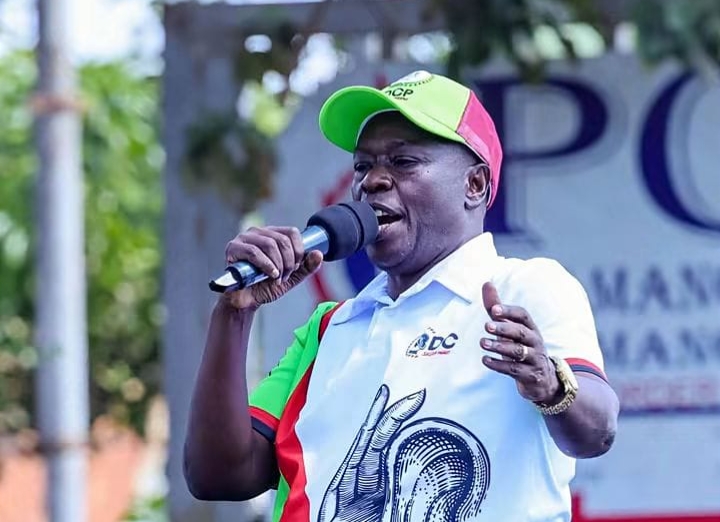
Democracy for the Citizens Party (DCP) leader Rigathi Gachagua has launched a fresh attack on President William Ruto, accusing him of undermining the dignity of the presidency through inflammatory language, exploiting regional divisions for political gain and creating uncertainty over preparations for the 2027 General Election.
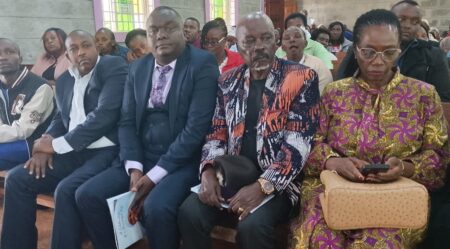
Speaking during a church service at African Inland Church (AIC) Bathi in Lari Constituency, Kiambu County, where he also officially opened the church, the former Deputy President challenged religious leaders to confront the Head of State over what he described as increasingly unbecoming conduct.
Gachagua singled out Catholic bishops, who have recently called on political leaders to abandon insults and vulgar exchanges, saying their concerns were justified but that they should direct their intervention at the President.
He argued that the President, by virtue of his office, carries a greater responsibility to maintain decorum and set an example for other leaders and the younger generation.
“The Catholic bishops are right to speak out. But let them help us by asking the President to stop using insulting language. He is the President of the Republic of Kenya and should protect the dignity of that office,” Gachagua said.
He urged church leaders, particularly bishops from AIC, Anglican Church of Kenya and Presbyterian Church of East Africa, to arrange a meeting with Mr Ruto and counsel him against language that could erode public confidence in the presidency.
Gachagua maintained that opposition leaders would continue responding to the President whenever he attacked them personally, arguing that political competition should not be confused with the standards expected of the office of the Head of State.
He challenged the President to abandon personal attacks and return political debate to issues of policy, governance and national development.
“If he stops the insults, we will return to discussing policies. But if he chooses to engage in insults, we will meet him there,” he said.
The DCP leader accused Mr Ruto of spending excessive time on political campaigns at the expense of government responsibilities, alleging that his public engagements were increasingly characterised by attacks against political opponents.
He further claimed that the President’s language was sending the wrong message to children and undermining the respect traditionally associated with the presidency.
The remarks add to the escalating political confrontation between the two former allies, whose fallout has increasingly shaped opposition politics and the contest for influence in the Mt Kenya region ahead of the 2027 elections.
In a separate political address, Gachagua accused President Ruto of using the slogan ‘one person, one vote, one shilling’ to create divisions between Mt Kenya and other communities.
He argued that the narrative was being used to portray the Mt Kenya region as having enjoyed disproportionate development under previous administrations, while other parts of the country were allegedly neglected.
According to Gachagua, the President was presenting himself to other communities as a leader capable of redistributing development resources by shifting investments away from regions that had historically benefited.
He warned Mt Kenya residents against what he termed a political scheme intended to turn other communities against them by portraying their region as an obstacle to equitable development.
Gachagua drew parallels with the divisive political environment surrounding the 2007 General Election, warning that regional grievances could be exploited to generate hostility between communities.
He, however, expressed confidence that Kenyans from different ethnic backgrounds would reject attempts to turn the Mt Kenya region into a political enemy.
He cited the Kikuyu community’s historical commercial and social relations with other parts of the country, arguing that political disagreements should not be allowed to undermine national cohesion.
“The people of Mt Kenya are not enemies of the Luos, Luhyas, Somalis or any other community. We are Kenyans who live and do business with everyone,” he said.
He claimed that communities across the country had increasingly recognised the importance of maintaining peaceful relations with Mt Kenya residents, despite their political differences with the current administration.
The former Deputy President also revisited the political decision that led to his falling out with Mr Ruto, using a leopard and sheep analogy to describe what he said was his mistaken assessment of the President before the 2022 General Election.
He recalled that former President Uhuru Kenyatta had warned him against trusting Mr Ruto, but that he had dismissed the concerns at the time.
Gachagua said he had initially believed Mr Ruto was a trustworthy political partner, only to conclude later that his former ally had different intentions.
The analogy was part of a broader effort to portray his political fallout with the President as a consequence of betrayal and broken political commitments.
Beyond the political attacks, Gachagua raised concerns over the expiry of the Independent Electoral and Boundaries Commission’s (IEBC) contract with Smartmatic, the technology provider associated with Kenya’s biometric voter registration and election management systems.
He warned that the expiry of the contract on November 24 could disrupt voter registration and potentially leave the electoral commission without a clear technological framework as preparations for the 2027 elections gather momentum.
Gachagua questioned the commission’s readiness to transition to another technology provider, arguing that a fresh procurement process could take approximately six months.
He also referred to a separate proposed technology procurement that he said was facing legal challenges, warning that unresolved disputes could complicate efforts to secure an alternative system in time.
The DCP leader called for immediate consultations between IEBC and political stakeholders to establish how continuity in voter registration and other electoral processes would be guaranteed.
He insisted that the commission should not make decisions concerning critical electoral infrastructure without consulting political parties and other stakeholders.
“We cannot allow a vacuum. We must meet the stakeholders immediately and discuss how the Smartmatic contract can be renewed so that voter registration continues,” he said.
He announced that DCP would seek a meeting with IEBC to discuss the matter, warning that the party would mobilise Kenyans if the commission declined to engage it.
The intervention places the electoral technology question at the centre of emerging political tensions, with parties expected to closely scrutinise the commission’s procurement decisions, voter registration arrangements and preparations for the next General Election.
Gachagua’s demands come at a time when the country is expected to intensify preparations for the 2027 polls, with electoral technology, voter registration and the independence of IEBC likely to feature prominently in political negotiations.
The former Deputy President’s three pronged attack on the President, however, also reflects the increasingly confrontational political environment as opposition formations seek to consolidate support and challenge the Kenya Kwanza administration ahead of the next electoral contest.