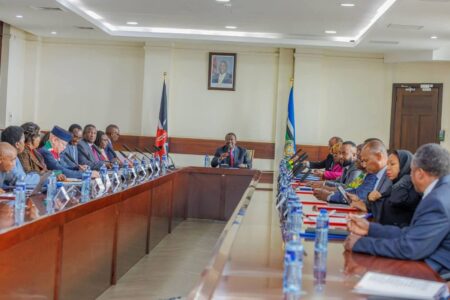







The Government has reaffirmed its commitment to restoring confidence in Kenya’s co-operative movement through far-reaching SACCO sector reforms, recovery of lost funds and tougher accountability measures targeting officials implicated in financial mismanagement.
This emerged when the Cabinet Secretary for Co-operatives and MSMEs Development, Wycliffe Oparanya, accompanied by Principal Secretary Patrick Kilemi, appeared before the Senate Standing Committee on Trade, Industrialization and Tourism chaired by Issa Boy Juma.
The meeting focused on ongoing SACCO sector reforms, the status of Metropolitan National SACCO, and the recovery and stabilization programme at KUSCCO.
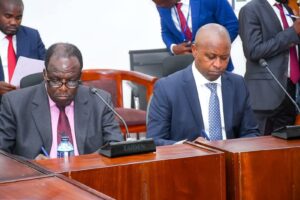
appearing before the Senate Standing Committee on Trade, Industrialization and Tourism
Addressing the Committee, Oparanya said recovery efforts at Metropolitan National SACCO were ongoing through administrative, judicial and investigative processes aimed at safeguarding members’ savings and ensuring those responsible are held accountable.
He told senators that investigations by the Directorate of Criminal Investigations were continuing, while surcharges had already been issued against affected parties. Cases before the Co-operative Tribunal are also progressing in accordance with the law.
The Cabinet Secretary noted that the Government was determined to recover funds where possible and protect the SACCO movement from future financial collapses.
On the status of KUSCCO, Oparanya briefed senators on the progress made in the recovery and stabilization programme following a forensic audit and reconstruction of accounts that exposed financial irregularities.
He acknowledged that the recovery process remained complex but said notable milestones had already been achieved through governance reforms, verification of claims, debt restructuring, cost rationalization, asset recovery and legal action against those implicated.
The CS further revealed that partial refunds had already been made to affected SACCOs and members as part of efforts to restore stability and confidence within the sector.
Oparanya also outlined a raft of reforms being undertaken by the Ministry to strengthen oversight and governance in SACCOs across the country.
The reforms are anchored in Sessional Paper No. 4 of 2020 on the National Co-operative Policy and the Co-operatives Bill, 2024, which seek to modernize and streamline operations within the co-operative sector.
Among the proposed measures are enhanced powers for the Sacco Societies Regulatory Authority, improved member protection mechanisms, establishment of a SACCO Deposit Guarantee Fund, creation of a Central Liquidity Facility, a Shared Services Platform, a SACCO Stabilization Fund and the rollout of a digital co-operative registry.
“These reforms are intended to strengthen governance, improve supervision and shield members from financial losses arising from mismanagement and fraud,” Oparanya told the Committee.
Kiambu Senator Karungo wa Thang’wa, who sits on the committee, said Parliament would not allow a few individuals to exploit loopholes in SACCOs and steal savings belonging to ordinary Kenyans.
“As much as SACCOs are private member-owned institutions, we cannot allow a few individuals to swindle or steal money belonging to ordinary Kenyans including farmers, teachers, police officers and workers who have entrusted them with their savings,” said Thang’wa.
He emphasized the need for stricter laws to enhance oversight, accountability and protection of members’ funds.
At the same time, Senator Jonathan Mandago said the Senate remained committed to supporting reforms aimed at strengthening the co-operative sector and promoting sustainable economic growth.
Mandago said the Committee spent the better part of the day engaging the Ministry on the state of SACCO reforms and deliberating on pending statements before the committee touching on challenges facing the sector.
He noted that the Senate would continue pushing for policies and legislation that promote accountability, inclusivity and prudent management of co-operative societies.
The meeting comes at a time when the SACCO sector is under heightened scrutiny following financial challenges affecting some co-operative societies, raising concerns among millions of members who rely on SACCOs for savings, credit facilities and investment opportunities.
The Government has maintained that ongoing reforms are intended to restore public confidence, strengthen institutional safeguards and ensure the long-term sustainability of the country’s co-operative movement.