






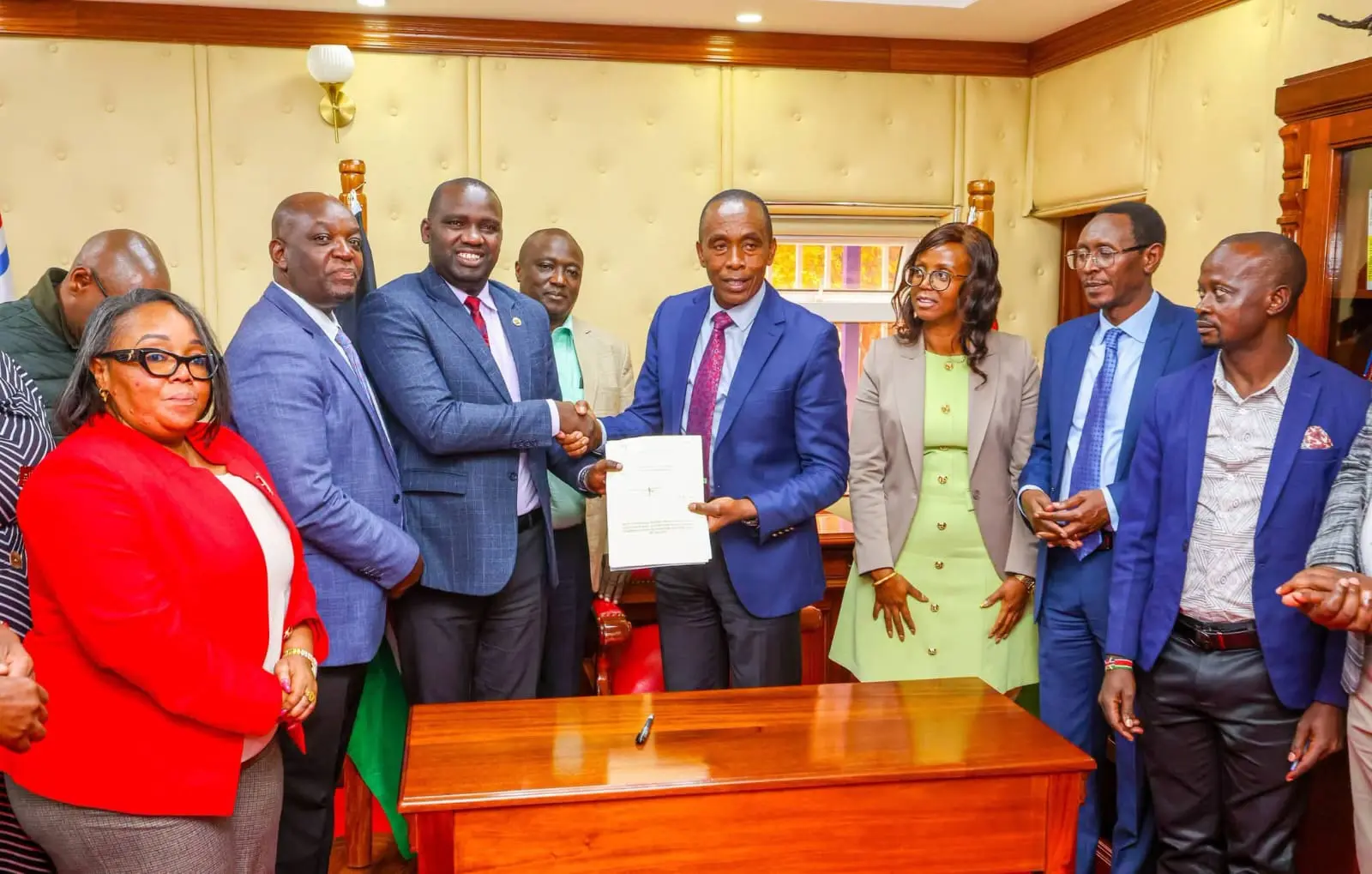
Kiambu County has taken a major step towards implementing its development agenda after Governor Kimani Wamatangi assented to the 2026/2027 County Appropriation Bill, paving the way for the implementation of a budget worth Sh25.1 billion aimed at accelerating infrastructure development, improving healthcare services, expanding education programmes and stimulating economic growth.
The Governor signed the Appropriation Bill following its approval by the Kiambu County Assembly, saying the budget reflects the county government’s commitment to transforming livelihoods through strategic investments in priority sectors.
Speaking after signing the Bill, Wamatangi said the budget, which targets Sh8.9 billion in Own Source Revenue, places significant emphasis on roads infrastructure, healthcare, education, agriculture, trade, water connectivity and youth empowerment programmes.
He said roads remain one of the county’s biggest priorities, with Sh4.5 billion allocated towards the construction, rehabilitation and maintenance of road infrastructure to improve accessibility and unlock economic opportunities.
“The budget focuses on roads infrastructure, equipping and operationalisation of more new hospitals, education, agriculture support, trade, water connectivity and youth-related programmes,” the Governor said.
The budget was approved by the Kiambu County Assembly on June 23, 2026, during a sitting chaired by Speaker Charles Thiong’o, after a motion was moved by Budget and Appropriations Committee Chairperson Josephine Muongi, MCA for Limuru Central Ward, and seconded by Julius Kahura, MCA for Kiganjo Ward.
In addition to passing the budget estimates, Members of the County Assembly also approved the Appropriations Bill, giving legal effect to the expenditure plans, as well as an additional Sh8 million Emergency Fund report.
The approved budget comprises projected own-source revenue of approximately Sh8.59 billion, with recurrent expenditure standing at Sh16.6 billion, bringing the total budget to Sh25.17 billion.
While presenting the Budget and Appropriations Committee report, Muongi said the estimates had been tabled before the Assembly on May 22, 2026, in accordance with the Public Finance Management Act and the Assembly Standing Orders before being subjected to detailed scrutiny by the committee and sectoral committees.
She noted that the committee held extensive consultations with the County Treasury, received submissions from various departments and conducted public participation forums across all 12 sub-counties, allowing residents to influence the final budget priorities.
“The committee thoroughly examined the estimates and incorporated views collected from wananchi during public participation. Subject to the approval of this Assembly, these recommendations shall form the basis for the enactment of the Appropriation Act for the Financial Year 2026/2027,” she said.
The budget gives priority to transport infrastructure, healthcare, education, agriculture, trade, water services and market development as the county seeks to improve service delivery while stimulating local economic growth.
Majority Leader Godfrey Waiyaki, MCA for Kalimoni Ward, welcomed the budget, saying it demonstrates the county’s commitment to settling pending bills while increasing investments in access roads.
He revealed that the Department of Finance and Economic Planning had committed Sh1 billion towards payment of pending bills during the 2026/2027 financial year.
“We have also allocated a substantial amount of money for access roads across the county, which will improve connectivity and support economic development,” Waiyaki said.
Karuri Ward MCA Peter Njoroge praised the increased roads allocation, saying it would enable construction and improvement of more access roads in every ward.
However, he challenged the County Executive to speed up project implementation, arguing that delayed execution had previously denied residents the full benefits of approved budgets.
“I congratulate the Budget Committee for allocating more resources to roads. This will help us construct more kilometres of access roads in each ward, but I am calling upon the Executive to implement this budget without prolonged delays,” he said.
Murera Ward MCA Moses Ngatha welcomed the inclusion of market construction projects and the planned upgrading of Mugutha Hospital to Level Three status, describing the projects as transformative for residents.
“We have been considered for market construction in my ward for the first time, and the upgrading of Mugutha Hospital will have a great impact on my people,” he said.
Nevertheless, Ngatha expressed concern over the county’s ambitious own-source revenue targets, warning that excessive licensing fees could place an additional burden on small businesses.
He urged the county government to review the revenue measures during supplementary budgets while ensuring procurement processes for development projects are expedited.
Other Members of the County Assembly, including Minority Leader Joe Kigara of Ng’enda Ward and John Muthondu of Kihara Ward, raised concerns over delays in the implementation of ward development projects, pending bills and bursary disbursement.
Riabai Ward MCA Hezron Mwangi attributed the slow implementation of development projects to procurement and financial bottlenecks within the County Executive despite what he described as sound budget planning.
“The Finance and Economic Planning Department has been doing a great job, but procurement and finance challenges are stalling projects at the implementation stage,” he said.
Kiambu Township Ward MCA Francis Koina called for the speedy settlement of pending bills, noting that delayed payments were hurting suppliers, contractors and investors doing business with the county.
“We need to settle pending bills across all departments because we are affecting people who invest in this county, and we must protect them,” Koina said.
With the Governor’s assent, the Appropriation Act now takes effect, allowing departments to begin implementing projects outlined in the 2026/2027 budget.
County leaders expressed optimism that the substantial investments in roads, healthcare, education, agriculture, water, markets and youth programmes will improve public service delivery, stimulate local economic growth and enhance the quality of life for residents across Kiambu County.