










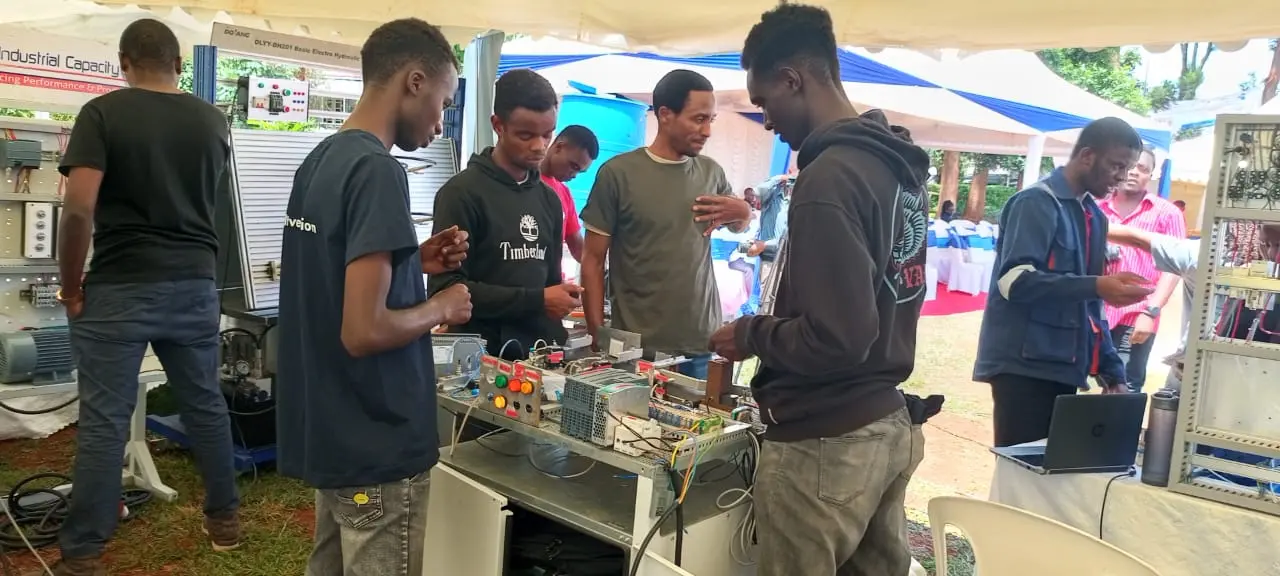
All students enrolled in the dual training program under the Technical and Vocational Education and Training (TVET) system will secure employment by the time they complete their studies, the State Department for TVET has assured.
Speaking during the Dual TVET Week held at Kiambu National Polytechnic (KINAP) in Kiambu Town, Joseph Njau, Secretary at the State Department for TVET, said the employability rate among trainees under the dual system is now approaching 100 percent.
“Initially, industries accused us of producing half-baked graduates.
But now, we are training alongside the industry itself. By the time the trainees leave the classroom, they are fully prepared for the job market,” Njau stated.
The Dual TVET Week, themed “Strengthening Training Partnerships for Youth Employability,” highlighted how collaboration between learning institutions and industries has transformed workforce development. Njau noted that the approach has significantly reduced the cost of training for industries, as graduates are ready to work immediately.
“These trainees are well-crafted professionals who start working from day one.
This has reduced the expenses industries previously incurred in retraining new employees,” he added.


Njau revealed that the department is partnering with various development agencies—including GIZ, the Government of Finland, and AHK—to expand the adoption of dual training programs across both public and private TVET institutions.
He further commended the creativity and innovation of TVET trainees, noting that many are developing market-ready products using recycled materials.
“We have witnessed remarkable innovations from our trainees, especially in turning waste into valuable products. This is a strong step toward promoting circular economy practices,” he said.
Njau emphasized that innovation within TVETs is not confined to classrooms, as trainees actively market their creations on social media and other online platforms.
“We encourage e-marketing so that their products are showcased and recognized globally. Our trainees are now using influencers and digital platforms to reach wider audiences,” he remarked.
He urged Kenyan youth and adults alike to consider enrolling in TVET institutions to acquire practical skills that enhance employability.
“Our programs are short and impactful—some take just three months to complete, and you are certified for the job market. TVETs are open to everyone, not just the youth,” Njau said.
He also announced the launch of an initiative dubbed “Kazi Majuu”, which seeks to link TVET graduates with job opportunities abroad upon completion of their training.
“Students can also access support from the Higher Education Loans Board (HELB) for school fees, while we have partnered with ‘angel investors’ through the Kenya Private Sector Alliance (KEPSA) to help fund innovators,” he added.