











The Principal Secretary for Technical and Vocational Education and Training (TVET), Dr. Esther Muoria, has reaffirmed the government’s commitment to strengthening partnerships between TVET institutions and industries to ensure graduates are readily absorbed into the job market upon certification.
Speaking at the Kiambu National Polytechnic (KINAP) during a two-day quarterly meeting that brought together TVET institutional heads, regional directors, ministry officials, and representatives from key agencies such as CDACC, KS-TVET, the TVET Authority, and KNQA, Dr. Muoria said the discussions underscored a united resolve to redefine the role of TVET in driving Kenya’s national development agenda.
“We are putting our best foot forward to make our institutions self-sufficient. By bringing industries into TVETs, we aim to introduce dual training where young people can gain both theoretical and practical experience,” she said.
Dr. Muoria noted that the ministry had engaged Professor Paul Ndirangu Kioni, former Vice-Chancellor of Dedan Kimathi University, alongside a scholar from the Massachusetts Institute of Technology (MIT), to deliberate on how to effectively integrate industries into technical institutions.
“We have the human resource, students, and machinery. What we need are investors and industrial partners who can help market and scale the innovations developed within our institutions,” she added.

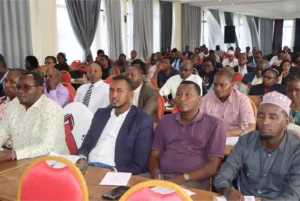
The meeting also featured Yohan Kim from the International Youth Fellowship, who delivered a session on Mind Education—a program emphasizing mindset transformation for institutional sustainability and leadership innovation. Kim compared mindset to software, saying that without upgrading one’s “mental software,” even the best systems cannot perform optimally.
Dr. Muoria credited the session for inspiring a reflective discussion on Kenya’s development trajectory compared to countries like South Korea.
“In 1963, Kenya’s economy was stronger than Korea’s. We even lent them seed capital. Today, they have overtaken us through mindset transformation and strategic innovation. We must learn from that journey,” she said.
Highlighting progress within the TVET sector, Dr. Muoria revealed that student enrollment had risen sharply from 300,000 to 800,000 over the last two years. However, she noted the need for greater effort to attract more young people who are not in education, employment, or training.
“We have improved our curriculum and infrastructure, but we must now focus on drawing youth into our programs. We need to ask ourselves why so many remain outside formal training despite the available opportunities,” she remarked.
She emphasized that such quarterly meetings are crucial in shaping strategies to make TVETs more appealing and responsive to current market demands.
“We need to think beyond the traditional approach. Both the hardware and software—our systems and our mindsets—must align to achieve transformation,” Dr. Muoria said.
Konoin Technical Training Institute Principal, Wesley Sigei, echoed her sentiments, emphasizing that the meetings enable institutions to track progress on implementing the Competency-Based Education and Training (CBET) curriculum introduced in 2023.
“We’ve transitioned from the old system where trainees took up to three years before certification. Under CBET, learners can now be assessed and certified within three months. The focus is on skill mastery and employability,” he said.
Sigei noted that many TVETs now possess more advanced equipment than some industries and have formed partnerships that allow students to split their time between classroom instruction and on-the-job training—a model known as dual training.
“Our trainees spend 50% of their time in institutions and 50% in industries. This ensures they acquire the precise skills employers need,” he added.
As Kenya seeks to realize its Vision 2030 and accelerate industrial growth, Dr. Muoria underscored that TVETs will remain at the heart of national transformation—driving innovation, youth empowerment, and sustainable economic development.