










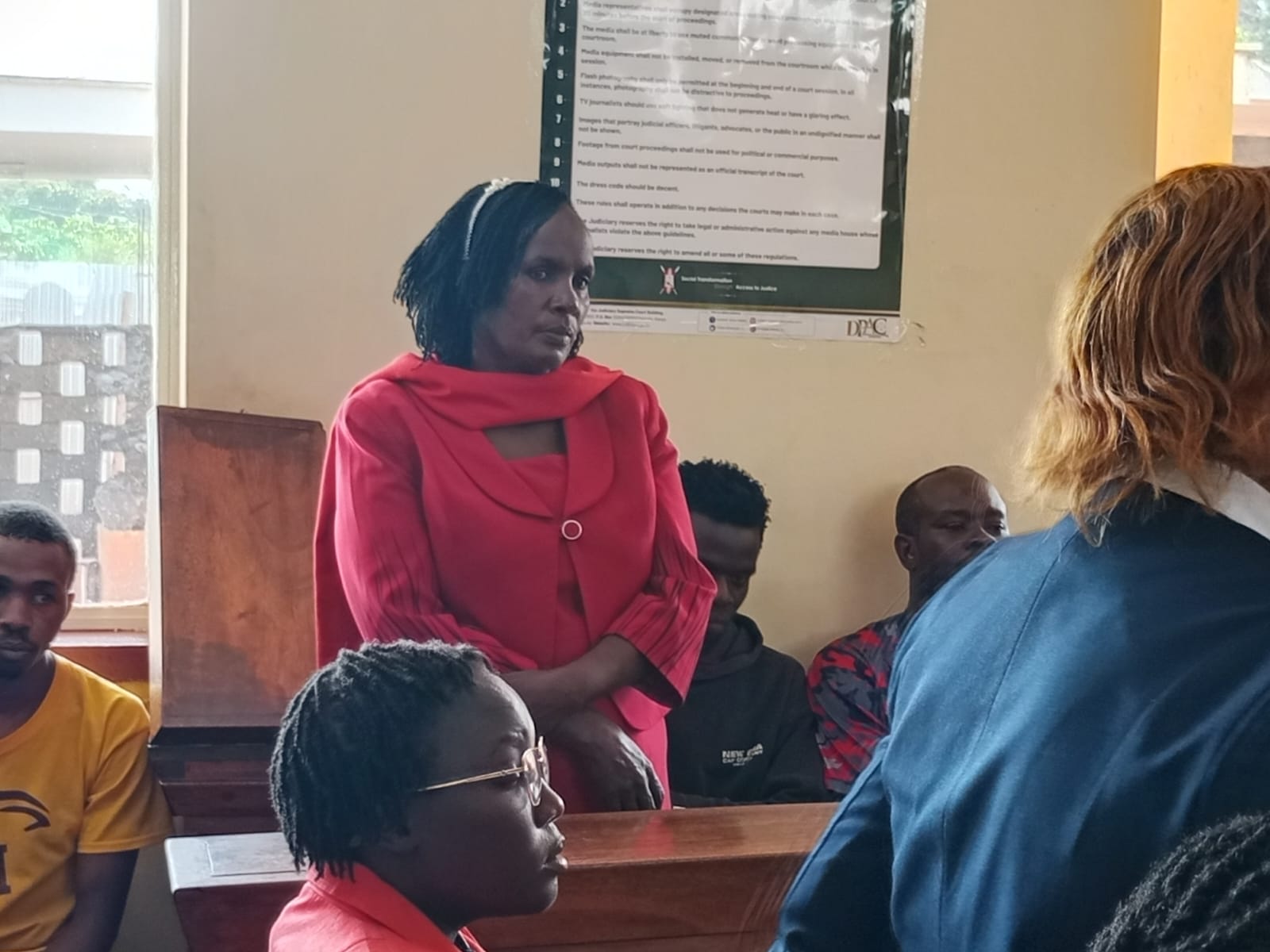
The principal of St Teresiah Preparatory School in Ngemwa, Kiambu County, has denied assaulting her estranged husband, a veteran Kenyan pilot, in a case that has brought to the fore a long-running domestic dispute involving the two parties.
Lucy Nungari appeared before Kiambu Resident Magistrate Eric Muriuki, where she denied a charge of assault causing actual bodily harm, contrary to Section 251 of the Penal Code.
The complainant in the case is identified as Patrick Waweru Mwangi, who is said to be the accused’s estranged husband.
The court released Nungari on a cash bail of Sh100,000 or a surety bond of Sh200,000. The matter will come up for a pre-trial conference on August 6, 2026.
The plea-taking was preceded by a spirited legal contest after the defence made two applications seeking to prevent the proceedings from proceeding as scheduled.
Defence lawyer Jane Odiya asked the court to defer the plea, arguing that the new criminal case was closely connected to another pending matter before the same court in which Patrick Waweru is the accused.
Ms Odiya told the court that the existing case, identified as Kiambu Criminal Case No. 2115 of 2025, involved allegations of assault causing actual bodily harm against her client, allegedly through strangulation.
She argued that the alleged incident occurred on November 18, 2025, and that the new charge against her client had been brought shortly before the hearing of the earlier case.
According to the defence, the new proceedings amounted to an abuse of the court process and the criminal justice system, given that the two cases arose from what she described as the same transaction.
The lawyer urged the court to consider the circumstances surrounding the two cases, including protection orders that had allegedly been issued in December 2025.
She questioned why the two parties had not been charged together, arguing that the complainant in the present case was himself facing criminal proceedings arising from the same domestic dispute.
“An accused in one matter cannot quickly come and claim to be a complainant in another matter,” Ms Odiya submitted, urging the court to interrogate the circumstances under which the fresh charges had been preferred.
She maintained that her application was not intended to prosecute the other criminal case but to demonstrate why the plea in the new matter should be deferred pending consideration of the issues arising in the earlier case.
The prosecution, however, opposed the application, insisting that the Office of the Director of Public Prosecutions (ODPP) had independently reviewed the matter and made a decision to charge the suspect.
The prosecution argued that the existence of another criminal case did not prevent the ODPP from exercising its constitutional mandate to institute criminal proceedings where there was sufficient evidence.
Counsel representing the complainant, Kimani Wakimaa, also opposed the defence applications and urged the court to allow the plea to proceed.
Wakimaa told the court that the complainant’s participation in the proceedings was legally permissible, citing the Supreme Court decision in *John Lendrix Waswa v Republic*, Petition No. 23 of 2019.
He also opposed an application seeking to bar the media from covering the proceedings, arguing that there was no legal basis for preventing journalists from reporting on an open court process.
He maintained that the fact that the accused was a school principal did not make the case different from other criminal matters before Kenyan courts.
“There is nothing special with this case,” the lawyer submitted, arguing that the proceedings should be covered by the media like any other matter.
He further told the court that the domestic nature of the dispute was not a new development and that both parties and their advocates had been aware of the family relationship and the circumstances surrounding the dispute from the beginning.
According to the complainant’s lawyer, the matter had taken time to reach court following engagements involving the police, the ODPP and attempts at alternative dispute resolution.
He argued that the ODPP was an independent constitutional office and could not be directed by an advocate’s letter on whether to prosecute a matter.
The lawyer urged the court to allow the plea to be taken and leave the two criminal cases to proceed independently.
He said the existence of the other case did not extinguish the present charge and that each matter had its own legal process.
The complainant’s legal team further opposed the bond terms sought for the accused, citing concerns over possible interference with witnesses and the complainant.
The court was told that the complainant and the accused share children and that the accused had allegedly used the children to intimidate or threaten the complainant.
The lawyer claimed there had also been an alleged attempt to interfere with the investigating officer, although he acknowledged that he did not have the relevant reports before the court.
He asked the court, if it was inclined to release the accused on bond, to impose strict conditions barring her from contacting or interfering with the complainant and witnesses, except where permitted by the court or through approved alternative dispute resolution mechanisms.
In a ruling on the two applications, Magistrate Eric Muriuki declined to bar the media from covering the proceedings.
The magistrate noted that no sufficient reason had been presented to justify restricting media coverage and that no law had been cited to support such a restriction.
The court relied on the constitutional principle of a fair and public hearing, noting that court proceedings are generally open to the public unless there are compelling legal reasons to restrict access.
The magistrate therefore found no merit in the application seeking to bar the media from covering the case.
On the application seeking to defer plea-taking, the court considered the existence of the earlier criminal case involving Patrick Waweru, as well as correspondence and documents presented by the parties and the prosecution.
The court noted that the ODPP had reviewed the matter and made a decision to charge the suspect.
The magistrate also referred to correspondence from the police and prosecution indicating that the complaint remained outstanding and that there was material that included an independent eyewitness and P3 medical evidence.
In determining whether the plea should be deferred, the court considered the constitutional powers of the ODPP under Article 157 of the Constitution.
The court noted that the Director of Public Prosecutions has the constitutional mandate to institute and undertake criminal proceedings against any person before any court, and that the office does not require the consent of any person or authority to commence criminal proceedings.
The court further observed that the ODPP is constitutionally independent in the exercise of its prosecutorial mandate and is not subject to the direction or control of any person or authority.
The magistrate, while considering the defence argument that the two cases arose from the same transaction, held that the existence of another criminal matter did not, by itself, prevent the prosecution from instituting a separate case where it had independently determined that there was sufficient evidence to proceed.
The court also cited established legal principles that criminal proceedings should be founded on a proper factual basis and sufficient evidence capable of supporting a prosecutable case.
Having considered the submissions by the defence, prosecution and the complainant’s legal team, the court allowed the criminal process to proceed.
Nungari subsequently entered a plea of not guilty to the assault charge and was released on a cash bail of Sh100,000 or a surety bond of Sh200,000.
The court directed that the matter proceed to a pre-trial conference on August 6, 2026.
The case is expected to attract attention as the parties continue to pursue separate criminal proceedings arising from their strained relationship, with the court having directed that the two matters proceed through their respective legal processes.