








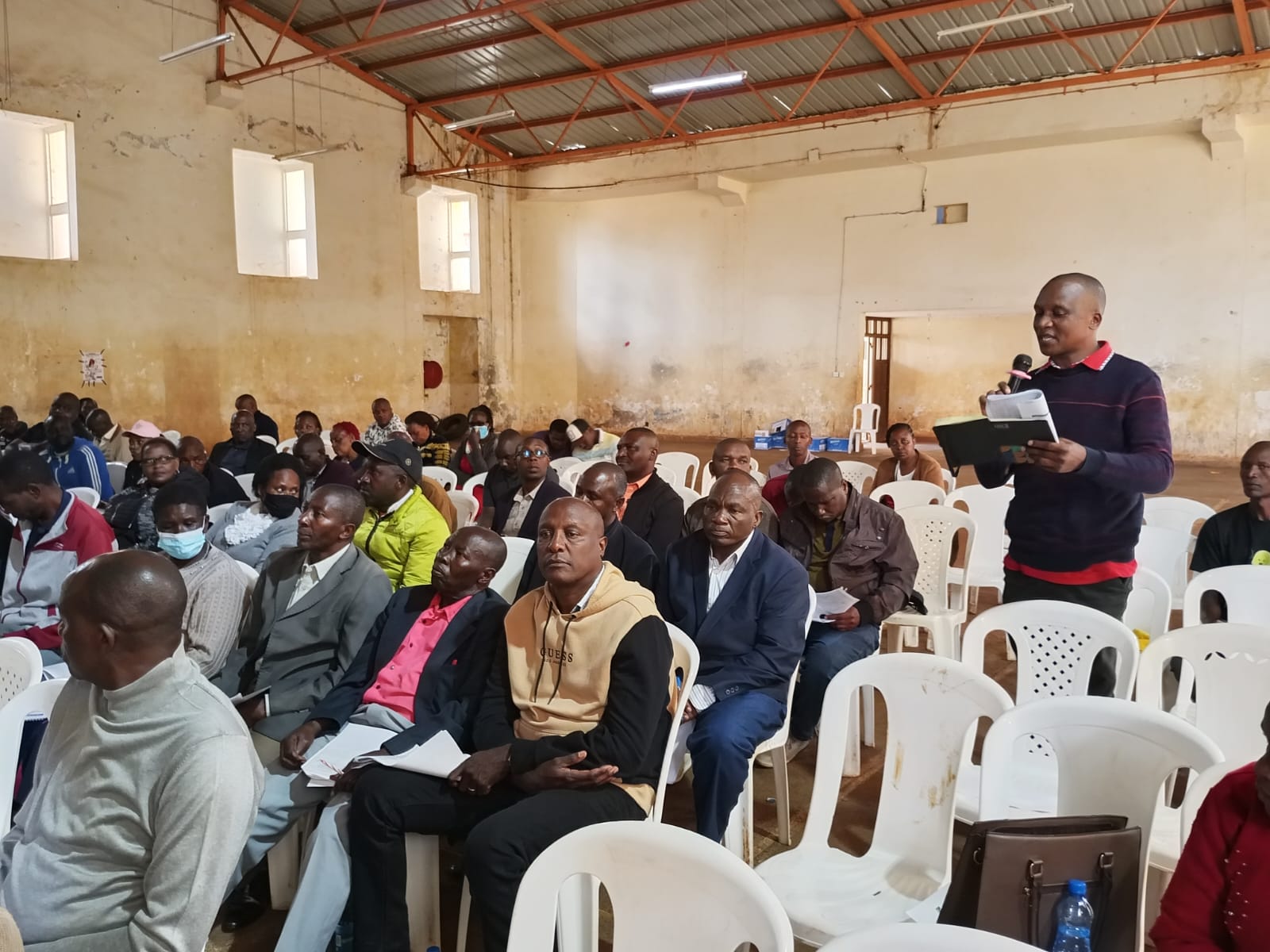
The National Assembly’s Justice and Legal Affairs Committee (JLAC) on Saturday concluded its nationwide public participation exercise on the Public Participation Bill (National Assembly Bill No. 44 of 2025) with a final forum held at the Kiambu Town Community Hall in Kiambu.
The exercise, which has spanned 24 counties since its launch in March 2026, seeks to establish a clear and enforceable legal framework to guide citizen engagement in governance processes across the country.
Speaking during the closing session, JLAC Chairperson and Tharaka Member of Parliament George Gitonga Murugara said the committee had gathered extensive views from Kenyans, which would significantly shape the final draft of the Bill.

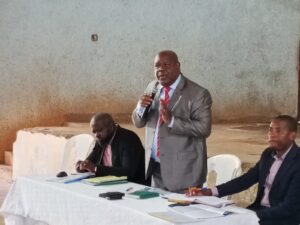
“Today marks our last day of public participation. We have traversed over 24 counties and received very rich views from wananchi on how to improve this Bill,” said Murugara. “These views are not cosmetic. We will incorporate them into proposed amendments to ensure the law reflects the will of the people.”
The proposed legislation is anchored on Article 118 of the Constitution of Kenya 2010, which mandates Parliament to facilitate public involvement in legislative processes. It also draws from other constitutional provisions emphasizing transparency, accountability, and inclusivity in governance.
Across the country—and echoed strongly in Kiambu—citizens consistently raised concerns about the lack of clear timelines in public participation processes. Many participants argued that the use of vague terms such as “reasonable time” leaves room for manipulation and exclusion.
Another major issue was the need for enhanced civic education. Participants stressed that effective public engagement depends on citizens being adequately informed about policies and legislation beforehand.
“We have heard clearly from the public that civic education must come first,” Murugara noted. “People want to understand what is being discussed so they can give meaningful input.”
A unique proposal that emerged during the consultations was the inclusion of children in public participation processes, reflecting growing calls for intergenerational inclusivity in governance.
During the Kiambu forum, stakeholders also highlighted a prevailing “trust deficit” between the public and government institutions. Contributors urged lawmakers to strengthen provisions requiring authorities to not only collect but also faithfully consider public submissions.
One participant proposed amendments to ensure that responsible authorities explicitly demonstrate how public views are analyzed and incorporated into decision-making.
“There must be a mechanism to assure citizens that their voices count,” said a contributor. “Without feedback, public participation risks becoming a mere formality.”
Titus Macharia emphasized the need to harmonize provisions within the Bill to avoid duplication and improve clarity. He suggested cross-referencing clauses to streamline submission processes and recommended replacing discretionary language such as “may” with mandatory terms like “shall” to strengthen compliance.
Macharia also underscored the importance of prudent use of public resources, cautioning against duplication of participation forums by different government entities.
Ting’ang’a Ward MCA Napoleon Mwaura called for deeper decentralization of public participation to the village level, arguing that citizens at the grassroots must be empowered and facilitated to engage effectively.
He pointed out that inadequate funding for civic education at both national and county levels continues to hinder meaningful participation.
“Public participation is where wananchi understand what government is doing,” he said. “Without proper funding for civic education, many remain unaware and disengaged.”
Mwaura also stressed the need for structured feedback mechanisms to inform citizens why certain proposals are accepted or rejected, warning that lack of transparency discourages future participation.
Officials acknowledged challenges in mobilizing citizens to attend participation forums, noting that turnout is often low unless there are direct incentives. Participants urged Kenyans to take a more proactive role in governance, even in the absence of facilitation.
“There are many important government programs, but without public input, we cannot move forward effectively,” one administrator said, calling for a culture shift toward active citizenship.
Murugara announced that the committee would finalize its report within a week and table it in Parliament in early April. Debate on the Bill is expected to begin shortly thereafter, with lawmakers targeting its passage by June 2026.
“This is a critical piece of legislation,” he said. “Once enacted, it will standardize how public participation is conducted across all levels of government.”
As the curtain falls on the nationwide exercise, attention now shifts to Parliament, where the collected views of Kenyans will shape what could become a landmark law in strengthening democratic governance and citizen engagement in Kenya.