








The Micro and Small Enterprises Authority (MSEA) has successfully completed the rollout of Cohort One of the Business Development Services (BDS) Classroom Training under Component Two of the Kenya Jobs and Economic Transformation (KJET) Project, marking a major milestone in efforts to strengthen the competitiveness of micro, small and medium enterprise (MSME) clusters across the country.
The five-week training programme, which officially kicked off on November 10, 2025, was implemented in all 47 counties and reached 94 MSME clusters selected for the first cohort.
The initiative is part of the KJET Project’s broader strategy to boost enterprise productivity, job creation and inclusive economic growth under the Bottom-up Economic Transformation Agenda.
Speaking during a monitoring exercise in Kiambu and Kajiado counties, the Principal Secretary in the State Department for MSMEs Development, Susan Mang’eni, underscored the transformative impact of the cluster-based approach adopted under KJET.
She noted that many MSMEs struggle to scale up because they operate in isolation, limiting their bargaining power, access to finance, technology adoption and ability to compete effectively in the market.
“The KJET Project is redefining how Kenya supports its micro and small enterprises. Our focus has shifted from fragmented interventions to coordinated, structured and high-impact support that strengthens entire clusters and value chains,” said Mang’eni.
“Through this BDS programme, MSMEs are being equipped with tools to improve productivity, formalise operations, access new markets and build sustainable businesses. These trainings are not an end in themselves, but a foundation for scaling Kenya’s competitiveness, job creation and inclusive economic growth.”
With the classroom phase now concluded, all 94 clusters will transition into a three-month mentorship phase. During this period, each cluster will receive customised, hands-on support aimed at helping participants apply the skills acquired, streamline their operations and enhance overall business performance.
Component Two of the KJET Project focuses on strengthening the productivity and growth of MSME clusters operating within priority value chains identified under the Bottom-up Economic Transformation Agenda.
These include edible oils, construction materials, textiles, rice, tea, coffee, dairy, leather, the blue economy and minerals. Through structured BDS training and targeted co-investment support, the component seeks to stimulate enterprise development, expand market access and support the creation and improvement of jobs.
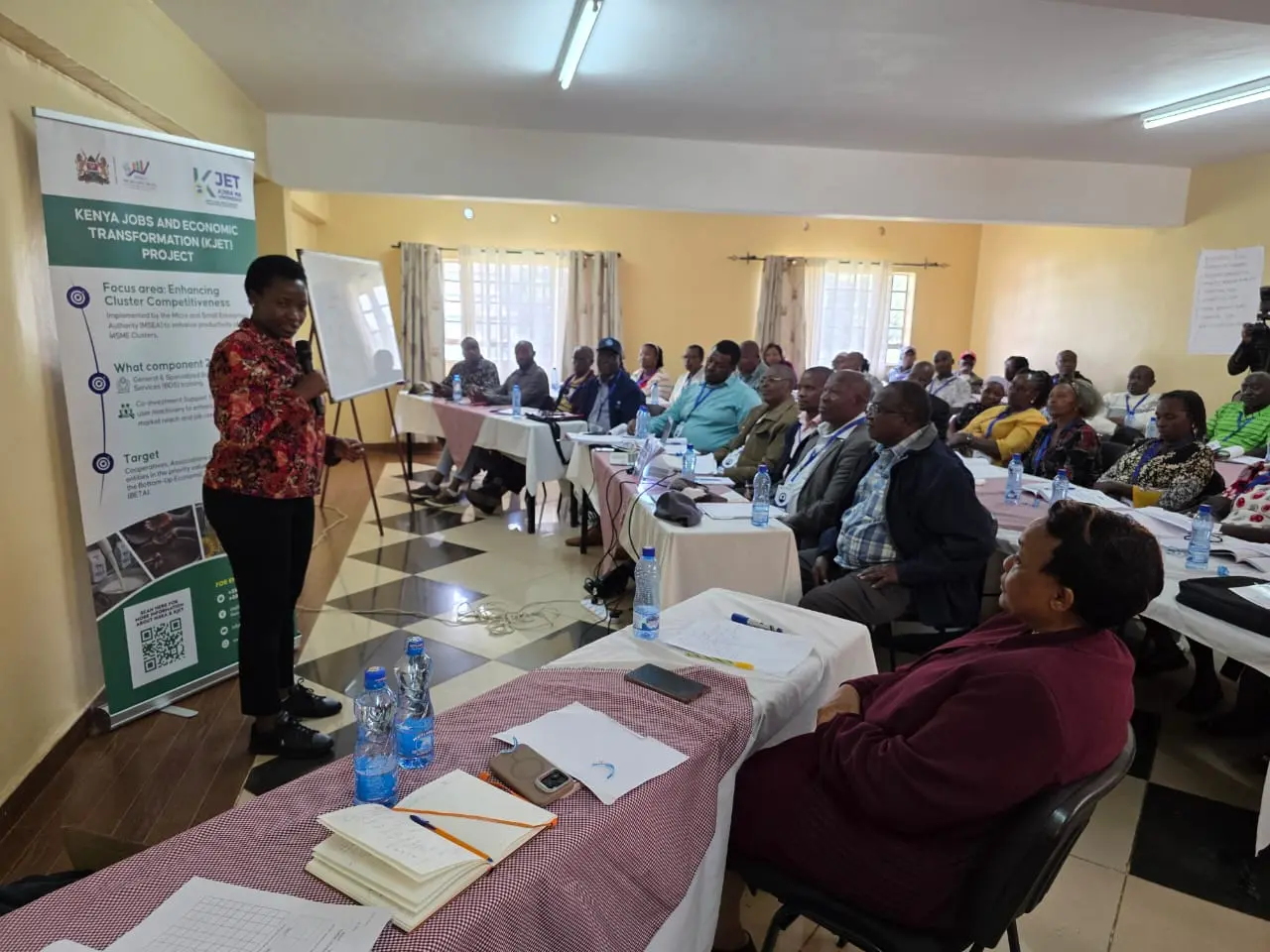
The nationwide training programme exposed MSME clusters to a comprehensive 12-module curriculum designed to enhance enterprise performance, boost productivity and build long-term competitiveness.
The sessions were delivered through practical case studies, hands-on exercises and interactive group work facilitated by experienced trainers, ensuring that participants gained actionable skills applicable to their businesses.
MSEA has now invited eligible cooperatives, associations and cluster-based MSMEs to apply for Cohort Two of the BDS Training, which remains open until December 31, 2025.
Interested clusters are encouraged to submit their applications early through the KJET portal to benefit from the support offered under Component Two of the project.
Established under the Micro and Small Enterprises Act of 2012, MSEA is a state corporation under the Ministry of Cooperatives and Micro, Small and Medium Enterprises Development. The Authority is mandated to formulate, coordinate and harmonise policies and programmes that promote the development, regulation and competitiveness of micro and small enterprises across Kenya.
The Kenya Jobs and Economic Transformation (KJET) Project is a five-year Government of Kenya initiative funded by the World Bank and running from 2024 to 2029. Its objective is to increase private sector investment, improve access to markets and sustainable finance, and create or enhance job opportunities.
The project targets formally registered MSME clusters across all 47 counties and aims to benefit at least 45,000 Kenyans, including a minimum of 6,800 women, through new or improved employment opportunities.