









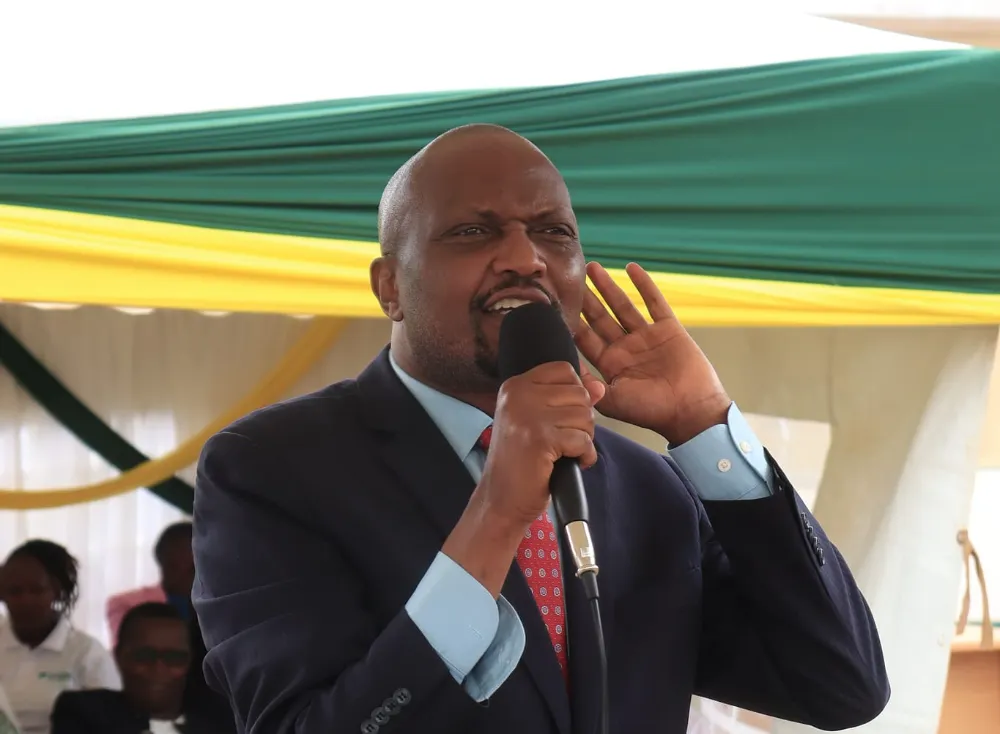
Former Cabinet Secretary Moses Kuria has issued a stern warning regarding the looming youth unemployment crisis in Kenya. Following the Jamhuri Day celebrations led by President William Ruto, the Chama Cha Kazi party leader argued that the government’s current focus on heavy infrastructure projects might fail to address the immediate needs of the next generation. He emphasized that building roads and railways is insufficient without a parallel strategy for job creation.
Kuria highlighted recent education statistics to illustrate the magnitude of the challenge facing the nation. He pointed out that over 1.1 million students completed their Kenya Junior Secondary Education Assessment (KJSEA) this year alone. According to the former trade minister, these learners represent a massive wave of young people who will flood the job market in just three years upon completing their senior secondary education.
The vocal politician stressed that the administration must urgently pivot its attention toward the private sector to avert a social disaster. While acknowledging the value of dual carriageways and the Standard Gauge Railway, Kuria insisted that concrete economic policies are necessary to absorb the incoming workforce. He argued that infrastructure development alone cannot guarantee livelihoods for millions of graduates seeking sustainable employment.
In a statement that resonated widely on social media, Kuria used the colloquial phrase “Kitatulamba” to describe the potential consequences of inaction. He cautioned that if the government fails to prioritize meaningful employment opportunities now, the country will eventually face an unmanageable crisis. His remarks suggested that the window for implementing effective economic reforms is rapidly closing as the population of job seekers swells.
This critique comes shortly after President Ruto outlined ambitious plans for new highways and transport networks during his address at Nyayo Stadium. While the Head of State championed these projects as pillars of national development, Kuria’s rebuttal shifts the conversation toward human capital. The former advisor maintains that the stability of the nation depends more on household incomes than on physical assets.
Kuria has recently been vocal on various national issues, positioning himself as an independent voice within the political landscape. His latest comments add to a growing debate on whether Kenya’s economic model is adequately prepared for its demographic shifts. The government has yet to issue a formal response to his specific projections regarding the 2028 labor market influx.