







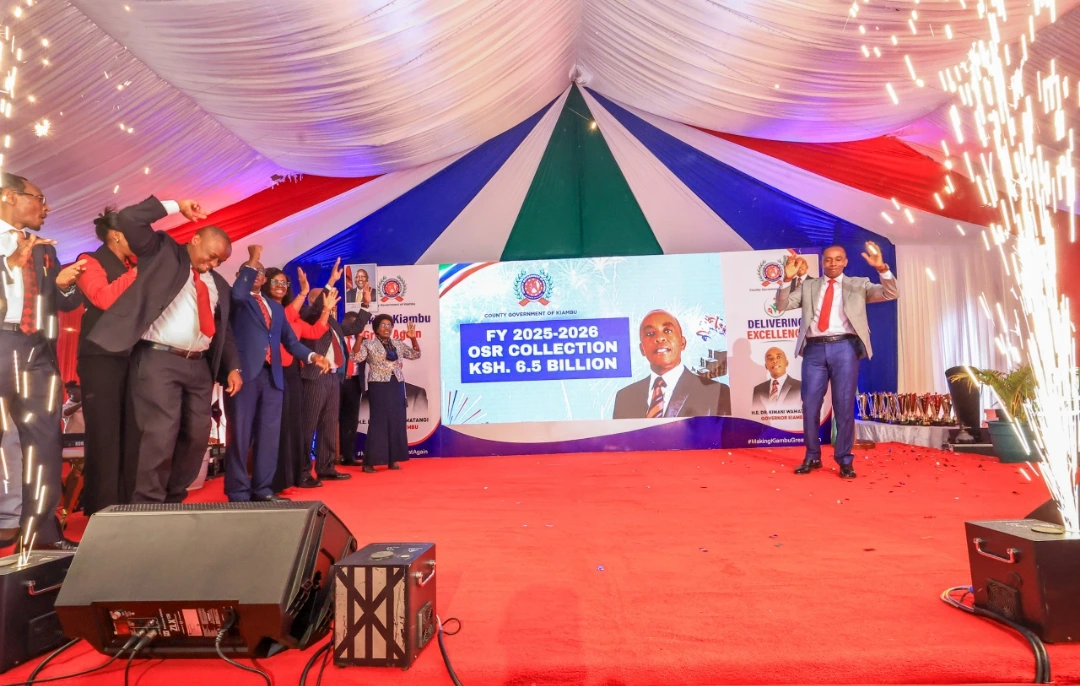
Kiambu County has increased its own-source revenue collection to Sh6.5 billion in the 2025/2026 financial year, marking a significant rise from the Sh2.8 billion collected when Governor Kimani Wamatangi took office.
The achievement was unveiled during a ceremony attended by senior county officials, members of the County Assembly and other stakeholders, with Governor Wamatangi attributing the growth to improved financial discipline, automation, accountability and efforts to curb wastage.
Wamatangi said the county’s own-source revenue had risen steadily from Sh2.8 billion in the first year of his administration to Sh3.59 billion, before increasing to Sh4.57 billion in the second year and Sh5.45 billion in the third year.
The latest figure of Sh6.5 billion, he said, demonstrated that Kiambu had the potential to significantly expand its revenue base without necessarily increasing the financial burden on residents.
“We didn’t do this by asking our people to pay more. We did this by asking government to waste less,” the governor said.
He said the county would now seek to increase its own-source revenue to a level equivalent to the funds it receives from the national government.
According to the governor, Kiambu receives about Sh11.5 billion annually in national government allocations, and his administration is targeting to match that amount in own-source revenue within the next three years.
“God willing, in the year 2028, this county will be collecting that Sh11.5 billion plus,” Wamatangi said, adding that increased revenue would enable the county to improve service delivery.
The governor said the county’s revenue performance was not the result of a windfall but a product of discipline, commitment and deliberate reforms in revenue administration.
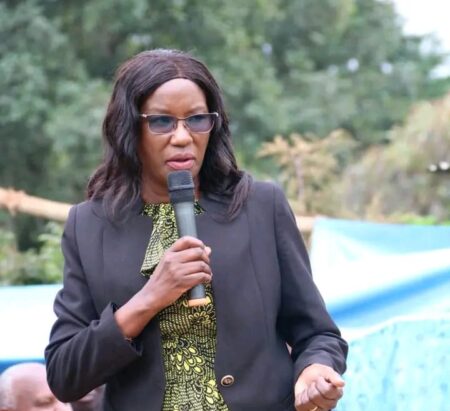
County Executive Committee Member for Finance Nancy Kirumba said Kiambu had more than doubled its own-source revenue collection between the 2022/2023 and 2025/2026 financial years.
She attributed the growth to strong leadership, automation, improved accountability, enhanced revenue management systems and teamwork among county staff.
The CECM finance said a 2022 study by the Commission on Revenue Allocation had estimated Kiambu’s revenue potential at Sh13.95 billion, describing the figure as both a challenge and an opportunity for the county.
She said the county had invested in digital systems, strengthened revenue administration and improved the experience of taxpayers as part of efforts to unlock its full revenue potential.
“Performance matters, innovation matters, integrity matters, and excellence deserves recognition,” kirumba said.
She urged county officers to continue embracing innovation, integrity and better customer service while improving compliance to generate additional resources for healthcare, roads, water, education and other essential services.
The event also featured recognition of revenue teams and other departments for their contribution to the county’s revenue performance during the financial year.
Wamatangi said the increase in revenue had enabled his administration to implement a number of projects in education, healthcare, energy, roads, transport and sports.
He cited the construction of 512 Early Childhood Development Education (ECDE) centres across the county as one of the flagship achievements of his administration.
According to the governor, the centres were built with two classrooms for PP1 and PP2, teachers’ offices, play areas and ablution facilities, alongside provision of learning materials.
He also highlighted the county’s feeding programme for ECDE learners, saying it was intended to ensure children were able to attend school in a conducive environment and improve their learning experience.
Wamatangi said the projects were part of his administration’s pledge to ensure that no child was left behind in education.
He said the county had also expanded investment in healthcare, citing the completion of six Level Four hospitals with a combined capacity of more than 180 beds and the construction of 28 Level Three hospitals.
The governor further said the county had introduced telemedicine services, with local doctors participating in procedures supported remotely by specialists in the United Kingdom.
He said the county had also made progress in ensuring the availability of medicines in public health facilities.
On energy, Wamatangi said the county had reduced its annual electricity bill from about Sh700 million to approximately Sh290 million through the installation of solar-powered infrastructure.
He said 12,000 solar streetlights had already been installed, with another 12,000 planned during the current year and additional installations expected in the following year.
The governor said the transition to renewable energy would eventually eliminate the county’s public electricity bill while expanding lighting across the county.
He also defended the county’s decision to continue financing road improvements despite delays in the disbursement of funds under the road maintenance levy.
Wamatangi said Kiambu had been entitled to about Sh400 million annually under the fund but had received only Sh100 million, despite the county having an estimated entitlement of more than Sh1 billion over the period.
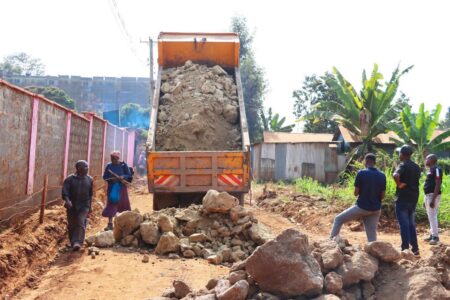
He said the county would continue implementing road projects using available resources rather than abandon residents to poor road infrastructure.
“We shall not sit and say that we have an excuse because the money has not been disbursed,” he said.
The governor also cited the construction of 14 modern bus parks, saying the facilities had been designed to provide opportunities for small businesses through kiosks and stalls.
He said the initiative was intended to combine transport infrastructure with enterprise development and job creation for young people.
Investment in sports infrastructure was also highlighted, with Wamatangi saying the county had embarked on developing modern stadia, including the Githunguri facility, which he said was substantially complete and already usable.
On the proposed elevation of Thika to city status, Wamatangi said the move would strengthen Kiambu’s position as a regional commercial and economic hub.
He said the county was also exploring plans for an airport, which he argued would boost trade, exports and connectivity for Kiambu and neighbouring regions.
The governor’s remarks came amid growing political interest in his administration’s record, but he said he had deliberately chosen to prioritise development over political campaigns.
Using an analogy of a balanced diet, Wamatangi said leaders needed to balance politics with development, arguing that residents ultimately judge elected leaders by the projects and services delivered during their tenure.
“Politics will come. And when politics comes and meet people who have a record to show that they were given a job and they were true to what they said to the people in the first place, then that is what matters,” he said.
He said his administration’s ambition was to position Kiambu as a model county that other devolved units could benchmark on service delivery and revenue mobilisation.
County Assembly Speaker Charles Thiong’o commended the county executive for the revenue performance and said the Assembly had played its role by passing legislation and budgets necessary to support the administration’s programmes.
He cited the establishment of the Kiambu Revenue Authority as one of the key measures that had helped strengthen revenue collection.
However, Thiong’o called for a review of the national revenue-sharing formula, arguing that heavily populated counties such as Kiambu were disadvantaged by the current formula.
He challenged Members of Parliament and senators to lobby for a more equitable allocation of national resources to counties while supporting efforts to improve own-source revenue.
“Everybody must play their bit. As they challenge us to do our bit, they must also equally play their bit so that we move this together,” Thiong’o said.
The Majority Leader in the County Assembly Godfrey Muceke also praised the governor’s administration, saying increased revenue had been reflected in investments in healthcare, street lighting and other services.
He said the county’s political leadership should focus on development and urged residents to support efforts aimed at maintaining stability.
Wamatangi, who previously served as a senator for 10 years, said his administration’s achievements were a reflection of the trust residents had placed in the county leadership.
He thanked residents for complying with revenue requirements and supporting the county government’s efforts to mobilise resources.
The governor also credited the County Assembly and county executive team for working together to advance the administration’s development agenda.
He said the revenue milestone should not be viewed as the end of the journey but as a foundation for further growth.
With Kiambu’s estimated revenue potential standing at Sh13.95 billion, the governor said his administration would continue pursuing reforms aimed at closing the gap between actual collections and the county’s potential.
The governor’s target of raising own-source revenue to at least Sh11.5 billion within the next three years could significantly alter the county’s financial position, giving it greater capacity to finance development programmes and reduce reliance on national government transfers.
For the county administration, the Sh6.5 billion milestone is therefore being presented not only as a record revenue collection but also as a measure of the impact of reforms in financial management, digital revenue collection and accountability.
Wamatangi said the ultimate test would be whether the resources collected from residents were translated into tangible improvements in their lives.
He pledged that the county would continue reinvesting its resources in sectors that directly affect residents, including education, healthcare, roads, water, energy, transport and youth enterprise.
The governor said Kiambu’s journey towards becoming a model county would depend on maintaining political stability, strengthening revenue systems and ensuring that public resources were used responsibly.
“We are not stopping here,” he said, maintaining that the county had only begun to realise its potential.