










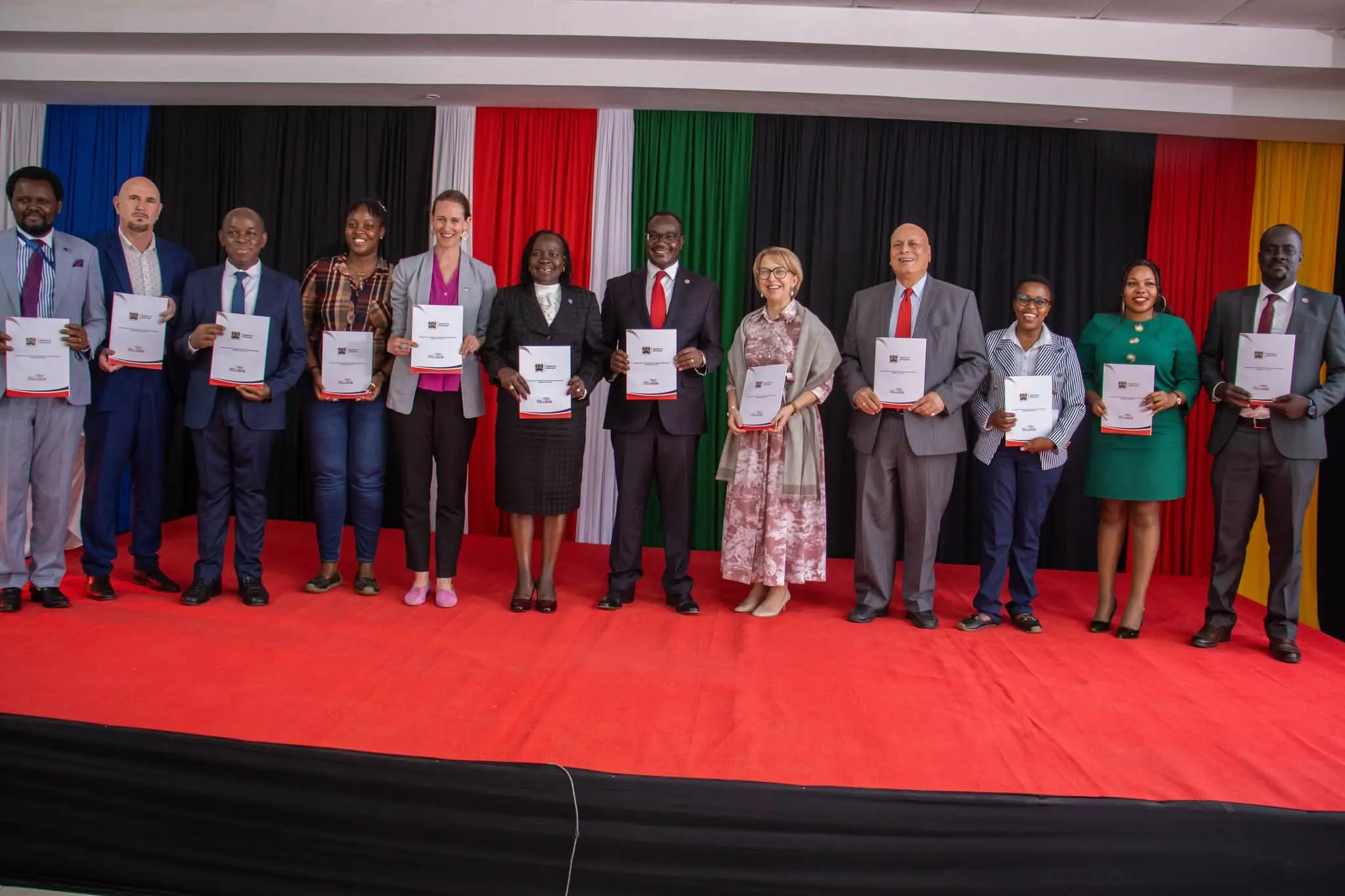
The Government has officially cemented its commitment to a practical, industry-aligned education system with the launch of the TVET Dual Training Policy.
Education Cabinet Secretary Julius Ogamba officiated the landmark event at the Kiambu National Polytechnic (KINAP), declaring that the policy is set to profoundly shape Kenya’s skills future.
CS Ogamba emphasized that the Dual Training Policy addresses the core needs of the youth, stating, “Learning thrives where theory meets practice, classrooms meet workplaces, and young people gain experience, confidence, leading to meaningful employment.”
He stressed the government’s duty: “Our young people do not ask for charity but ask for opportunity. We must equip our youths with skills, with confidence, and with pathways to dignified work.” The policy, a critical pillar in implementing the Competency-Based Education and Training (CBET) model, is designed to create a strong, deliberate bridge between training institutions and industries.
“The policy launch is not just a milestone, it is a national commitment that is skills over paper, competence over theory, and opportunities over promises,” the CS affirmed.
The Dual Training Policy offers the “best of both worlds”: classroom knowledge combined with significant workplace experience. This model is seen as the answer to bridging the perennial gap between training outcomes and employment needs.
TVET institutions act as knowledge centers.
Industries serve as learning and innovation hubs.
Government is the enabler and guarantor of standards.
CS Ogamba called on industry players in all sectors to deepen their engagement, noting that through the policy, employers will actively design forward-looking curricula, open their doors for real-world working environments, mentor trainees, and participate in assessing their competence.
The launch was made possible through strong technical cooperation with the Federal Republic of Germany and the Federal Republic of Finland, who have shared their expertise and helped shape a system that is uniquely Kenyan yet globally competitive.
H.E. Riina-Riika Heikka, the Ambassador of Finland to Kenya, commended the government’s dedication to revitalizing the TVET sector. She highlighted the success of the jointly funded Promotion of Youth Employment and Vocational Training project, implemented by GIZ, which supported the policy’s development.
“Nearly 10,000 students have enrolled in dual training courses at more than 80 TVET institutions across the country,” the Ambassador reported, noting that almost 40% of the trainees are women.
Furthermore, over 1,500 companies are actively involved in training students.
Ambassador Heikka noted that the policy creates a collective, national framework and urged stakeholders to now shift their focus to implementation.
Speaking at the launch, Sammy Waititu, Principal of Kiambu National Polytechnic (KINAP), showcased the institution’s remarkable progress as a pioneer in the program.
“We started with 20 students in 2020 and at the moment we have a population of 337 students under dual training in industrial mechatronics only,” Mr. Waititu said.
KINAP, which has rolled out dual training to include hospitality and automotive courses, was recognized as the overall best institution in Dual TVET during the last award ceremony.
He also shared a compelling anecdote on industry value, where a previously reluctant company refused to release dual training students for exams because they had become “invaluable,” having installed a critical system that could not run without them.
CS Ogamba addressed media reports concerning education funding.
He emphatically stated that the approved means of capitation remain in place: Kshs 1,420 per learner per year in primary schools, Kshs 15,042 in junior schools, and Kshs 22,244 in senior schools.
He also clarified reports on boarding fees: “The government has not revised the boarding fees payable by learners at any level… The approved board fees remains as it has always been. Reports appearing in some sections of the media to the contrary are incorrect.”
The government has also been boosting financial support for TVET students, with the Higher Education Loans Board (HELB) recently releasing Ksh 441 million for upkeep loans to 54,204 TVET students, bringing the total funding this financial year (2025/2026) to over Ksh 3.47 billion for more than 126,000 students.