



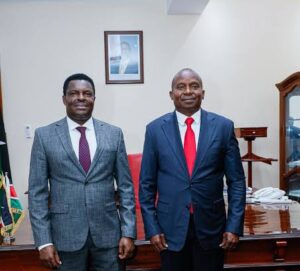






Africa must urgently harmonise standards for goods and services to dismantle regulatory barriers that continue to undermine intra-African trade and delay the continent’s quest for economic sovereignty, Deputy President Kithure Kindiki has said.
Prof Kindiki said Africa’s final frontier of liberation was no longer political independence but economic freedom, wealth creation and the ability of its people and businesses to trade seamlessly across borders.
He said the African Continental Free Trade Area (AfCFTA) had created the foundation for a continental market of more than 1.3 billion people and a combined gross domestic product of about $3.4 trillion, but warned that the opportunity could remain largely unrealised unless countries removed unnecessary regulatory bottlenecks.
“A market of 1.3 billion people that is fragmented into 54 regulatory silos is not one market. It is 54 small ones, wearing the costume of a large one,” Prof Kindiki said.
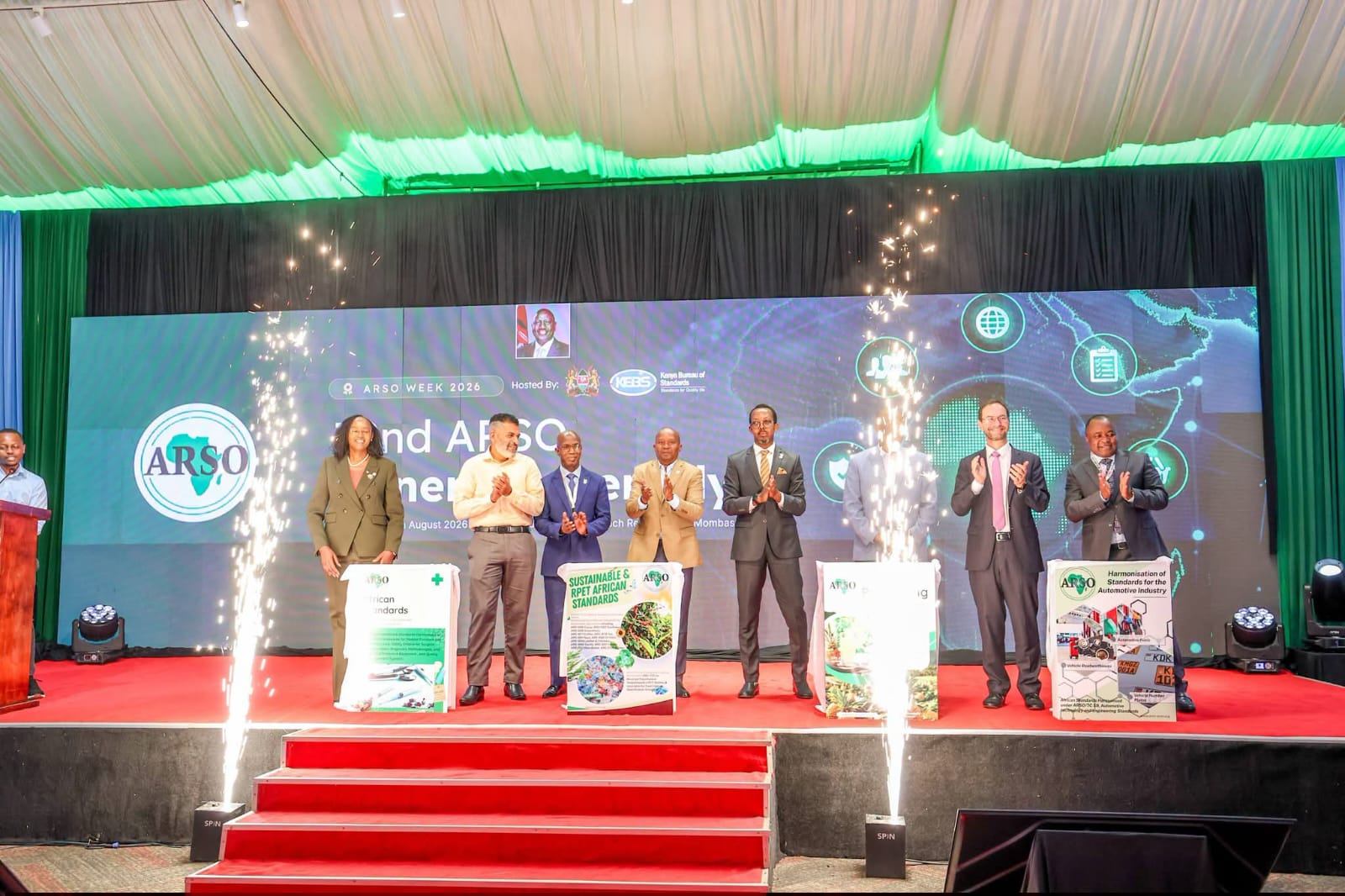
The Deputy President spoke in Mombasa on Wednesday when he represented President William Ruto at the official opening of the 32nd General Assembly of the African Organisation for Standardisation (ARSO).
The meeting brought together stakeholders in standards, quality assurance and trade as Africa seeks to deepen implementation of AfCFTA and build a more integrated continental economy.
Prof Kindiki said multiple testing, inspection and certification requirements were imposing unnecessary costs on African manufacturers, exporters and especially small and medium-sized enterprises.
He cited instances where the same product is subjected to repeated conformity assessments in different countries despite having already met recognised quality requirements elsewhere on the continent.
“A cement bag tested in Nairobi and retested in Lagos, a pharmaceutical product certified in Cairo and recertified in Accra and a solar panel inspected in Kigali and re-inspected in Dakar is nothing but wasteful duplication,” he said.
The DP said repeated testing was effectively an additional tax on businesses, with the cost ultimately passed on to consumers and undermining the competitiveness of African products.
“Every duplicate test is a tax on African enterprise, paid not to a treasury, but to inefficiency borne by the same small and medium enterprises this Assembly seeks to serve,” he said.
He challenged national standards institutions to accelerate the development and adoption of harmonised standards and mutual recognition arrangements that would allow products certified in one African country to access markets across the continent without being subjected to unnecessary repeat inspections.
Prof Kindiki said the ARSO General Assembly’s theme, “One Standard — One Test — One Certificate — Accepted Everywhere,” should move beyond being a conference slogan and become a practical framework for continental trade.
He said a functioning single African market would require standards that open borders rather than create new barriers, while certificates issued by recognised institutions should command confidence across national jurisdictions.
“When a Namibian manufacturer tests a product once and that certificate opens doors in Kinshasa, Lusaka, Abidjan and Maseru without a second inspection, a second fee or a second delay, that is not a technical achievement. That is African economic sovereignty, made real by one certificate,” he said.
The Deputy President pointed to the East African Community as evidence that regional harmonisation of standards is achievable.
He said the adoption of common standards and shared quality marks within the EAC had demonstrated how countries could reduce technical barriers to trade while improving consumer confidence and market access.
“The lesson from the EAC is clear: what is possible among immediate neighbours is possible across Africa. The challenge before ARSO is to take this regional proof of concept and give it a continental scale,” Prof Kindiki said.
He urged ARSO and national standards bodies to build on progress already achieved through continental and international cooperation, including the ARSO-ISO Enhanced Cooperation Agreement and the Kigali Agreement.
The agreements, he said, offered an important foundation for strengthening Africa’s participation in global quality infrastructure while ensuring that African standards respond to the needs of local industries and consumers.
Kenya, he said, was prepared to play a leading role in strengthening the continent’s standards infrastructure.
Prof Kindiki announced that Nairobi would host the 2028 ISO Annual Meeting, describing the event as an opportunity for Kenya and Africa to demonstrate their growing influence in global standardisation.
“We look forward to welcoming the global standardisation community to Nairobi, and to demonstrate that Africa is not a mere participant in the global quality infrastructure, it is helping to shape its future,” he said.
He also announced that Kenya would provide land in Nairobi for the construction of a permanent headquarters for ARSO.
The move, he said, was a demonstration of Kenya’s commitment to building stronger continental institutions capable of supporting trade, industrialisation and economic integration.
“We offer ARSO a permanent home from which its vision can flourish, its operations can expand and its influence can radiate across Africa and the globe,” Prof Kindiki said.
The Deputy President linked the harmonisation of standards to Kenya’s broader development ambitions, saying the country was looking beyond Vision 2030 towards a prosperous and competitive Africa by 2060.
He said Kenya’s ambition was to become a high-income, globally competitive, technologically advanced and industrialised economy, but noted that the country’s prosperity was closely tied to that of the wider continent.
Prof Kindiki said African countries must therefore shift from viewing each other primarily as competitors to recognising the continent’s enormous potential as an integrated production and consumption market.
He said stronger intra-African trade would create opportunities for manufacturers, farmers, innovators and small businesses while reducing the continent’s dependence on external markets.
The push for common standards is particularly important as African countries seek to increase the movement of locally manufactured goods under AfCFTA.
Without compatible quality requirements, mutual recognition of certification and efficient conformity assessment systems, businesses can face delays, higher compliance costs and limited access to markets despite the existence of a continental free-trade framework.
Prof Kindiki said the success of AfCFTA would ultimately be measured not by the number of agreements signed but by whether African businesses could actually move their products across borders quickly, affordably and predictably.
He urged standards agencies, governments and the private sector to work together to turn Africa’s vast population and economic potential into tangible opportunities for wealth creation.
The Deputy President said the continent had already taken significant steps towards integration, but warned that bureaucratic and technical barriers could undermine those gains if countries failed to act collectively.
He called for a standards system in which quality certification becomes a bridge to markets rather than another obstacle to trade.
“Africa’s economic sovereignty and wealth creation are the remaining frontier of our continent’s final liberation and freedom,” Prof Kindiki said.
He said the continent’s ability to produce, process, certify and trade its own goods would be central to building a self-reliant Africa capable of creating jobs and prosperity for its growing population.
The ARSO General Assembly is expected to provide a platform for African standards bodies and other stakeholders to advance cooperation on quality infrastructure, mutual recognition and the removal of technical barriers to trade.
Prof Kindiki said the goal should be to transform Africa’s enormous market from an aspiration on paper into a practical economic space where a product that meets agreed standards in one country can compete across the continent without facing repeated regulatory hurdles.